

E ¼ hν ¼ ħω,
ð1:1Þ
where ħ h/2π and ω ¼ 2πν. The quantity ω is called angular frequency with ν
being frequency. The quantity ħ is said to be a reduced Planck constant.
Also Einstein (1917) concluded that momentum of light quantum p is identical to
the energy of light quantum divided by light velocity in vacuum c. That is, we have
p ¼ E=c ¼ ħω=c ¼ ħk,
ð1:2Þ
where k 2π/λ (λ is wavelength of light in vacuum) and k is called wavenumber.
Using vector notation, we have
p = ħk,
ð1:3Þ
where k
2π
λ n (n: a unit vector in the direction of propagation of light) is said to be a
wavenumber vector.
Meanwhile, Arthur Compton (1923) conducted various experiments where he
investigated how an incident X-ray beam was scattered by matter (e.g., graphite,
copper). As a result, Compton found out a systematical redshift in X-ray wavelengths as a function of scattering angles of the X-ray beam (Compton effect).
Moreover he found that the shift in wavelengths depended only on the scattering
angle regardless of quality of material of a scatterer. The results can be summarized
in a simple equation described as
Δλ ¼
h
m e c
1 À cos θ
ð
Þ ,
ð1:4Þ
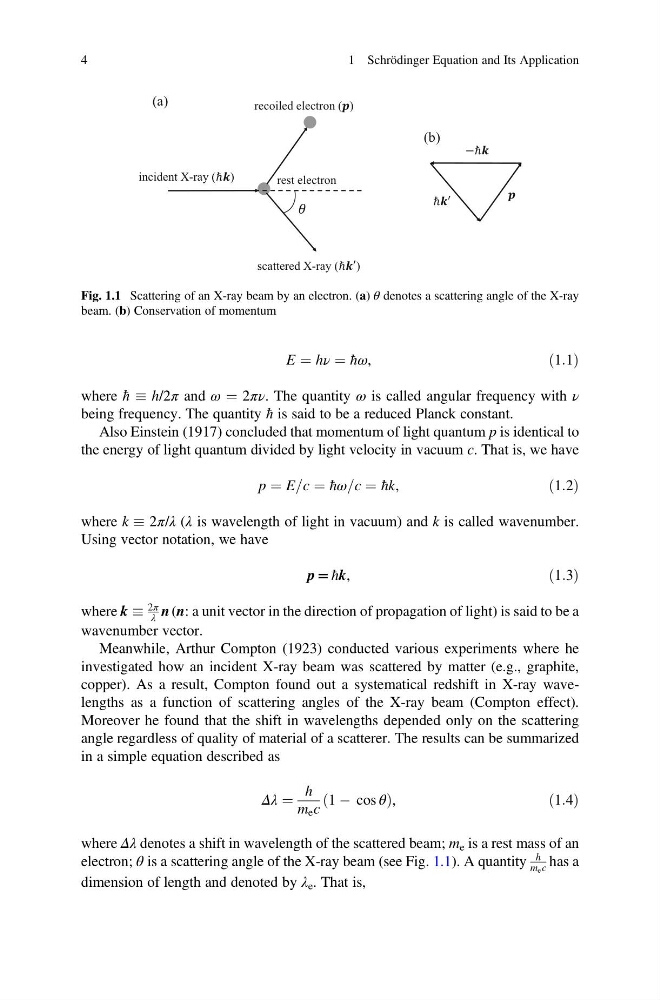
where Δλ denotes a shift in wavelength of the scattered beam; m e is a rest mass of an
electron; θ is a scattering angle of the X-ray beam (see Fig. 1.1). A quantity
h
m e c has a
dimension of length and denoted by λ e . That is,
recoiled electron ( )
rest electron
incident X-ray (ℏ )
scattered X-ray ( )
(a)
(b)
ℏ ′
−ℏ
ℏ ′
Fig. 1.1 Scattering of an X-ray beam by an electron. (a) θ denotes a scattering angle of the X-ray
beam. (b) Conservation of momentum
4
1 Schrödinger Equation and Its Application
ð1:1Þ
where ħ h/2π and ω ¼ 2πν. The quantity ω is called angular frequency with ν
being frequency. The quantity ħ is said to be a reduced Planck constant.
Also Einstein (1917) concluded that momentum of light quantum p is identical to
the energy of light quantum divided by light velocity in vacuum c. That is, we have
p ¼ E=c ¼ ħω=c ¼ ħk,
ð1:2Þ
where k 2π/λ (λ is wavelength of light in vacuum) and k is called wavenumber.
Using vector notation, we have
p = ħk,
ð1:3Þ
where k
2π
λ n (n: a unit vector in the direction of propagation of light) is said to be a
wavenumber vector.
Meanwhile, Arthur Compton (1923) conducted various experiments where he
investigated how an incident X-ray beam was scattered by matter (e.g., graphite,
copper). As a result, Compton found out a systematical redshift in X-ray wavelengths as a function of scattering angles of the X-ray beam (Compton effect).
Moreover he found that the shift in wavelengths depended only on the scattering
angle regardless of quality of material of a scatterer. The results can be summarized
in a simple equation described as
Δλ ¼
h
m e c
1 À cos θ
ð
Þ ,
ð1:4Þ
where Δλ denotes a shift in wavelength of the scattered beam; m e is a rest mass of an
electron; θ is a scattering angle of the X-ray beam (see Fig. 1.1). A quantity
h
m e c has a
dimension of length and denoted by λ e . That is,
recoiled electron ( )
rest electron
incident X-ray (ℏ )
scattered X-ray ( )
(a)
(b)
ℏ ′
−ℏ
ℏ ′
Fig. 1.1 Scattering of an X-ray beam by an electron. (a) θ denotes a scattering angle of the X-ray
beam. (b) Conservation of momentum
4
1 Schrödinger Equation and Its Application