

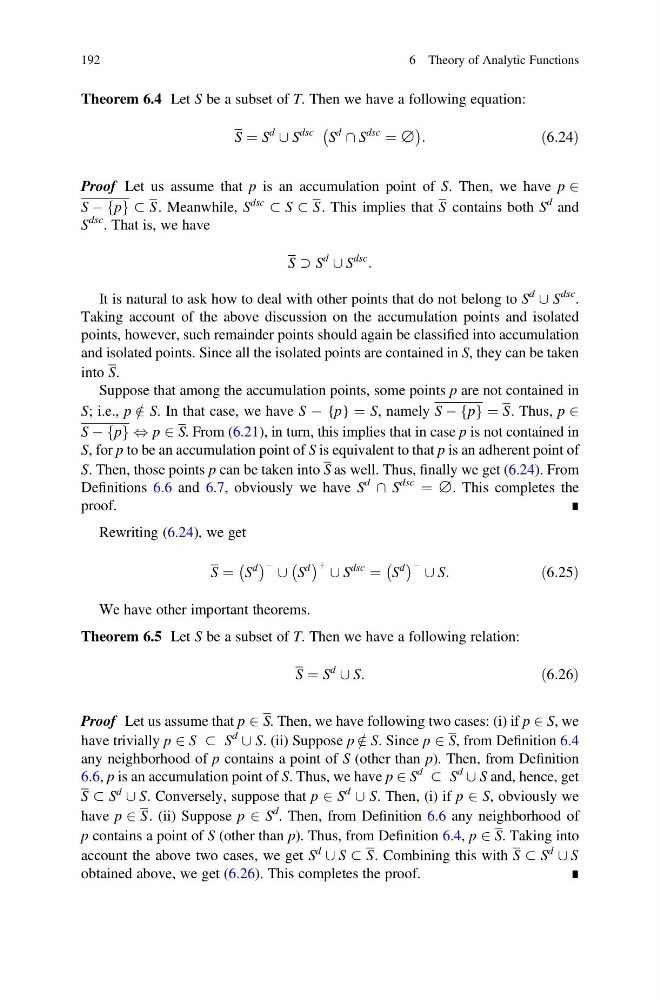
Theorem 6.4 Let S be a subset of T. Then we have a following equation:
S ¼ S
d
[ S
dsc S
d
\ S
dsc
¼ ∅
À
Á
:
ð6:24Þ
Proof Let us assume that p is an accumulation point of S. Then, we have p 2
S À p
f g ⊂ S. Meanwhile, S
dsc
⊂ S ⊂ S. This implies that S contains both S
d and
S
dsc . That is, we have
S ⊃ S
d
[ S
dsc
:
It is natural to ask how to deal with other points that do not belong to S
d
[ S
dsc .
Taking account of the above discussion on the accumulation points and isolated
points, however, such remainder points should again be classified into accumulation
and isolated points. Since all the isolated points are contained in S, they can be taken
into S.
Suppose that among the accumulation points, some points p are not contained in
S; i.e., p =
2 S. In that case, we have S À {p} ¼ S, namely S À p
f g ¼ S. Thus, p 2
S À p
f g , p 2 S. From (6.21), in turn, this implies that in case p is not contained in
S, for p to be an accumulation point of S is equivalent to that p is an adherent point of
S. Then, those points p can be taken into S as well. Thus, finally we get (6.24). From
Definitions 6.6 and 6.7, obviously we have S
d
\ S
dsc
¼ ∅. This completes the
proof.
∎
Rewriting (6.24), we get
S ¼ S
d
À Á À [ S
d
À Á þ [ S
dsc
¼ S
d
À Á À [ S:
ð6:25Þ
We have other important theorems.
Theorem 6.5 Let S be a subset of T. Then we have a following relation:
S ¼ S
d
[ S:
ð6:26Þ
Proof Let us assume that p 2 S. Then, we have following two cases: (i) if p 2 S, we
have trivially p 2 S ⊂ S
d
[ S. (ii) Suppose p =
2 S. Since p 2 S, from Definition 6.4
any neighborhood of p contains a point of S (other than p). Then, from Definition
6.6, p is an accumulation point of S. Thus, we have p 2 S
d
⊂ S
d
[ S and, hence, get
S ⊂ S
d
[ S. Conversely, suppose that p 2 S
d
[ S. Then, (i) if p 2 S, obviously we
have p 2 S. (ii) Suppose p 2 S
d . Then, from Definition 6.6 any neighborhood of
p contains a point of S (other than p). Thus, from Definition 6.4, p 2 S. Taking into
account the above two cases, we get S
d
[ S ⊂ S. Combining this with S ⊂ S
d
[ S
obtained above, we get (6.26). This completes the proof.
∎
192
6 Theory of Analytic Functions
S ¼ S
d
[ S
dsc S
d
\ S
dsc
¼ ∅
À
Á
:
ð6:24Þ
Proof Let us assume that p is an accumulation point of S. Then, we have p 2
S À p
f g ⊂ S. Meanwhile, S
dsc
⊂ S ⊂ S. This implies that S contains both S
d and
S
dsc . That is, we have
S ⊃ S
d
[ S
dsc
:
It is natural to ask how to deal with other points that do not belong to S
d
[ S
dsc .
Taking account of the above discussion on the accumulation points and isolated
points, however, such remainder points should again be classified into accumulation
and isolated points. Since all the isolated points are contained in S, they can be taken
into S.
Suppose that among the accumulation points, some points p are not contained in
S; i.e., p =
2 S. In that case, we have S À {p} ¼ S, namely S À p
f g ¼ S. Thus, p 2
S À p
f g , p 2 S. From (6.21), in turn, this implies that in case p is not contained in
S, for p to be an accumulation point of S is equivalent to that p is an adherent point of
S. Then, those points p can be taken into S as well. Thus, finally we get (6.24). From
Definitions 6.6 and 6.7, obviously we have S
d
\ S
dsc
¼ ∅. This completes the
proof.
∎
Rewriting (6.24), we get
S ¼ S
d
À Á À [ S
d
À Á þ [ S
dsc
¼ S
d
À Á À [ S:
ð6:25Þ
We have other important theorems.
Theorem 6.5 Let S be a subset of T. Then we have a following relation:
S ¼ S
d
[ S:
ð6:26Þ
Proof Let us assume that p 2 S. Then, we have following two cases: (i) if p 2 S, we
have trivially p 2 S ⊂ S
d
[ S. (ii) Suppose p =
2 S. Since p 2 S, from Definition 6.4
any neighborhood of p contains a point of S (other than p). Then, from Definition
6.6, p is an accumulation point of S. Thus, we have p 2 S
d
⊂ S
d
[ S and, hence, get
S ⊂ S
d
[ S. Conversely, suppose that p 2 S
d
[ S. Then, (i) if p 2 S, obviously we
have p 2 S. (ii) Suppose p 2 S
d . Then, from Definition 6.6 any neighborhood of
p contains a point of S (other than p). Thus, from Definition 6.4, p 2 S. Taking into
account the above two cases, we get S
d
[ S ⊂ S. Combining this with S ⊂ S
d
[ S
obtained above, we get (6.26). This completes the proof.
∎
192
6 Theory of Analytic Functions