

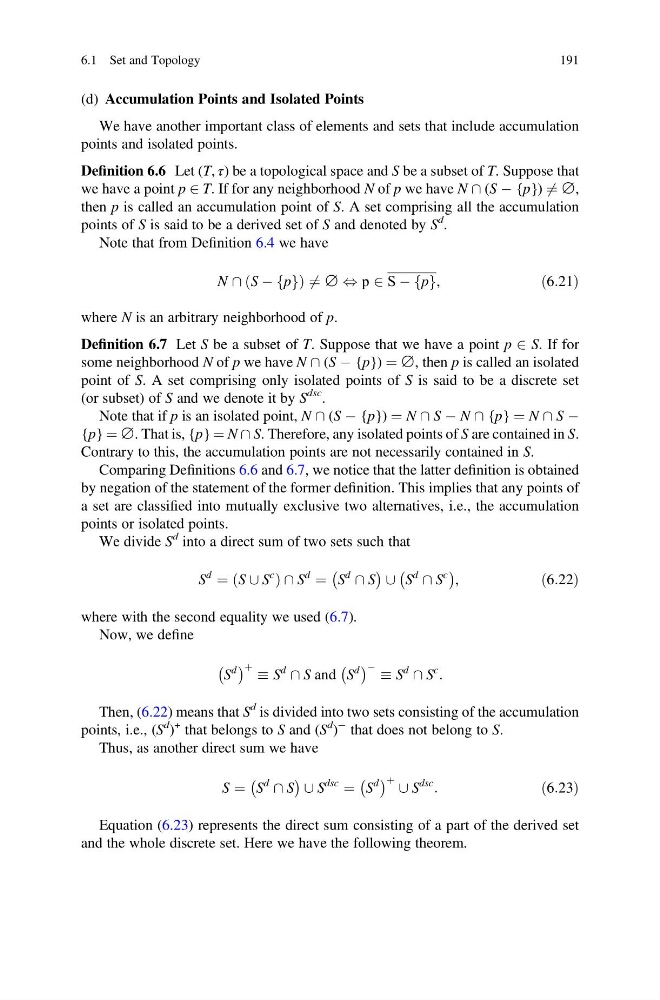
(d) Accumulation Points and Isolated Points
We have another important class of elements and sets that include accumulation
points and isolated points.
Definition 6.6 Let (T, τ) be a topological space and S be a subset of T. Suppose that
we have a point p 2 T. If for any neighborhood N of p we have N \ (S À {p}) 6 ¼ ∅,
then p is called an accumulation point of S. A set comprising all the accumulation
points of S is said to be a derived set of S and denoted by S
d
.
Note that from Definition 6.4 we have
N \ S À p
f g
ð
Þ6 ¼ ∅ , p 2 S À p
f g,
ð6:21Þ
where N is an arbitrary neighborhood of p.
Definition 6.7 Let S be a subset of T. Suppose that we have a point p 2 S. If for
some neighborhood N of p we have N \ (S À {p}) ¼ ∅, then p is called an isolated
point of S. A set comprising only isolated points of S is said to be a discrete set
(or subset) of S and we denote it by S
dsc
.
Note that if p is an isolated point, N \ (S À {p}) ¼ N \ S À N \ {p} ¼ N \ S À
{p} ¼ ∅. That is, {p} ¼ N \ S. Therefore, any isolated points of S are contained in S.
Contrary to this, the accumulation points are not necessarily contained in S.
Comparing Definitions 6.6 and 6.7, we notice that the latter definition is obtained
by negation of the statement of the former definition. This implies that any points of
a set are classified into mutually exclusive two alternatives, i.e., the accumulation
points or isolated points.
We divide S
d into a direct sum of two sets such that
S
d
¼ S [ S
c
ð
Þ\S
d
¼ S
d
\ S
À
Á [ S
d
\ S
c
À
Á
,
ð6:22Þ
where with the second equality we used (6.7).
Now, we define
S
d
À Á þ S
d
\ S and S
d
À Á À S
d
\ S
c
:
Then, (6.22) means that S
d is divided into two sets consisting of the accumulation
points, i.e., (S
d )
+ that belongs to S and (S
d )
À that does not belong to S.
Thus, as another direct sum we have
S ¼ S
d
\ S
À
Á [ S
dsc
¼ S
d
À Á þ [ S
dsc
:
ð6:23Þ
Equation (6.23) represents the direct sum consisting of a part of the derived set
and the whole discrete set. Here we have the following theorem.
6.1 Set and Topology
191
We have another important class of elements and sets that include accumulation
points and isolated points.
Definition 6.6 Let (T, τ) be a topological space and S be a subset of T. Suppose that
we have a point p 2 T. If for any neighborhood N of p we have N \ (S À {p}) 6 ¼ ∅,
then p is called an accumulation point of S. A set comprising all the accumulation
points of S is said to be a derived set of S and denoted by S
d
.
Note that from Definition 6.4 we have
N \ S À p
f g
ð
Þ6 ¼ ∅ , p 2 S À p
f g,
ð6:21Þ
where N is an arbitrary neighborhood of p.
Definition 6.7 Let S be a subset of T. Suppose that we have a point p 2 S. If for
some neighborhood N of p we have N \ (S À {p}) ¼ ∅, then p is called an isolated
point of S. A set comprising only isolated points of S is said to be a discrete set
(or subset) of S and we denote it by S
dsc
.
Note that if p is an isolated point, N \ (S À {p}) ¼ N \ S À N \ {p} ¼ N \ S À
{p} ¼ ∅. That is, {p} ¼ N \ S. Therefore, any isolated points of S are contained in S.
Contrary to this, the accumulation points are not necessarily contained in S.
Comparing Definitions 6.6 and 6.7, we notice that the latter definition is obtained
by negation of the statement of the former definition. This implies that any points of
a set are classified into mutually exclusive two alternatives, i.e., the accumulation
points or isolated points.
We divide S
d into a direct sum of two sets such that
S
d
¼ S [ S
c
ð
Þ\S
d
¼ S
d
\ S
À
Á [ S
d
\ S
c
À
Á
,
ð6:22Þ
where with the second equality we used (6.7).
Now, we define
S
d
À Á þ S
d
\ S and S
d
À Á À S
d
\ S
c
:
Then, (6.22) means that S
d is divided into two sets consisting of the accumulation
points, i.e., (S
d )
+ that belongs to S and (S
d )
À that does not belong to S.
Thus, as another direct sum we have
S ¼ S
d
\ S
À
Á [ S
dsc
¼ S
d
À Á þ [ S
dsc
:
ð6:23Þ
Equation (6.23) represents the direct sum consisting of a part of the derived set
and the whole discrete set. Here we have the following theorem.
6.1 Set and Topology
191