

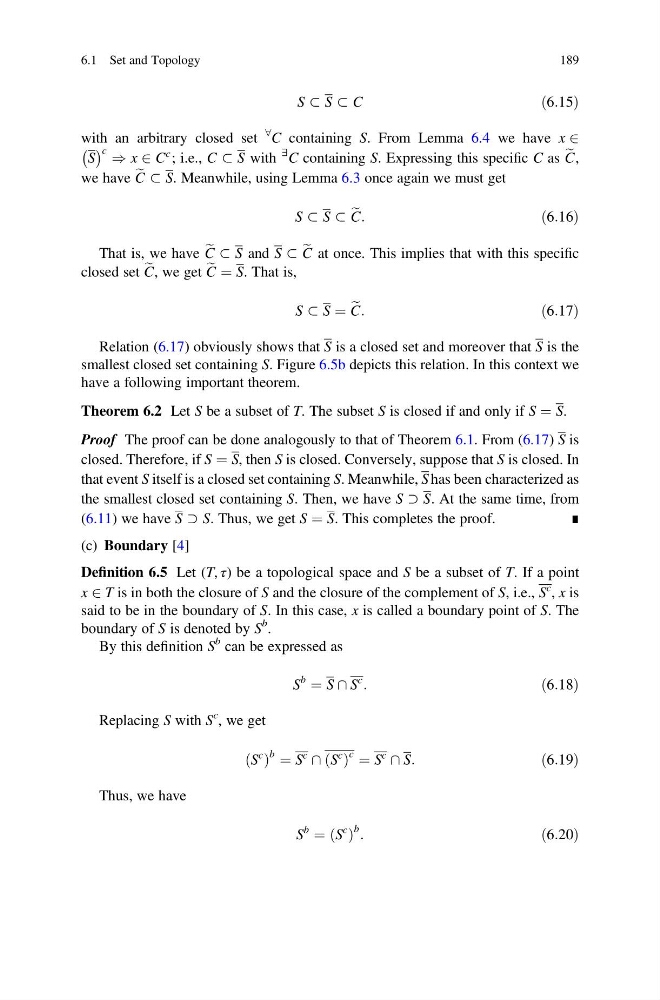
S ⊂ S ⊂ C
ð6:15Þ
with an arbitrary closed set
8
C containing S. From Lemma 6.4 we have x 2
S
À Á c ) x 2 C
c ; i.e., C ⊂ S with
∃ C containing S. Expressing this specific C as e
C,
we have e
C ⊂ S. Meanwhile, using Lemma 6.3 once again we must get
S ⊂ S ⊂ e
C:
ð6:16Þ
That is, we have e
C ⊂ S and S ⊂ e
C at once. This implies that with this specific
closed set e
C, we get e
C ¼ S. That is,
S ⊂ S ¼ e
C:
ð6:17Þ
Relation (6.17) obviously shows that S is a closed set and moreover that S is the
smallest closed set containing S. Figure 6.5b depicts this relation. In this context we
have a following important theorem.
Theorem 6.2 Let S be a subset of T. The subset S is closed if and only if S ¼ S.
Proof The proof can be done analogously to that of Theorem 6.1. From (6.17) S is
closed. Therefore, if S ¼ S, then S is closed. Conversely, suppose that S is closed. In
that event S itself is a closed set containing S. Meanwhile, S has been characterized as
the smallest closed set containing S. Then, we have S ⊃ S. At the same time, from
(6.11) we have S ⊃ S. Thus, we get S ¼ S. This completes the proof.
∎
(c) Boundary [4]
Definition 6.5 Let (T, τ) be a topological space and S be a subset of T. If a point
x 2 T is in both the closure of S and the closure of the complement of S, i.e., S
c , x is
said to be in the boundary of S. In this case, x is called a boundary point of S. The
boundary of S is denoted by S
b .
By this definition S
b can be expressed as
S
b
¼ S \ S
c
:
ð6:18Þ
Replacing S with S
c , we get
S
c
ð Þ
b ¼ S
c
\ S
c
ð Þ
c ¼ S
c
\ S:
ð6:19Þ
Thus, we have
S
b
¼ S
c
ð Þ
b :
ð6:20Þ
6.1 Set and Topology
189
ð6:15Þ
with an arbitrary closed set
8
C containing S. From Lemma 6.4 we have x 2
S
À Á c ) x 2 C
c ; i.e., C ⊂ S with
∃ C containing S. Expressing this specific C as e
C,
we have e
C ⊂ S. Meanwhile, using Lemma 6.3 once again we must get
S ⊂ S ⊂ e
C:
ð6:16Þ
That is, we have e
C ⊂ S and S ⊂ e
C at once. This implies that with this specific
closed set e
C, we get e
C ¼ S. That is,
S ⊂ S ¼ e
C:
ð6:17Þ
Relation (6.17) obviously shows that S is a closed set and moreover that S is the
smallest closed set containing S. Figure 6.5b depicts this relation. In this context we
have a following important theorem.
Theorem 6.2 Let S be a subset of T. The subset S is closed if and only if S ¼ S.
Proof The proof can be done analogously to that of Theorem 6.1. From (6.17) S is
closed. Therefore, if S ¼ S, then S is closed. Conversely, suppose that S is closed. In
that event S itself is a closed set containing S. Meanwhile, S has been characterized as
the smallest closed set containing S. Then, we have S ⊃ S. At the same time, from
(6.11) we have S ⊃ S. Thus, we get S ¼ S. This completes the proof.
∎
(c) Boundary [4]
Definition 6.5 Let (T, τ) be a topological space and S be a subset of T. If a point
x 2 T is in both the closure of S and the closure of the complement of S, i.e., S
c , x is
said to be in the boundary of S. In this case, x is called a boundary point of S. The
boundary of S is denoted by S
b .
By this definition S
b can be expressed as
S
b
¼ S \ S
c
:
ð6:18Þ
Replacing S with S
c , we get
S
c
ð Þ
b ¼ S
c
\ S
c
ð Þ
c ¼ S
c
\ S:
ð6:19Þ
Thus, we have
S
b
¼ S
c
ð Þ
b :
ð6:20Þ
6.1 Set and Topology
189