

e
O ¼ S
∘
⊂ S:
ð6:14Þ
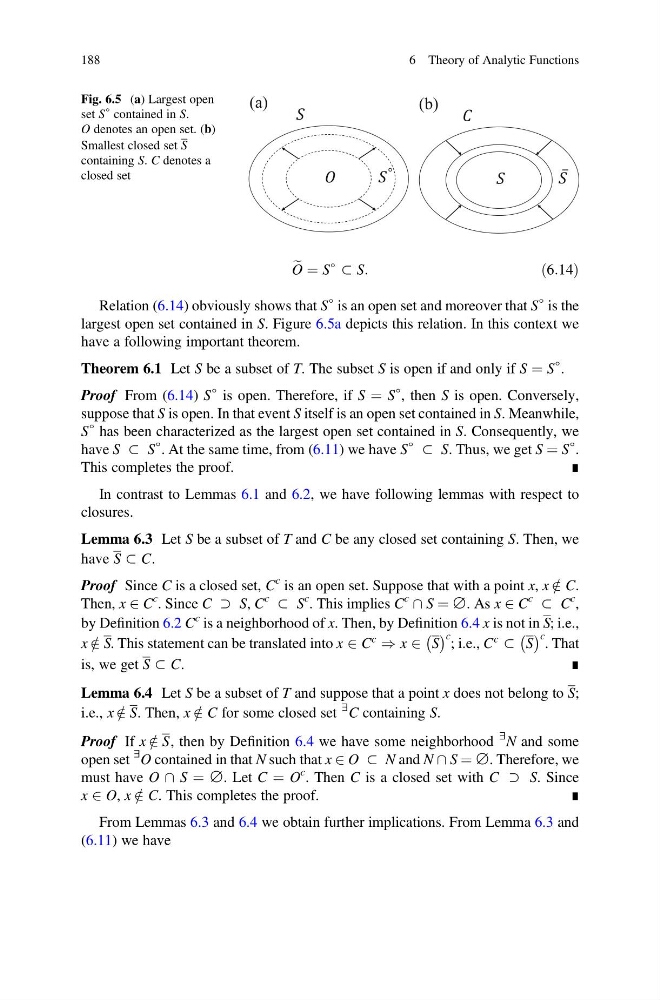
Relation (6.14) obviously shows that S
∘ is an open set and moreover that S
∘ is the
largest open set contained in S. Figure 6.5a depicts this relation. In this context we
have a following important theorem.
Theorem 6.1 Let S be a subset of T. The subset S is open if and only if S ¼ S
∘ .
Proof From (6.14) S
∘ is open. Therefore, if S ¼ S
∘ , then S is open. Conversely,
suppose that S is open. In that event S itself is an open set contained in S. Meanwhile,
S
∘ has been characterized as the largest open set contained in S. Consequently, we
have S ⊂ S
∘ . At the same time, from (6.11) we have S
∘
⊂ S. Thus, we get S ¼ S
∘ .
This completes the proof.
∎
In contrast to Lemmas 6.1 and 6.2, we have following lemmas with respect to
closures.
Lemma 6.3 Let S be a subset of T and C be any closed set containing S. Then, we
have S ⊂ C.
Proof Since C is a closed set, C
c is an open set. Suppose that with a point x, x =
2 C.
Then, x 2 C
c . Since C ⊃ S, C
c
⊂ S
c . This implies C
c
\ S ¼ ∅. As x 2 C
c
⊂ C
c ,
by Definition 6.2 C
c is a neighborhood of x. Then, by Definition 6.4 x is not in S; i.e.,
x =
2 S. This statement can be translated into x 2 C
c
) x 2 S
À Á c ; i.e., C
c
⊂ S
À Á c . That
is, we get S ⊂ C.
∎
Lemma 6.4 Let S be a subset of T and suppose that a point x does not belong to S;
i.e., x =
2 S. Then, x =
2 C for some closed set
∃ C containing S.
Proof If x =
2 S, then by Definition 6.4 we have some neighborhood
∃ N and some
open set
∃ O contained in that N such that x 2 O ⊂ N and N \ S ¼ ∅. Therefore, we
must have O \ S ¼ ∅. Let C ¼ O
c . Then C is a closed set with C ⊃ S. Since
x 2 O, x =
2 C. This completes the proof.
∎
From Lemmas 6.3 and 6.4 we obtain further implications. From Lemma 6.3 and
(6.11) we have
°
(a)
(b)
̅
Fig. 6.5 (a) Largest open
set S
∘ contained in S.
O denotes an open set. (b)
Smallest closed set S
containing S. C denotes a
closed set
188
6 Theory of Analytic Functions
O ¼ S
∘
⊂ S:
ð6:14Þ
Relation (6.14) obviously shows that S
∘ is an open set and moreover that S
∘ is the
largest open set contained in S. Figure 6.5a depicts this relation. In this context we
have a following important theorem.
Theorem 6.1 Let S be a subset of T. The subset S is open if and only if S ¼ S
∘ .
Proof From (6.14) S
∘ is open. Therefore, if S ¼ S
∘ , then S is open. Conversely,
suppose that S is open. In that event S itself is an open set contained in S. Meanwhile,
S
∘ has been characterized as the largest open set contained in S. Consequently, we
have S ⊂ S
∘ . At the same time, from (6.11) we have S
∘
⊂ S. Thus, we get S ¼ S
∘ .
This completes the proof.
∎
In contrast to Lemmas 6.1 and 6.2, we have following lemmas with respect to
closures.
Lemma 6.3 Let S be a subset of T and C be any closed set containing S. Then, we
have S ⊂ C.
Proof Since C is a closed set, C
c is an open set. Suppose that with a point x, x =
2 C.
Then, x 2 C
c . Since C ⊃ S, C
c
⊂ S
c . This implies C
c
\ S ¼ ∅. As x 2 C
c
⊂ C
c ,
by Definition 6.2 C
c is a neighborhood of x. Then, by Definition 6.4 x is not in S; i.e.,
x =
2 S. This statement can be translated into x 2 C
c
) x 2 S
À Á c ; i.e., C
c
⊂ S
À Á c . That
is, we get S ⊂ C.
∎
Lemma 6.4 Let S be a subset of T and suppose that a point x does not belong to S;
i.e., x =
2 S. Then, x =
2 C for some closed set
∃ C containing S.
Proof If x =
2 S, then by Definition 6.4 we have some neighborhood
∃ N and some
open set
∃ O contained in that N such that x 2 O ⊂ N and N \ S ¼ ∅. Therefore, we
must have O \ S ¼ ∅. Let C ¼ O
c . Then C is a closed set with C ⊃ S. Since
x 2 O, x =
2 C. This completes the proof.
∎
From Lemmas 6.3 and 6.4 we obtain further implications. From Lemma 6.3 and
(6.11) we have
°
(a)
(b)
̅
Fig. 6.5 (a) Largest open
set S
∘ contained in S.
O denotes an open set. (b)
Smallest closed set S
containing S. C denotes a
closed set
188
6 Theory of Analytic Functions