

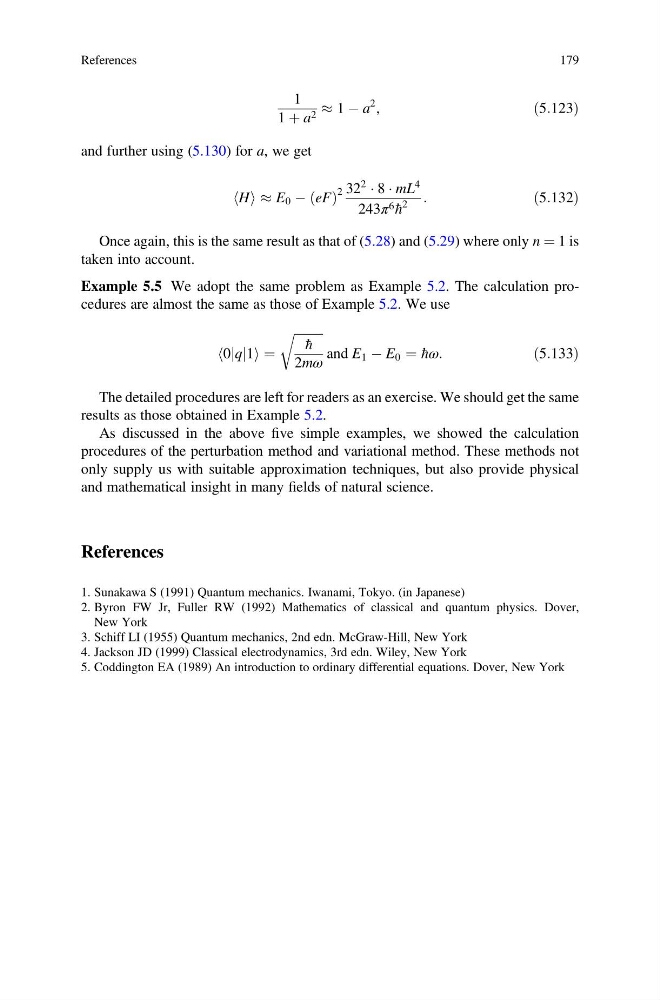
1
1 þ a 2 % 1 À a
2 ,
ð5:123Þ
and further using (5.130) for a, we get
H
h i % E 0 À eF
ð Þ
2 32
2
Á 8 Á mL
4
243π 6 h
2
:
ð5:132Þ
Once again, this is the same result as that of (5.28) and (5.29) where only n ¼ 1 is
taken into account.
Example 5.5 We adopt the same problem as Example 5.2. The calculation procedures are almost the same as those of Example 5.2. We use
0jqj1
h
i¼
ffiffiffiffiffiffiffiffiffi ffi
h
2mω
r
and E 1 À E 0 ¼ hω:
ð5:133Þ
The detailed procedures are left for readers as an exercise. We should get the same
results as those obtained in Example 5.2.
As discussed in the above five simple examples, we showed the calculation
procedures of the perturbation method and variational method. These methods not
only supply us with suitable approximation techniques, but also provide physical
and mathematical insight in many fields of natural science.
References
1. Sunakawa S (1991) Quantum mechanics. Iwanami, Tokyo. (in Japanese)
2. Byron FW Jr, Fuller RW (1992) Mathematics of classical and quantum physics. Dover,
New York
3. Schiff LI (1955) Quantum mechanics, 2nd edn. McGraw-Hill, New York
4. Jackson JD (1999) Classical electrodynamics, 3rd edn. Wiley, New York
5. Coddington EA (1989) An introduction to ordinary differential equations. Dover, New York
References
179
1 þ a 2 % 1 À a
2 ,
ð5:123Þ
and further using (5.130) for a, we get
H
h i % E 0 À eF
ð Þ
2 32
2
Á 8 Á mL
4
243π 6 h
2
:
ð5:132Þ
Once again, this is the same result as that of (5.28) and (5.29) where only n ¼ 1 is
taken into account.
Example 5.5 We adopt the same problem as Example 5.2. The calculation procedures are almost the same as those of Example 5.2. We use
0jqj1
h
i¼
ffiffiffiffiffiffiffiffiffi ffi
h
2mω
r
and E 1 À E 0 ¼ hω:
ð5:133Þ
The detailed procedures are left for readers as an exercise. We should get the same
results as those obtained in Example 5.2.
As discussed in the above five simple examples, we showed the calculation
procedures of the perturbation method and variational method. These methods not
only supply us with suitable approximation techniques, but also provide physical
and mathematical insight in many fields of natural science.
References
1. Sunakawa S (1991) Quantum mechanics. Iwanami, Tokyo. (in Japanese)
2. Byron FW Jr, Fuller RW (1992) Mathematics of classical and quantum physics. Dover,
New York
3. Schiff LI (1955) Quantum mechanics, 2nd edn. McGraw-Hill, New York
4. Jackson JD (1999) Classical electrodynamics, 3rd edn. Wiley, New York
5. Coddington EA (1989) An introduction to ordinary differential equations. Dover, New York
References
179