

¼ E
0
ð Þ
0 À eF 0jxj0
h
iþ ÀeF
ð
Þ
2
X 1
n¼1
1
E
0
ð Þ
0 À E
0
ð Þ
2nÀ1
h
i n sin jxj0
h
i
j
j
2 ,
ð5:25Þ
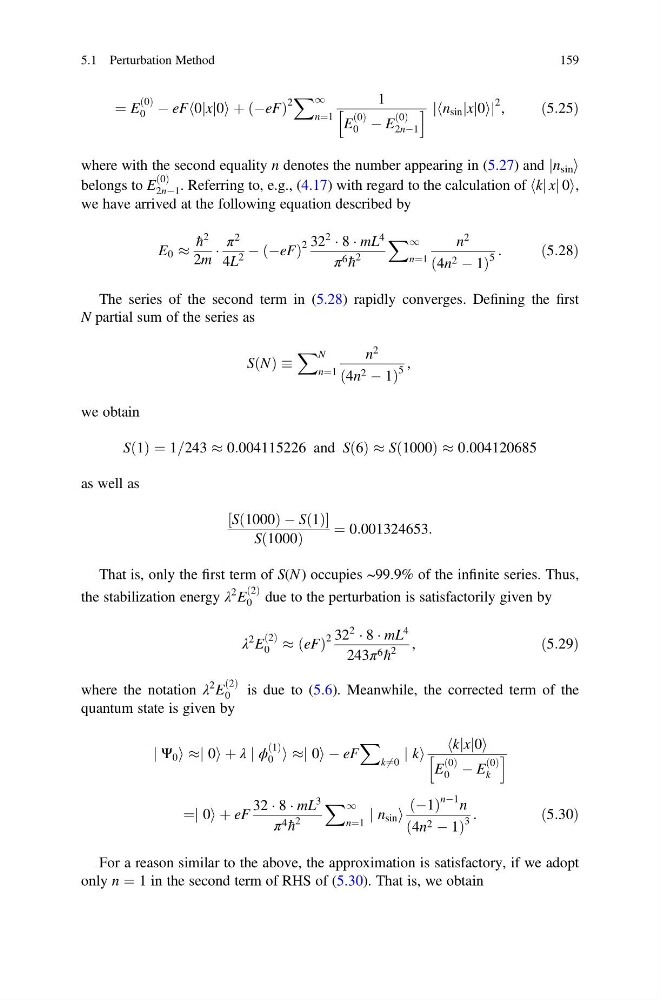
where with the second equality n denotes the number appearing in (5.27) and jn sin i
belongs to E
0
ð Þ
2nÀ1 . Referring to, e.g., (4.17) with regard to the calculation of hkj xj 0i,
we have arrived at the following equation described by
E 0 %
h
2
2m
Á
π
2
4L
2
À ÀeF
ð
Þ
2 32
2
Á 8 Á mL
4
π 6 h
2
X 1
n¼1
n
2
4n 2 À 1
ð
Þ
5
:
ð5:28Þ
The series of the second term in (5.28) rapidly converges. Defining the first
N partial sum of the series as
S N
ð Þ
X N
n¼1
n
2
4n 2 À 1
ð
Þ
5
,
we obtain
S 1
ð Þ ¼ 1=243 % 0:004115226 and S 6
ð Þ % S 1000
ð
Þ%0:004120685
as well as
S 1000
ð
ÞÀS 1
ð Þ
½
S 1000
ð
Þ
¼ 0:001324653:
That is, only the first term of S(N ) occupies ~99.9% of the infinite series. Thus,
the stabilization energy λ
2 E
2
ð Þ
0 due to the perturbation is satisfactorily given by
λ
2 E
2
ð Þ
0 % eF
ð Þ
2 32
2
Á 8 Á mL
4
243π 6 h
2
,
ð5:29Þ
where the notation λ
2 E
2
ð Þ
0
is due to (5.6). Meanwhile, the corrected term of the
quantum state is given by
j Ψ 0 i %j 0i þ λ j ϕ
1
ð Þ
0 i %j 0i À eF
X
k6 ¼0
j ki
kjxj0
h
i
E
0
ð Þ
0 À E
0
ð Þ
k
h
i
¼j 0i þ eF
32 Á 8 Á mL
3
π 4 h
2
X 1
n¼1
j n sin i
À1
ð Þ
nÀ1 n
4n 2 À 1
ð
Þ
3
:
ð5:30Þ
For a reason similar to the above, the approximation is satisfactory, if we adopt
only n ¼ 1 in the second term of RHS of (5.30). That is, we obtain
5.1 Perturbation Method
159
0
ð Þ
0 À eF 0jxj0
h
iþ ÀeF
ð
Þ
2
X 1
n¼1
1
E
0
ð Þ
0 À E
0
ð Þ
2nÀ1
h
i n sin jxj0
h
i
j
j
2 ,
ð5:25Þ
where with the second equality n denotes the number appearing in (5.27) and jn sin i
belongs to E
0
ð Þ
2nÀ1 . Referring to, e.g., (4.17) with regard to the calculation of hkj xj 0i,
we have arrived at the following equation described by
E 0 %
h
2
2m
Á
π
2
4L
2
À ÀeF
ð
Þ
2 32
2
Á 8 Á mL
4
π 6 h
2
X 1
n¼1
n
2
4n 2 À 1
ð
Þ
5
:
ð5:28Þ
The series of the second term in (5.28) rapidly converges. Defining the first
N partial sum of the series as
S N
ð Þ
X N
n¼1
n
2
4n 2 À 1
ð
Þ
5
,
we obtain
S 1
ð Þ ¼ 1=243 % 0:004115226 and S 6
ð Þ % S 1000
ð
Þ%0:004120685
as well as
S 1000
ð
ÞÀS 1
ð Þ
½
S 1000
ð
Þ
¼ 0:001324653:
That is, only the first term of S(N ) occupies ~99.9% of the infinite series. Thus,
the stabilization energy λ
2 E
2
ð Þ
0 due to the perturbation is satisfactorily given by
λ
2 E
2
ð Þ
0 % eF
ð Þ
2 32
2
Á 8 Á mL
4
243π 6 h
2
,
ð5:29Þ
where the notation λ
2 E
2
ð Þ
0
is due to (5.6). Meanwhile, the corrected term of the
quantum state is given by
j Ψ 0 i %j 0i þ λ j ϕ
1
ð Þ
0 i %j 0i À eF
X
k6 ¼0
j ki
kjxj0
h
i
E
0
ð Þ
0 À E
0
ð Þ
k
h
i
¼j 0i þ eF
32 Á 8 Á mL
3
π 4 h
2
X 1
n¼1
j n sin i
À1
ð Þ
nÀ1 n
4n 2 À 1
ð
Þ
3
:
ð5:30Þ
For a reason similar to the above, the approximation is satisfactory, if we adopt
only n ¼ 1 in the second term of RHS of (5.30). That is, we obtain
5.1 Perturbation Method
159