

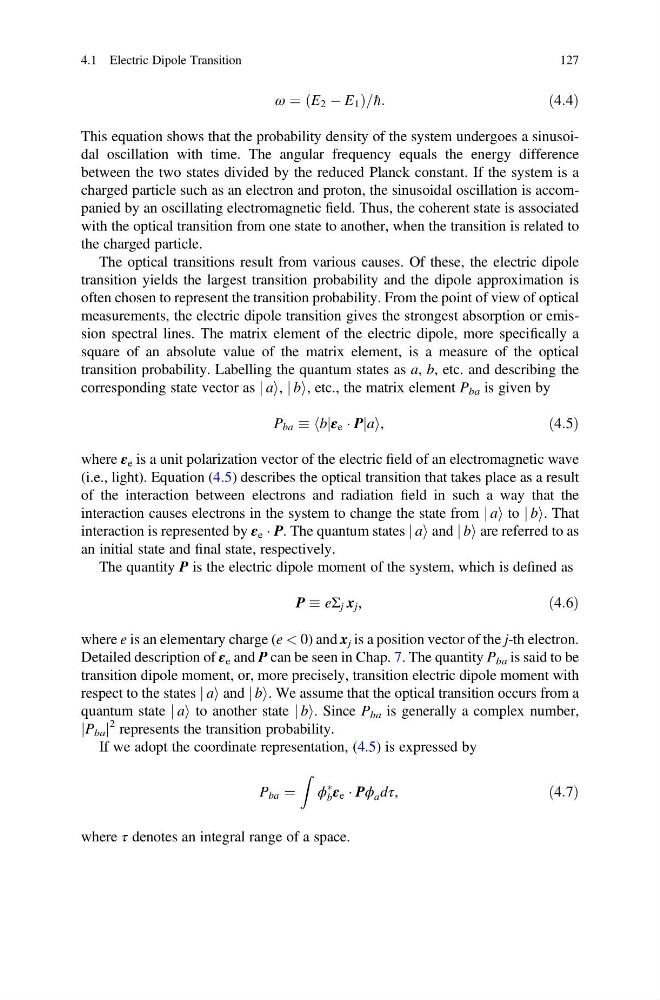
ω ¼ E 2 À E 1
ð
Þ =h:
ð4:4Þ
This equation shows that the probability density of the system undergoes a sinusoidal oscillation with time. The angular frequency equals the energy difference
between the two states divided by the reduced Planck constant. If the system is a
charged particle such as an electron and proton, the sinusoidal oscillation is accompanied by an oscillating electromagnetic field. Thus, the coherent state is associated
with the optical transition from one state to another, when the transition is related to
the charged particle.
The optical transitions result from various causes. Of these, the electric dipole
transition yields the largest transition probability and the dipole approximation is
often chosen to represent the transition probability. From the point of view of optical
measurements, the electric dipole transition gives the strongest absorption or emission spectral lines. The matrix element of the electric dipole, more specifically a
square of an absolute value of the matrix element, is a measure of the optical
transition probability. Labelling the quantum states as a, b, etc. and describing the
corresponding state vector as j ai, j bi, etc., the matrix element P ba is given by
P ba bjε e Á Pja
h
i ,
ð4:5Þ
where ε e is a unit polarization vector of the electric field of an electromagnetic wave
(i.e., light). Equation (4.5) describes the optical transition that takes place as a result
of the interaction between electrons and radiation field in such a way that the
interaction causes electrons in the system to change the state from j ai to j bi. That
interaction is represented by ε e Á P. The quantum states j ai and j bi are referred to as
an initial state and final state, respectively.
The quantity P is the electric dipole moment of the system, which is defined as
P eΣ j x j ,
ð4:6Þ
where e is an elementary charge (e < 0) and x j is a position vector of the j-th electron.
Detailed description of ε e and P can be seen in Chap. 7. The quantity P ba is said to be
transition dipole moment, or, more precisely, transition electric dipole moment with
respect to the states j ai and j bi. We assume that the optical transition occurs from a
quantum state j ai to another state j bi. Since P ba is generally a complex number,
jP ba j
2 represents the transition probability.
If we adopt the coordinate representation, (4.5) is expressed by
P ba ¼
Z
ϕ
Ã
b ε e Á Pϕ a dτ,
ð4:7Þ
where τ denotes an integral range of a space.
4.1 Electric Dipole Transition
127
ð
Þ =h:
ð4:4Þ
This equation shows that the probability density of the system undergoes a sinusoidal oscillation with time. The angular frequency equals the energy difference
between the two states divided by the reduced Planck constant. If the system is a
charged particle such as an electron and proton, the sinusoidal oscillation is accompanied by an oscillating electromagnetic field. Thus, the coherent state is associated
with the optical transition from one state to another, when the transition is related to
the charged particle.
The optical transitions result from various causes. Of these, the electric dipole
transition yields the largest transition probability and the dipole approximation is
often chosen to represent the transition probability. From the point of view of optical
measurements, the electric dipole transition gives the strongest absorption or emission spectral lines. The matrix element of the electric dipole, more specifically a
square of an absolute value of the matrix element, is a measure of the optical
transition probability. Labelling the quantum states as a, b, etc. and describing the
corresponding state vector as j ai, j bi, etc., the matrix element P ba is given by
P ba bjε e Á Pja
h
i ,
ð4:5Þ
where ε e is a unit polarization vector of the electric field of an electromagnetic wave
(i.e., light). Equation (4.5) describes the optical transition that takes place as a result
of the interaction between electrons and radiation field in such a way that the
interaction causes electrons in the system to change the state from j ai to j bi. That
interaction is represented by ε e Á P. The quantum states j ai and j bi are referred to as
an initial state and final state, respectively.
The quantity P is the electric dipole moment of the system, which is defined as
P eΣ j x j ,
ð4:6Þ
where e is an elementary charge (e < 0) and x j is a position vector of the j-th electron.
Detailed description of ε e and P can be seen in Chap. 7. The quantity P ba is said to be
transition dipole moment, or, more precisely, transition electric dipole moment with
respect to the states j ai and j bi. We assume that the optical transition occurs from a
quantum state j ai to another state j bi. Since P ba is generally a complex number,
jP ba j
2 represents the transition probability.
If we adopt the coordinate representation, (4.5) is expressed by
P ba ¼
Z
ϕ
Ã
b ε e Á Pϕ a dτ,
ð4:7Þ
where τ denotes an integral range of a space.
4.1 Electric Dipole Transition
127