

f
h Dg
j i
Z 1
0
f
à Dgdρ
¼ f
à g
½
1
0 À
Z 1
0
Df
Ã
ð
Þgdρ
¼ f
à g
½
1
0 þ ÀDf
Ã
h
jgi,
ð3:282Þ
where f
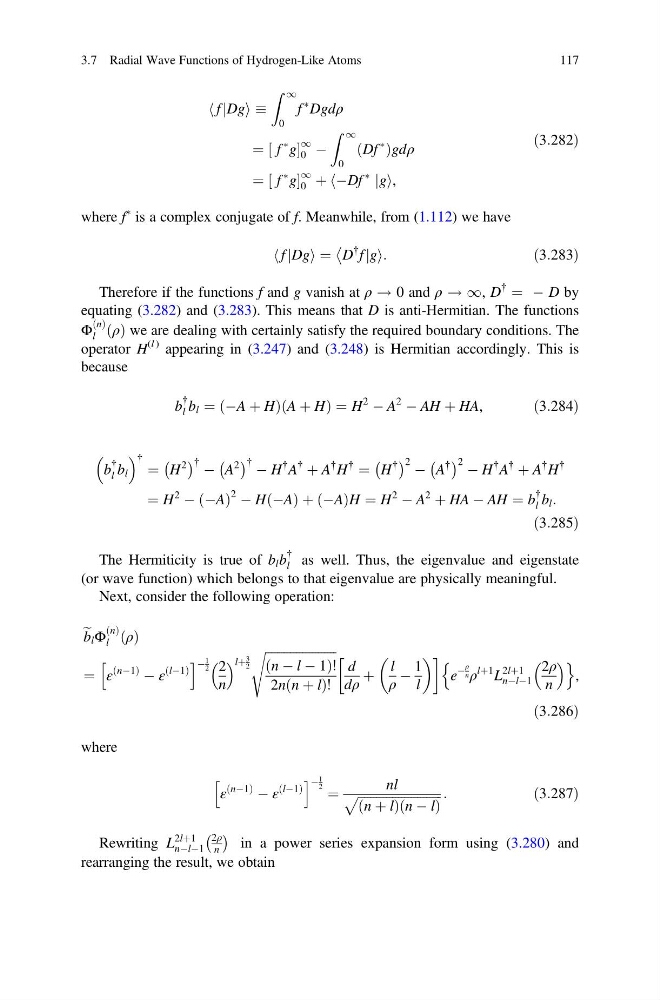
à is a complex conjugate of f. Meanwhile, from (1.112) we have
f
h Dg
j i ¼ D
{ f
g
j i:
ð3:283Þ
Therefore if the functions f and g vanish at ρ ! 0 and ρ ! 1, D
{
¼ À D by
equating (3.282) and (3.283). This means that D is anti-Hermitian. The functions
Φ
n
ð Þ
l
ρ
ð Þ we are dealing with certainly satisfy the required boundary conditions. The
operator H
(l ) appearing in (3.247) and (3.248) is Hermitian accordingly. This is
because
b
{
l b l ¼ ÀA þ H
ð
ÞA þ H
ð
Þ¼H
2
À A
2
À AH þ HA,
ð3:284Þ
b
{
l b l
{ ¼ H
2
À Á { À A
2
À Á { À H
{ A
{
þ A
{ H
{
¼ H
{
À Á 2 À A
{
À Á 2 À H
{ A
{
þ A
{ H
{
¼ H
2
À ÀA
ð Þ
2 À H ÀA
ð Þþ ÀA
ð ÞH ¼ H
2
À A
2
þ HA À AH ¼ b
{
l b l :
ð3:285Þ
The Hermiticity is true of b l b
{
l as well. Thus, the eigenvalue and eigenstate
(or wave function) which belongs to that eigenvalue are physically meaningful.
Next, consider the following operation:
e b l Φ
n
ð Þ
l
ρ
ð Þ
¼ ε
nÀ1
ð
Þ
À ε
lÀ1
ð
Þ
h
i À
1
2 2
n
lþ
3
2
ffiffiffiffiffiffiffiffiffiffiffiffiffiffiffiffiffiffiffiffiffiffiffi
n À l À 1
ð
Þ !
2n n þ l
ð
Þ!
s
d
dρ
þ
l
ρ
À
1
l
!
e
À
ρ
n ρ
lþ1 L
2lþ1
nÀlÀ1
2ρ
n
n
o
,
ð3:286Þ
where
ε
nÀ1
ð
Þ
À ε
lÀ1
ð
Þ
h
i À
1
2 ¼
nl
ffiffiffiffiffiffiffiffiffiffiffiffiffiffiffiffiffiffiffiffiffiffiffiffiffiffi ffi
n þ l
ð
Þ n À l
ð
Þ
p
:
ð3:287Þ
Rewriting L
2lþ1
nÀlÀ1
2ρ
n
À Á
in a power series expansion form using (3.280) and
rearranging the result, we obtain
3.7 Radial Wave Functions of Hydrogen-Like Atoms
117
h Dg
j i
Z 1
0
f
à Dgdρ
¼ f
à g
½
1
0 À
Z 1
0
Df
Ã
ð
Þgdρ
¼ f
à g
½
1
0 þ ÀDf
Ã
h
jgi,
ð3:282Þ
where f
à is a complex conjugate of f. Meanwhile, from (1.112) we have
f
h Dg
j i ¼ D
{ f
g
j i:
ð3:283Þ
Therefore if the functions f and g vanish at ρ ! 0 and ρ ! 1, D
{
¼ À D by
equating (3.282) and (3.283). This means that D is anti-Hermitian. The functions
Φ
n
ð Þ
l
ρ
ð Þ we are dealing with certainly satisfy the required boundary conditions. The
operator H
(l ) appearing in (3.247) and (3.248) is Hermitian accordingly. This is
because
b
{
l b l ¼ ÀA þ H
ð
ÞA þ H
ð
Þ¼H
2
À A
2
À AH þ HA,
ð3:284Þ
b
{
l b l
{ ¼ H
2
À Á { À A
2
À Á { À H
{ A
{
þ A
{ H
{
¼ H
{
À Á 2 À A
{
À Á 2 À H
{ A
{
þ A
{ H
{
¼ H
2
À ÀA
ð Þ
2 À H ÀA
ð Þþ ÀA
ð ÞH ¼ H
2
À A
2
þ HA À AH ¼ b
{
l b l :
ð3:285Þ
The Hermiticity is true of b l b
{
l as well. Thus, the eigenvalue and eigenstate
(or wave function) which belongs to that eigenvalue are physically meaningful.
Next, consider the following operation:
e b l Φ
n
ð Þ
l
ρ
ð Þ
¼ ε
nÀ1
ð
Þ
À ε
lÀ1
ð
Þ
h
i À
1
2 2
n
lþ
3
2
ffiffiffiffiffiffiffiffiffiffiffiffiffiffiffiffiffiffiffiffiffiffiffi
n À l À 1
ð
Þ !
2n n þ l
ð
Þ!
s
d
dρ
þ
l
ρ
À
1
l
!
e
À
ρ
n ρ
lþ1 L
2lþ1
nÀlÀ1
2ρ
n
n
o
,
ð3:286Þ
where
ε
nÀ1
ð
Þ
À ε
lÀ1
ð
Þ
h
i À
1
2 ¼
nl
ffiffiffiffiffiffiffiffiffiffiffiffiffiffiffiffiffiffiffiffiffiffiffiffiffiffi ffi
n þ l
ð
Þ n À l
ð
Þ
p
:
ð3:287Þ
Rewriting L
2lþ1
nÀlÀ1
2ρ
n
À Á
in a power series expansion form using (3.280) and
rearranging the result, we obtain
3.7 Radial Wave Functions of Hydrogen-Like Atoms
117