

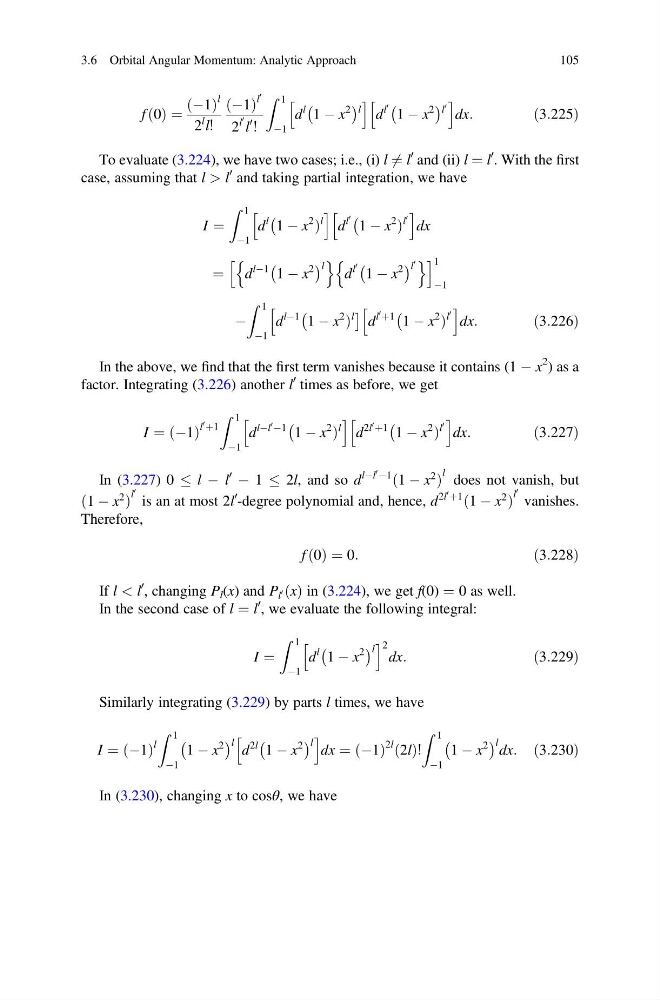
f 0
ð Þ ¼
À1
ð Þ
l
2
l l!
À1
ð Þ
l
0
2
l
0 l
0
!
Z 1
À1
h
d
l 1 À x
2
À
Á l
i
d
l
0
1 À x
2
À
Á l
0
h
i
dx:
ð3:225Þ
To evaluate (3.224), we have two cases; i.e., (i) l 6 ¼ l
0 and (ii) l ¼ l
0 . With the first
case, assuming that l > l
0 and taking partial integration, we have
I ¼
Z 1
À1
h
d
l
À
1 À x
2
Þ
l
i
d
l
0 À
1 À x
2
Þ
l
0
h
i
dx
¼ d
lÀ1 1 À x
2
À
Á l
n
o
d
l
0
1 À x
2
À
Á l
0
n
o
h
i 1
À1
À
Z 1
À1
d
lÀ1 1 À x
2
Þ
l
À
Ã
d
l
0 þ1
À
1 À x
2
Þ
l
0
h
i
dx:
h
ð3:226Þ
In the above, we find that the first term vanishes because it contains (1 À x
2 ) as a
factor. Integrating (3.226) another l
0 times as before, we get
I ¼ À1
ð Þ
l
0 þ1
Z 1
À1
d
lÀl
0 À1
À
1 À x
2
Þ
l
h
i
d
2l
0 þ1
À
1 À x
2
Þ
l
0
h
i
dx:
ð3:227Þ
In (3.227) 0
l À l
0 À 1
2l, and so d
lÀl
0 À1 1 À x
2
ð
Þ
l does not vanish, but
1 À x
2
ð
Þ
l
0
is an at most 2l
0
-degree polynomial and, hence, d
2l
0 þ1 1 À x
2
ð
Þ
l
0
vanishes.
Therefore,
f 0
ð Þ ¼ 0:
ð3:228Þ
If l < l
0 , changing P l (x) and P l
0 x
ð Þ in (3.224), we get f(0) ¼ 0 as well.
In the second case of l ¼ l
0 , we evaluate the following integral:
I ¼
Z 1
À1
d
l 1 À x
2
À
Á l
h
i 2
dx:
ð3:229Þ
Similarly integrating (3.229) by parts l times, we have
I ¼ À1
ð Þ
l
Z 1
À1
1 À x
2
À
Á l d
2l 1 À x
2
À
Á l
h
i
dx ¼ À1
ð Þ
2l 2l
ð Þ!
Z 1
À1
1 À x
2
À
Á l dx: ð3:230Þ
In (3.230), changing x to cosθ, we have
3.6 Orbital Angular Momentum: Analytic Approach
105
ð Þ ¼
À1
ð Þ
l
2
l l!
À1
ð Þ
l
0
2
l
0 l
0
!
Z 1
À1
h
d
l 1 À x
2
À
Á l
i
d
l
0
1 À x
2
À
Á l
0
h
i
dx:
ð3:225Þ
To evaluate (3.224), we have two cases; i.e., (i) l 6 ¼ l
0 and (ii) l ¼ l
0 . With the first
case, assuming that l > l
0 and taking partial integration, we have
I ¼
Z 1
À1
h
d
l
À
1 À x
2
Þ
l
i
d
l
0 À
1 À x
2
Þ
l
0
h
i
dx
¼ d
lÀ1 1 À x
2
À
Á l
n
o
d
l
0
1 À x
2
À
Á l
0
n
o
h
i 1
À1
À
Z 1
À1
d
lÀ1 1 À x
2
Þ
l
À
Ã
d
l
0 þ1
À
1 À x
2
Þ
l
0
h
i
dx:
h
ð3:226Þ
In the above, we find that the first term vanishes because it contains (1 À x
2 ) as a
factor. Integrating (3.226) another l
0 times as before, we get
I ¼ À1
ð Þ
l
0 þ1
Z 1
À1
d
lÀl
0 À1
À
1 À x
2
Þ
l
h
i
d
2l
0 þ1
À
1 À x
2
Þ
l
0
h
i
dx:
ð3:227Þ
In (3.227) 0
l À l
0 À 1
2l, and so d
lÀl
0 À1 1 À x
2
ð
Þ
l does not vanish, but
1 À x
2
ð
Þ
l
0
is an at most 2l
0
-degree polynomial and, hence, d
2l
0 þ1 1 À x
2
ð
Þ
l
0
vanishes.
Therefore,
f 0
ð Þ ¼ 0:
ð3:228Þ
If l < l
0 , changing P l (x) and P l
0 x
ð Þ in (3.224), we get f(0) ¼ 0 as well.
In the second case of l ¼ l
0 , we evaluate the following integral:
I ¼
Z 1
À1
d
l 1 À x
2
À
Á l
h
i 2
dx:
ð3:229Þ
Similarly integrating (3.229) by parts l times, we have
I ¼ À1
ð Þ
l
Z 1
À1
1 À x
2
À
Á l d
2l 1 À x
2
À
Á l
h
i
dx ¼ À1
ð Þ
2l 2l
ð Þ!
Z 1
À1
1 À x
2
À
Á l dx: ð3:230Þ
In (3.230), changing x to cosθ, we have
3.6 Orbital Angular Momentum: Analytic Approach
105