

3.6.1 Spherical Surface Harmonics and Associated Legendre
Differential Equation
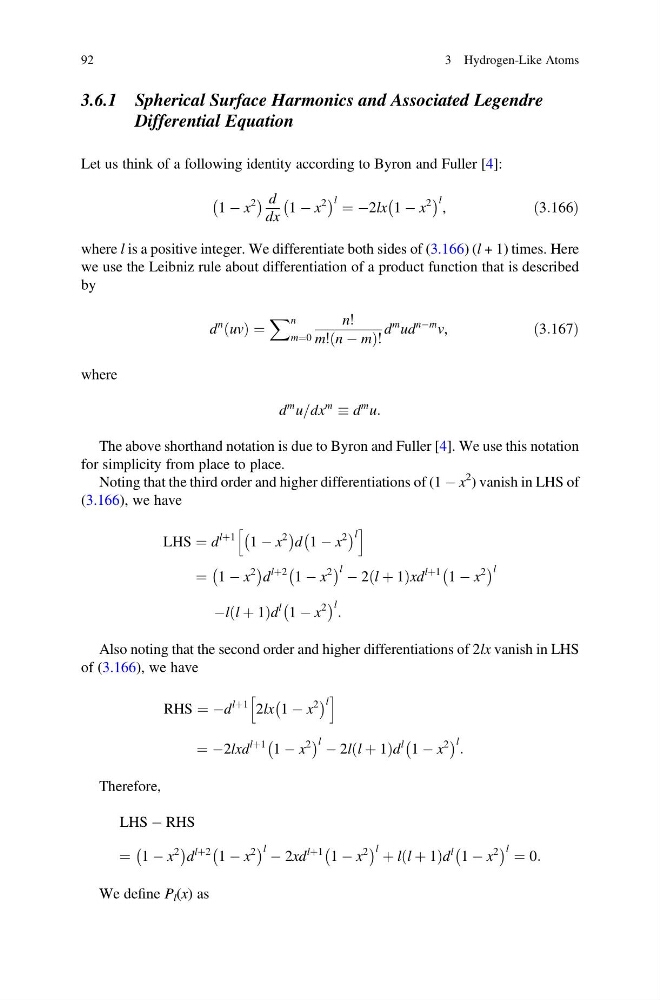
Let us think of a following identity according to Byron and Fuller [4]:
1 À x
2
À
Á d
dx
1 À x
2
À
Á l ¼ À2lx 1 À x
2
À
Á l ,
ð3:166Þ
where l is a positive integer. We differentiate both sides of (3.166) (l + 1) times. Here
we use the Leibniz rule about differentiation of a product function that is described
by
d
n uv
ð Þ ¼
X n
m¼0
n!
m! n À m
ð
Þ!
d
m ud
nÀm v,
ð3:167Þ
where
d
m u=dx
m
d
m u:
The above shorthand notation is due to Byron and Fuller [4]. We use this notation
for simplicity from place to place.
Noting that the third order and higher differentiations of (1 À x
2 ) vanish in LHS of
(3.166), we have
LHS ¼ d
lþ1 1 À x
2
À
Á
d 1 À x
2
À
Á l
h
i
¼ 1 À x
2
À
Á
d
lþ2 1 À x
2
À
Á l À 2 l þ 1
ð
Þxd
lþ1 1 À x
2
À
Á l
Àl l þ 1
ð
Þd
l 1 À x
2
À
Á l :
Also noting that the second order and higher differentiations of 2lx vanish in LHS
of (3.166), we have
RHS ¼ Àd
lþ1 2lx 1 À x
2
À
Á l
h
i
¼ À2lxd
lþ1 1 À x
2
À
Á l À 2l l þ 1
ð
Þd
l 1 À x
2
À
Á l :
Therefore,
LHS À RHS
¼ 1 À x
2
À
Á
d
lþ2 1 À x
2
À
Á l À 2xd
lþ1 1 À x
2
À
Á l þ l l þ 1
ð
Þd
l 1 À x
2
À
Á l ¼ 0:
We define P l (x) as
92
3 Hydrogen-Like Atoms
Differential Equation
Let us think of a following identity according to Byron and Fuller [4]:
1 À x
2
À
Á d
dx
1 À x
2
À
Á l ¼ À2lx 1 À x
2
À
Á l ,
ð3:166Þ
where l is a positive integer. We differentiate both sides of (3.166) (l + 1) times. Here
we use the Leibniz rule about differentiation of a product function that is described
by
d
n uv
ð Þ ¼
X n
m¼0
n!
m! n À m
ð
Þ!
d
m ud
nÀm v,
ð3:167Þ
where
d
m u=dx
m
d
m u:
The above shorthand notation is due to Byron and Fuller [4]. We use this notation
for simplicity from place to place.
Noting that the third order and higher differentiations of (1 À x
2 ) vanish in LHS of
(3.166), we have
LHS ¼ d
lþ1 1 À x
2
À
Á
d 1 À x
2
À
Á l
h
i
¼ 1 À x
2
À
Á
d
lþ2 1 À x
2
À
Á l À 2 l þ 1
ð
Þxd
lþ1 1 À x
2
À
Á l
Àl l þ 1
ð
Þd
l 1 À x
2
À
Á l :
Also noting that the second order and higher differentiations of 2lx vanish in LHS
of (3.166), we have
RHS ¼ Àd
lþ1 2lx 1 À x
2
À
Á l
h
i
¼ À2lxd
lþ1 1 À x
2
À
Á l À 2l l þ 1
ð
Þd
l 1 À x
2
À
Á l :
Therefore,
LHS À RHS
¼ 1 À x
2
À
Á
d
lþ2 1 À x
2
À
Á l À 2xd
lþ1 1 À x
2
À
Á l þ l l þ 1
ð
Þd
l 1 À x
2
À
Á l ¼ 0:
We define P l (x) as
92
3 Hydrogen-Like Atoms