

where again diagonal elements are zero and a (k + 1, k) element is
ffiffiffiffiffiffiffiffiffiffiffiffiffiffiffiffiffiffiffiffiffiffiffiffiffiffiffiffiffi ffi
2l À k þ 1
ð
ÞÁk
p
. In this case, nonzero elements are positioned just below the
zero diagonal elements. Notice also that M
(À) and M
(+) are adjoint to each other
and that these notations correspond to (2.65) and (2.66).
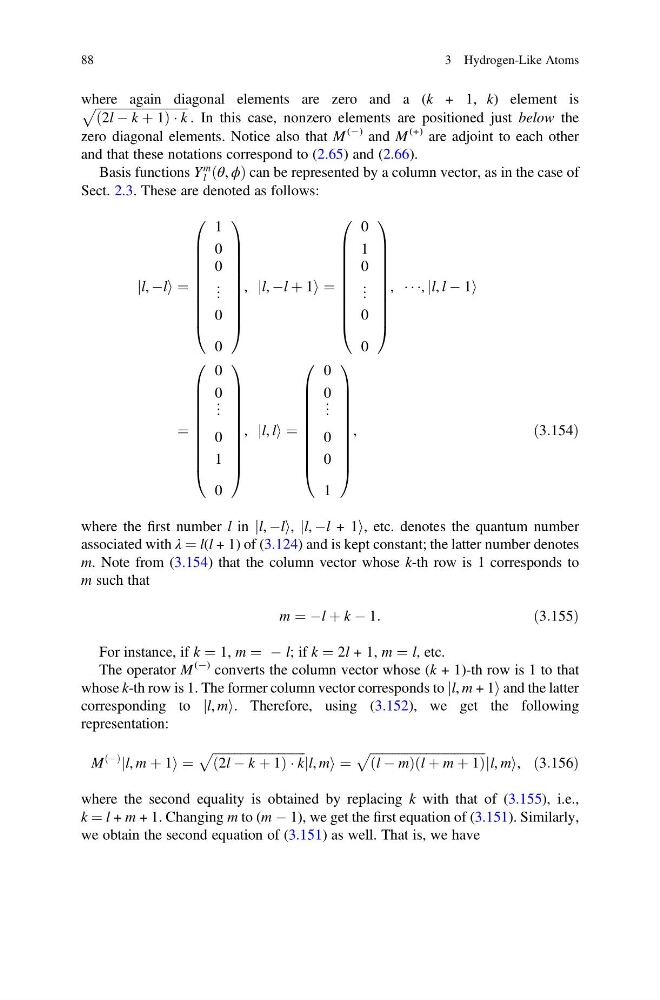
Basis functions Y
m
l θ, ϕ
ð
Þcan be represented by a column vector, as in the case of
Sect. 2.3. These are denoted as follows:
jl, Àli ¼
1
0
0
⋮
0
0
0
B
B
B
B
B
B
B
B
B
@
1
C
C
C
C
C
C
C
C
C
A
, jl, Àl þ 1i ¼
0
1
0
⋮
0
0
0
B
B
B
B
B
B
B
B
B
@
1
C
C
C
C
C
C
C
C
C
A
, Á Á Á, jl, l À 1i
¼
0
0
⋮
0
1
0
0
B
B
B
B
B
B
B
B
B
@
1
C
C
C
C
C
C
C
C
C
A
, jl, li ¼
0
0
⋮
0
0
1
0
B
B
B
B
B
B
B
B
B
@
1
C
C
C
C
C
C
C
C
C
A
,
ð3:154Þ
where the first number l in jl, Àli, jl, Àl + 1i, etc. denotes the quantum number
associated with λ ¼ l(l + 1) of (3.124) and is kept constant; the latter number denotes
m. Note from (3.154) that the column vector whose k-th row is 1 corresponds to
m such that
m ¼ Àl þ k À 1:
ð3:155Þ
For instance, if k ¼ 1, m ¼ À l; if k ¼ 2l + 1, m ¼ l, etc.
The operator M
(À) converts the column vector whose (k + 1)-th row is 1 to that
whose k-th row is 1. The former column vector corresponds to jl, m + 1i and the latter
corresponding to jl, mi. Therefore, using (3.152), we get the following
representation:
M
À
ð Þ
jl, m þ 1i ¼
ffiffiffiffiffiffiffiffiffiffiffiffiffiffiffiffiffiffiffiffiffiffiffiffiffiffiffiffiffi ffi
2l À k þ 1
ð
ÞÁk
p
jl, mi ¼
ffiffiffiffiffiffiffiffiffiffiffiffiffiffiffiffiffiffiffiffiffiffiffiffiffiffiffiffiffiffiffiffiffiffiffiffiffi
l À m
ð
Þ l þ m þ 1
ð
Þ
p
jl, mi, ð3:156Þ
where the second equality is obtained by replacing k with that of (3.155), i.e.,
k ¼ l + m + 1. Changing m to (m À 1), we get the first equation of (3.151). Similarly,
we obtain the second equation of (3.151) as well. That is, we have
88
3 Hydrogen-Like Atoms
ffiffiffiffiffiffiffiffiffiffiffiffiffiffiffiffiffiffiffiffiffiffiffiffiffiffiffiffiffi ffi
2l À k þ 1
ð
ÞÁk
p
. In this case, nonzero elements are positioned just below the
zero diagonal elements. Notice also that M
(À) and M
(+) are adjoint to each other
and that these notations correspond to (2.65) and (2.66).
Basis functions Y
m
l θ, ϕ
ð
Þcan be represented by a column vector, as in the case of
Sect. 2.3. These are denoted as follows:
jl, Àli ¼
1
0
0
⋮
0
0
0
B
B
B
B
B
B
B
B
B
@
1
C
C
C
C
C
C
C
C
C
A
, jl, Àl þ 1i ¼
0
1
0
⋮
0
0
0
B
B
B
B
B
B
B
B
B
@
1
C
C
C
C
C
C
C
C
C
A
, Á Á Á, jl, l À 1i
¼
0
0
⋮
0
1
0
0
B
B
B
B
B
B
B
B
B
@
1
C
C
C
C
C
C
C
C
C
A
, jl, li ¼
0
0
⋮
0
0
1
0
B
B
B
B
B
B
B
B
B
@
1
C
C
C
C
C
C
C
C
C
A
,
ð3:154Þ
where the first number l in jl, Àli, jl, Àl + 1i, etc. denotes the quantum number
associated with λ ¼ l(l + 1) of (3.124) and is kept constant; the latter number denotes
m. Note from (3.154) that the column vector whose k-th row is 1 corresponds to
m such that
m ¼ Àl þ k À 1:
ð3:155Þ
For instance, if k ¼ 1, m ¼ À l; if k ¼ 2l + 1, m ¼ l, etc.
The operator M
(À) converts the column vector whose (k + 1)-th row is 1 to that
whose k-th row is 1. The former column vector corresponds to jl, m + 1i and the latter
corresponding to jl, mi. Therefore, using (3.152), we get the following
representation:
M
À
ð Þ
jl, m þ 1i ¼
ffiffiffiffiffiffiffiffiffiffiffiffiffiffiffiffiffiffiffiffiffiffiffiffiffiffiffiffiffi ffi
2l À k þ 1
ð
ÞÁk
p
jl, mi ¼
ffiffiffiffiffiffiffiffiffiffiffiffiffiffiffiffiffiffiffiffiffiffiffiffiffiffiffiffiffiffiffiffiffiffiffiffiffi
l À m
ð
Þ l þ m þ 1
ð
Þ
p
jl, mi, ð3:156Þ
where the second equality is obtained by replacing k with that of (3.155), i.e.,
k ¼ l + m + 1. Changing m to (m À 1), we get the first equation of (3.151). Similarly,
we obtain the second equation of (3.151) as well. That is, we have
88
3 Hydrogen-Like Atoms