

21.7.2 Alien Plant Control Projects in the Cape Floristic
Region
Most studies addressing the effectiveness of alien plant control measures in
South Africa have been carried out in the Cape Floristic Region (CFR) in the Western
and Eastern Cape provinces. The natural vegetation of the CFR comprises fynbos
shrublands, and the most prominent invasive species are trees and shrubs (Australian
Acacia, Hakea, and Pinus species in particular). Historical costs for control in CFR
protected areas between 1996 and 2015 amounted to ZAR 564 million (2015 values;
van Wilgen et al. 2016), additional amounts spent outside of formally protected areas.
When assessed at the scale of individual projects, there is clear evidence that progress
has been made. Macdonald et al. (1989) recorded marked declines in cover of all alien
species in the Cape of Good Hope Nature Reserve following the implementation of a
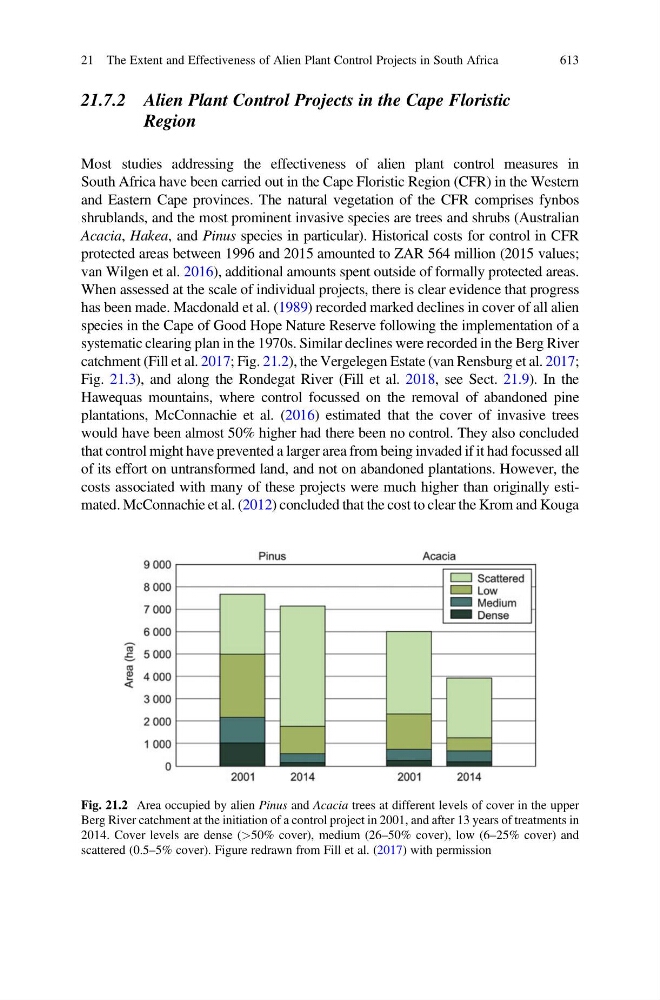
systematic clearing plan in the 1970s. Similar declines were recorded in the Berg River
catchment (Fill et al. 2017; Fig. 21.2), the Vergelegen Estate (van Rensburg et al. 2017;
Fig. 21.3), and along the Rondegat River (Fill et al. 2018, see Sect. 21.9). In the
Hawequas mountains, where control focussed on the removal of abandoned pine
plantations, McConnachie et al. (2016) estimated that the cover of invasive trees
would have been almost 50% higher had there been no control. They also concluded
that control might have prevented a larger area from being invaded if it had focussed all
of its effort on untransformed land, and not on abandoned plantations. However, the
costs associated with many of these projects were much higher than originally estimated. McConnachie et al. (2012) concluded that the cost to clear the Krom and Kouga
Fig. 21.2 Area occupied by alien Pinus and Acacia trees at different levels of cover in the upper
Berg River catchment at the initiation of a control project in 2001, and after 13 years of treatments in
2014. Cover levels are dense (>50% cover), medium (26–50% cover), low (6–25% cover) and
scattered (0.5–5% cover). Figure redrawn from Fill et al. (2017) with permission
21 The Extent and Effectiveness of Alien Plant Control Projects in South Africa
613