

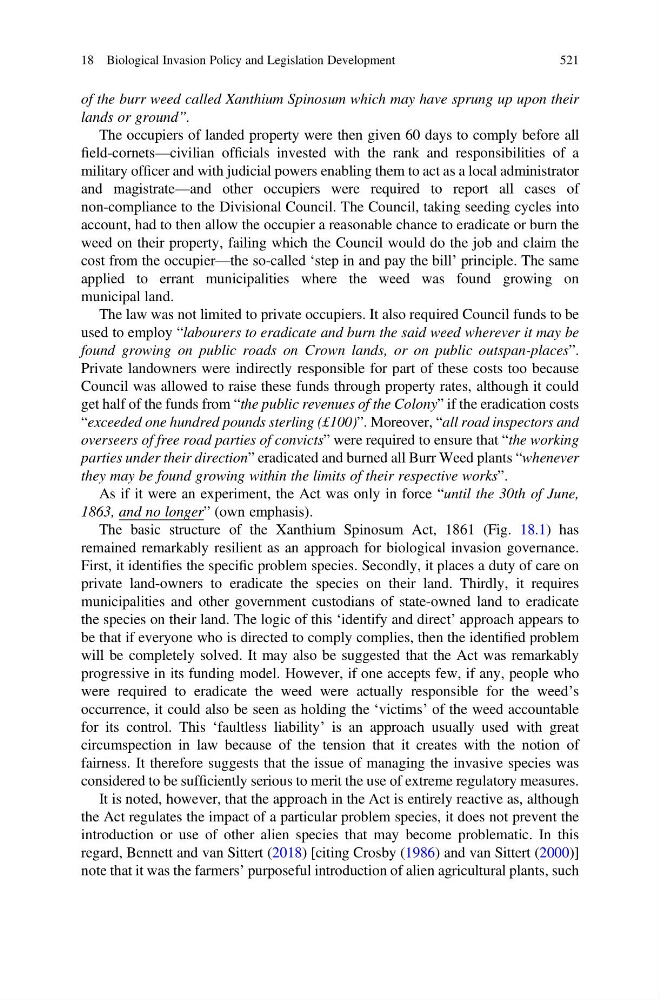
of the burr weed called Xanthium Spinosum which may have sprung up upon their
lands or ground”.
The occupiers of landed property were then given 60 days to comply before all
field-cornets—civilian officials invested with the rank and responsibilities of a
military officer and with judicial powers enabling them to act as a local administrator
and magistrate—and other occupiers were required to report all cases of
non-compliance to the Divisional Council. The Council, taking seeding cycles into
account, had to then allow the occupier a reasonable chance to eradicate or burn the
weed on their property, failing which the Council would do the job and claim the
cost from the occupier—the so-called ‘step in and pay the bill’ principle. The same
applied to errant municipalities where the weed was found growing on
municipal land.
The law was not limited to private occupiers. It also required Council funds to be
used to employ “labourers to eradicate and burn the said weed wherever it may be
found growing on public roads on Crown lands, or on public outspan-places”.
Private landowners were indirectly responsible for part of these costs too because
Council was allowed to raise these funds through property rates, although it could
get half of the funds from “the public revenues of the Colony” if the eradication costs
“exceeded one hundred pounds sterling (£100)”. Moreover, “all road inspectors and
overseers of free road parties of convicts” were required to ensure that “the working
parties under their direction” eradicated and burned all Burr Weed plants “whenever
they may be found growing within the limits of their respective works”.
As if it were an experiment, the Act was only in force “until the 30th of June,
1863, and no longer” (own emphasis).
The basic structure of the Xanthium Spinosum Act, 1861 (Fig. 18.1) has
remained remarkably resilient as an approach for biological invasion governance.
First, it identifies the specific problem species. Secondly, it places a duty of care on
private land-owners to eradicate the species on their land. Thirdly, it requires
municipalities and other government custodians of state-owned land to eradicate
the species on their land. The logic of this ‘identify and direct’ approach appears to
be that if everyone who is directed to comply complies, then the identified problem
will be completely solved. It may also be suggested that the Act was remarkably
progressive in its funding model. However, if one accepts few, if any, people who
were required to eradicate the weed were actually responsible for the weed’s
occurrence, it could also be seen as holding the ‘victims’ of the weed accountable
for its control. This ‘faultless liability’ is an approach usually used with great
circumspection in law because of the tension that it creates with the notion of
fairness. It therefore suggests that the issue of managing the invasive species was
considered to be sufficiently serious to merit the use of extreme regulatory measures.
It is noted, however, that the approach in the Act is entirely reactive as, although
the Act regulates the impact of a particular problem species, it does not prevent the
introduction or use of other alien species that may become problematic. In this
regard, Bennett and van Sittert (2018) [citing Crosby (1986) and van Sittert (2000)]
note that it was the farmers’ purposeful introduction of alien agricultural plants, such
18 Biological Invasion Policy and Legislation Development
521