

Burr Weed” which had spread “to an alarming extent in various parts of the
Colony”. Xanthium spinosum [commonly referred to as Spiny Cocklebur, or
(more archaically) Burr Weed] is a South American annual herbaceous plant with
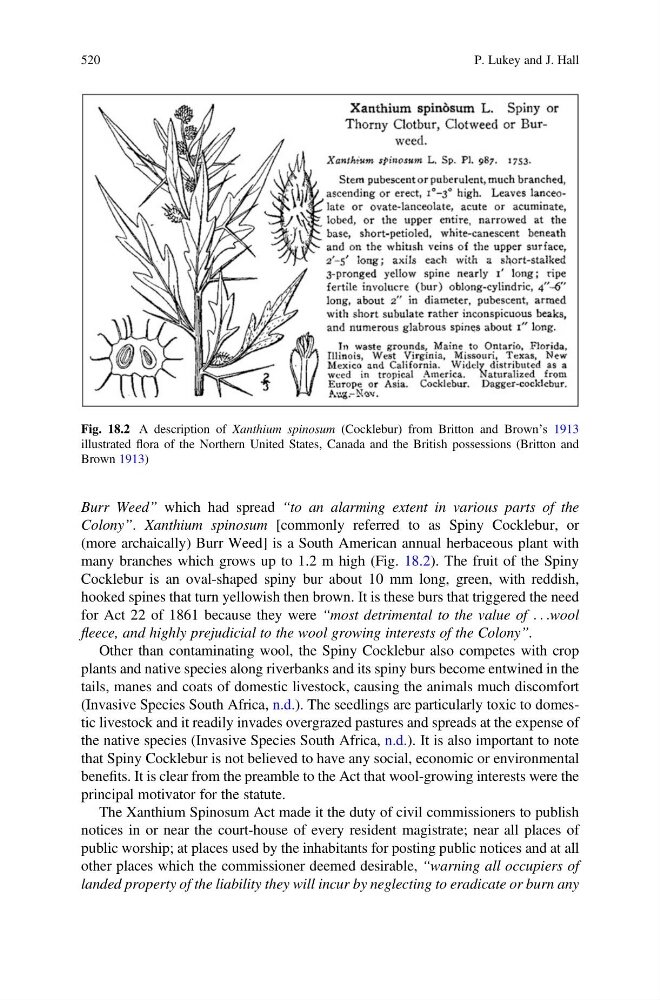
many branches which grows up to 1.2 m high (Fig. 18.2). The fruit of the Spiny
Cocklebur is an oval-shaped spiny bur about 10 mm long, green, with reddish,
hooked spines that turn yellowish then brown. It is these burs that triggered the need
for Act 22 of 1861 because they were “most detrimental to the value of . . .wool
fleece, and highly prejudicial to the wool growing interests of the Colony”.
Other than contaminating wool, the Spiny Cocklebur also competes with crop
plants and native species along riverbanks and its spiny burs become entwined in the
tails, manes and coats of domestic livestock, causing the animals much discomfort
(Invasive Species South Africa, n.d.). The seedlings are particularly toxic to domestic livestock and it readily invades overgrazed pastures and spreads at the expense of
the native species (Invasive Species South Africa, n.d.). It is also important to note
that Spiny Cocklebur is not believed to have any social, economic or environmental
benefits. It is clear from the preamble to the Act that wool-growing interests were the
principal motivator for the statute.
The Xanthium Spinosum Act made it the duty of civil commissioners to publish
notices in or near the court-house of every resident magistrate; near all places of
public worship; at places used by the inhabitants for posting public notices and at all
other places which the commissioner deemed desirable, “warning all occupiers of
landed property of the liability they will incur by neglecting to eradicate or burn any
Fig. 18.2 A description of Xanthium spinosum (Cocklebur) from Britton and Brown’s 1913
illustrated flora of the Northern United States, Canada and the British possessions (Britton and
Brown 1913)
520
P. Lukey and J. Hall