

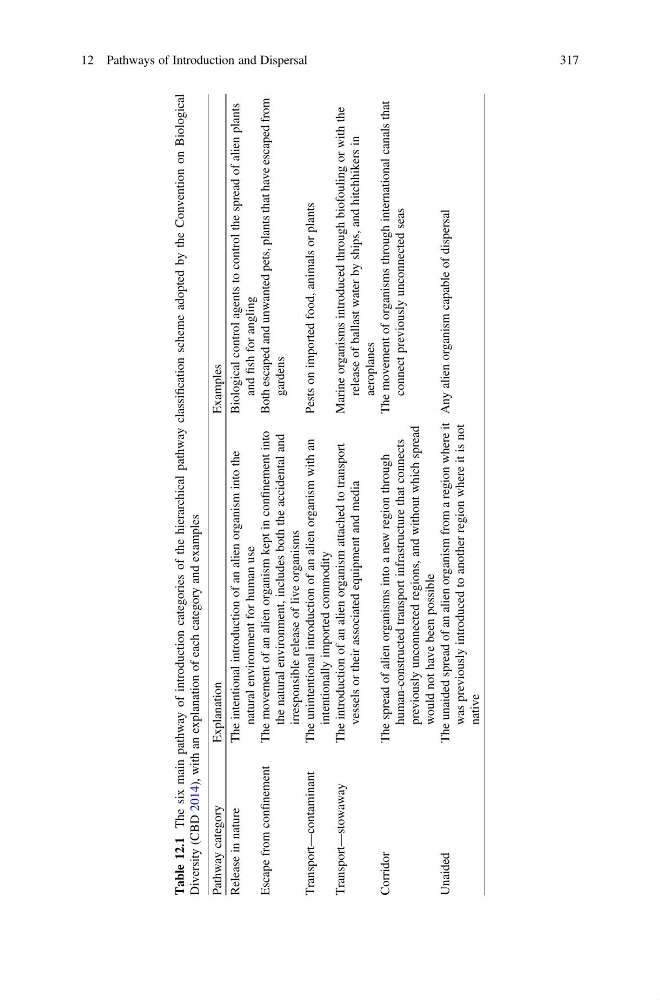
Table 12.1
The six main pathway of introduction categories of the hierarchical pathway classification scheme adopted by the Convention on Biological
Diversity (CBD 2014), with an explanation of each category and examples
Pathway category
Explanation
Examples
Release in nature
The intentional introduction of an alien organism into the
natural environment for human use
Biological control agents to control the spread of alien plants
and
fish for angling
Escape from confinement
The movement of an alien organism kept in confinement into
the natural environment, includes both the accidental and
irresponsible release of live organisms
Both escaped and unwanted pets, plants that have escaped from
gardens
Transport—contaminant
The unintentional introduction of an alien organism with an
intentionally imported commodity
Pests on imported food, animals or plants
Transport—stowaway
The introduction of an alien organism attached to transport
vessels or their associated equipment and media
Marine organisms introduced through biofouling or with the
release of ballast water by ships, and hitchhikers in
aeroplanes
Corridor
The spread of alien organisms into a new region through
human-constructed transport infrastructure that connects
previously unconnected regions, and without which spread
would not have been possible
The movement of organisms through international canals that
connect previously unconnected seas
Unaided
The unaided spread of an alien organism from a region where it
was previously introduced to another region where it is not
native
Any alien organism capable of dispersal
12 Pathways of Introduction and Dispersal
317
The six main pathway of introduction categories of the hierarchical pathway classification scheme adopted by the Convention on Biological
Diversity (CBD 2014), with an explanation of each category and examples
Pathway category
Explanation
Examples
Release in nature
The intentional introduction of an alien organism into the
natural environment for human use
Biological control agents to control the spread of alien plants
and
fish for angling
Escape from confinement
The movement of an alien organism kept in confinement into
the natural environment, includes both the accidental and
irresponsible release of live organisms
Both escaped and unwanted pets, plants that have escaped from
gardens
Transport—contaminant
The unintentional introduction of an alien organism with an
intentionally imported commodity
Pests on imported food, animals or plants
Transport—stowaway
The introduction of an alien organism attached to transport
vessels or their associated equipment and media
Marine organisms introduced through biofouling or with the
release of ballast water by ships, and hitchhikers in
aeroplanes
Corridor
The spread of alien organisms into a new region through
human-constructed transport infrastructure that connects
previously unconnected regions, and without which spread
would not have been possible
The movement of organisms through international canals that
connect previously unconnected seas
Unaided
The unaided spread of an alien organism from a region where it
was previously introduced to another region where it is not
native
Any alien organism capable of dispersal
12 Pathways of Introduction and Dispersal
317