

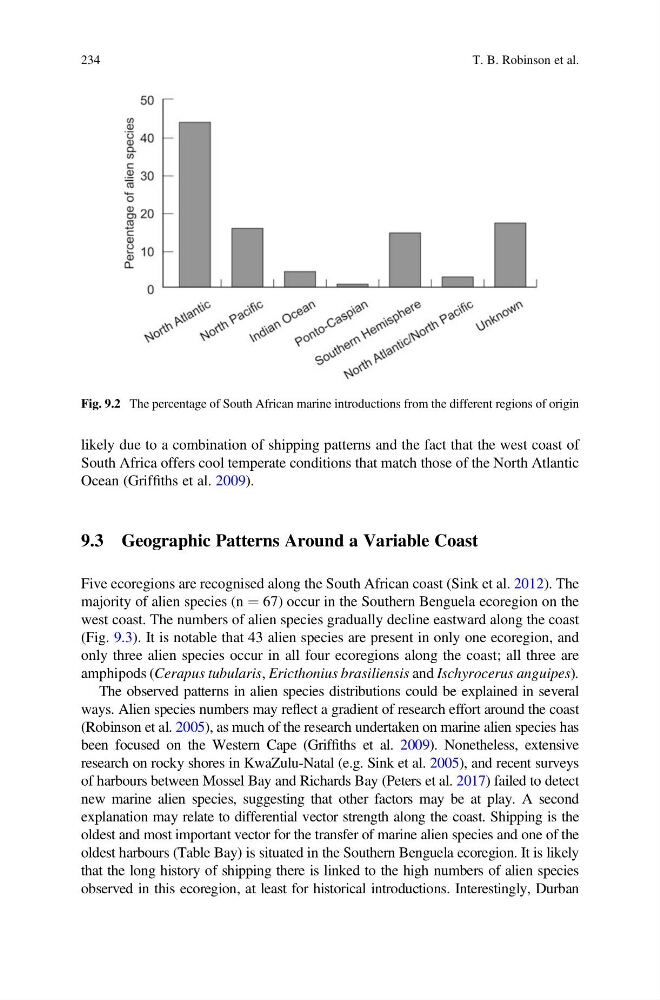
likely due to a combination of shipping patterns and the fact that the west coast of
South Africa offers cool temperate conditions that match those of the North Atlantic
Ocean (Griffiths et al. 2009).
9.3 Geographic Patterns Around a Variable Coast
Five ecoregions are recognised along the South African coast (Sink et al. 2012). The
majority of alien species (n ¼ 67) occur in the Southern Benguela ecoregion on the
west coast. The numbers of alien species gradually decline eastward along the coast
(Fig. 9.3). It is notable that 43 alien species are present in only one ecoregion, and
only three alien species occur in all four ecoregions along the coast; all three are
amphipods (Cerapus tubularis, Ericthonius brasiliensis and Ischyrocerus anguipes).
The observed patterns in alien species distributions could be explained in several
ways. Alien species numbers may reflect a gradient of research effort around the coast
(Robinson et al. 2005), as much of the research undertaken on marine alien species has
been focused on the Western Cape (Griffiths et al. 2009). Nonetheless, extensive
research on rocky shores in KwaZulu-Natal (e.g. Sink et al. 2005), and recent surveys
of harbours between Mossel Bay and Richards Bay (Peters et al. 2017) failed to detect
new marine alien species, suggesting that other factors may be at play. A second
explanation may relate to differential vector strength along the coast. Shipping is the
oldest and most important vector for the transfer of marine alien species and one of the
oldest harbours (Table Bay) is situated in the Southern Benguela ecoregion. It is likely
that the long history of shipping there is linked to the high numbers of alien species
observed in this ecoregion, at least for historical introductions. Interestingly, Durban
Fig. 9.2 The percentage of South African marine introductions from the different regions of origin
234
T. B. Robinson et al.
South Africa offers cool temperate conditions that match those of the North Atlantic
Ocean (Griffiths et al. 2009).
9.3 Geographic Patterns Around a Variable Coast
Five ecoregions are recognised along the South African coast (Sink et al. 2012). The
majority of alien species (n ¼ 67) occur in the Southern Benguela ecoregion on the
west coast. The numbers of alien species gradually decline eastward along the coast
(Fig. 9.3). It is notable that 43 alien species are present in only one ecoregion, and
only three alien species occur in all four ecoregions along the coast; all three are
amphipods (Cerapus tubularis, Ericthonius brasiliensis and Ischyrocerus anguipes).
The observed patterns in alien species distributions could be explained in several
ways. Alien species numbers may reflect a gradient of research effort around the coast
(Robinson et al. 2005), as much of the research undertaken on marine alien species has
been focused on the Western Cape (Griffiths et al. 2009). Nonetheless, extensive
research on rocky shores in KwaZulu-Natal (e.g. Sink et al. 2005), and recent surveys
of harbours between Mossel Bay and Richards Bay (Peters et al. 2017) failed to detect
new marine alien species, suggesting that other factors may be at play. A second
explanation may relate to differential vector strength along the coast. Shipping is the
oldest and most important vector for the transfer of marine alien species and one of the
oldest harbours (Table Bay) is situated in the Southern Benguela ecoregion. It is likely
that the long history of shipping there is linked to the high numbers of alien species
observed in this ecoregion, at least for historical introductions. Interestingly, Durban
Fig. 9.2 The percentage of South African marine introductions from the different regions of origin
234
T. B. Robinson et al.