

meant that sealing became unprofitable and that human traffic to the islands became
infrequent (Cooper 2008). In the austral summer of 1947/1948, the PEIs were
annexed by the South African Government, and a meteorological station, which,
in subsequent years was replaced by larger research stations, were established on
Marion Island. A permanent human presence has been maintained on the island
since then (Cooper 2008). The PEIs are currently designated as a Special Nature
Reserve, which means that it is reserved for research and conservation management
activities under permit only; tourist activities are not permitted on either of the
islands (Republic of South Africa 2004). Marion Island currently has a permanent
contingent of about 20–25 people living on the island for 13 months at a time. Island
stocks are usually replenished once a year during April/May, when annual teams are
replaced. During this time, additional personnel and scientists visit the island, so that
the number of people on the island increases to approximately 80. In contrast, visits
to Prince Edward Island are allowed only once every 4 years in terms of the islands’
management plan (Department of Environmental Affairs Directorate: Antarctica and
Islands 2010). As a consequence, Prince Edward Island supports significantly fewer
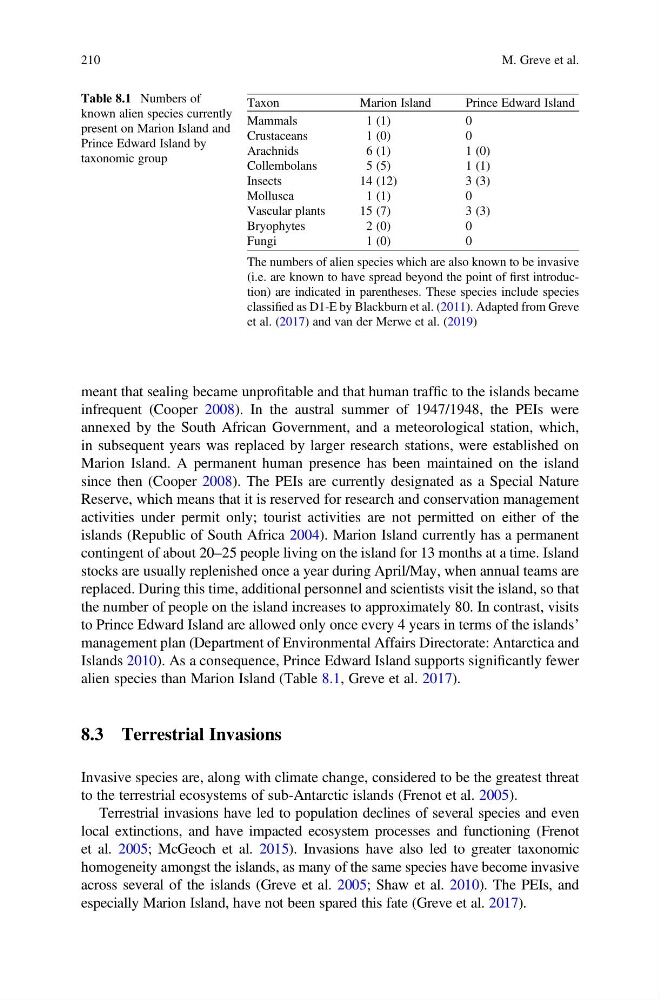
alien species than Marion Island (Table 8.1, Greve et al. 2017).
8.3 Terrestrial Invasions
Invasive species are, along with climate change, considered to be the greatest threat
to the terrestrial ecosystems of sub-Antarctic islands (Frenot et al. 2005).
Terrestrial invasions have led to population declines of several species and even
local extinctions, and have impacted ecosystem processes and functioning (Frenot
et al. 2005; McGeoch et al. 2015). Invasions have also led to greater taxonomic
homogeneity amongst the islands, as many of the same species have become invasive
across several of the islands (Greve et al. 2005; Shaw et al. 2010). The PEIs, and
especially Marion Island, have not been spared this fate (Greve et al. 2017).
Table 8.1 Numbers of
known alien species currently
present on Marion Island and
Prince Edward Island by
taxonomic group
Taxon
Marion Island
Prince Edward Island
Mammals
1 (1)
0
Crustaceans
1 (0)
0
Arachnids
6 (1)
1 (0)
Collembolans
5 (5)
1 (1)
Insects
14 (12)
3 (3)
Mollusca
1 (1)
0
Vascular plants
15 (7)
3 (3)
Bryophytes
2 (0)
0
Fungi
1 (0)
0
The numbers of alien species which are also known to be invasive
(i.e. are known to have spread beyond the point of first introduction) are indicated in parentheses. These species include species
classified as D1-E by Blackburn et al. (2011). Adapted from Greve
et al. (2017) and van der Merwe et al. (2019)
210
M. Greve et al.
infrequent (Cooper 2008). In the austral summer of 1947/1948, the PEIs were
annexed by the South African Government, and a meteorological station, which,
in subsequent years was replaced by larger research stations, were established on
Marion Island. A permanent human presence has been maintained on the island
since then (Cooper 2008). The PEIs are currently designated as a Special Nature
Reserve, which means that it is reserved for research and conservation management
activities under permit only; tourist activities are not permitted on either of the
islands (Republic of South Africa 2004). Marion Island currently has a permanent
contingent of about 20–25 people living on the island for 13 months at a time. Island
stocks are usually replenished once a year during April/May, when annual teams are
replaced. During this time, additional personnel and scientists visit the island, so that
the number of people on the island increases to approximately 80. In contrast, visits
to Prince Edward Island are allowed only once every 4 years in terms of the islands’
management plan (Department of Environmental Affairs Directorate: Antarctica and
Islands 2010). As a consequence, Prince Edward Island supports significantly fewer
alien species than Marion Island (Table 8.1, Greve et al. 2017).
8.3 Terrestrial Invasions
Invasive species are, along with climate change, considered to be the greatest threat
to the terrestrial ecosystems of sub-Antarctic islands (Frenot et al. 2005).
Terrestrial invasions have led to population declines of several species and even
local extinctions, and have impacted ecosystem processes and functioning (Frenot
et al. 2005; McGeoch et al. 2015). Invasions have also led to greater taxonomic
homogeneity amongst the islands, as many of the same species have become invasive
across several of the islands (Greve et al. 2005; Shaw et al. 2010). The PEIs, and
especially Marion Island, have not been spared this fate (Greve et al. 2017).
Table 8.1 Numbers of
known alien species currently
present on Marion Island and
Prince Edward Island by
taxonomic group
Taxon
Marion Island
Prince Edward Island
Mammals
1 (1)
0
Crustaceans
1 (0)
0
Arachnids
6 (1)
1 (0)
Collembolans
5 (5)
1 (1)
Insects
14 (12)
3 (3)
Mollusca
1 (1)
0
Vascular plants
15 (7)
3 (3)
Bryophytes
2 (0)
0
Fungi
1 (0)
0
The numbers of alien species which are also known to be invasive
(i.e. are known to have spread beyond the point of first introduction) are indicated in parentheses. These species include species
classified as D1-E by Blackburn et al. (2011). Adapted from Greve
et al. (2017) and van der Merwe et al. (2019)
210
M. Greve et al.