

in this region, and novel insights were generated under his leadership both on
invasions and the ecosystems studied more generally. For example, Chown and
Froneman (2008) published an overview of the structure, functioning and interactions of marine and terrestrial systems at the Prince Edward Islands. The overview
demonstrated how global challenges (including climate change, biological invasions, and over-exploitation) are playing out at regional and local levels in the
Southern Ocean. Chown left the CÁIÁB and emigrated to Australia in 2013, where
he took up a position as head of the School of Biological Sciences at Monash
University.
Prof. David Richardson (Fig. 2.13) was initially the Deputy-Director of the CÁIÁB,
and became Director in 2013. Initially, Richardson’s research was on invasive trees
and shrubs in the Fynbos Biome, but his interests have broadened considerably and
now encompass the full range of invasion science. As of mid-2019 he has published
355 papers in peer-reviewed journals, contributed to 69 chapters in 42 scientific
books, and edited or co-authored 8 scientific books. His work has been cited over
54,000 times, with an h-index of 112 on Google Scholar. Many of his efforts have
brought together prominent invasion scientists from around the globe, creating
significant opportunities to advance invasion science internationally. For example,
he arranged an international symposium that brought together leading scientists to
review the field in 2008. The symposium marked the 50th anniversary of the
publication in 1958 of the British ecologist Charles Elton’s seminal book “The
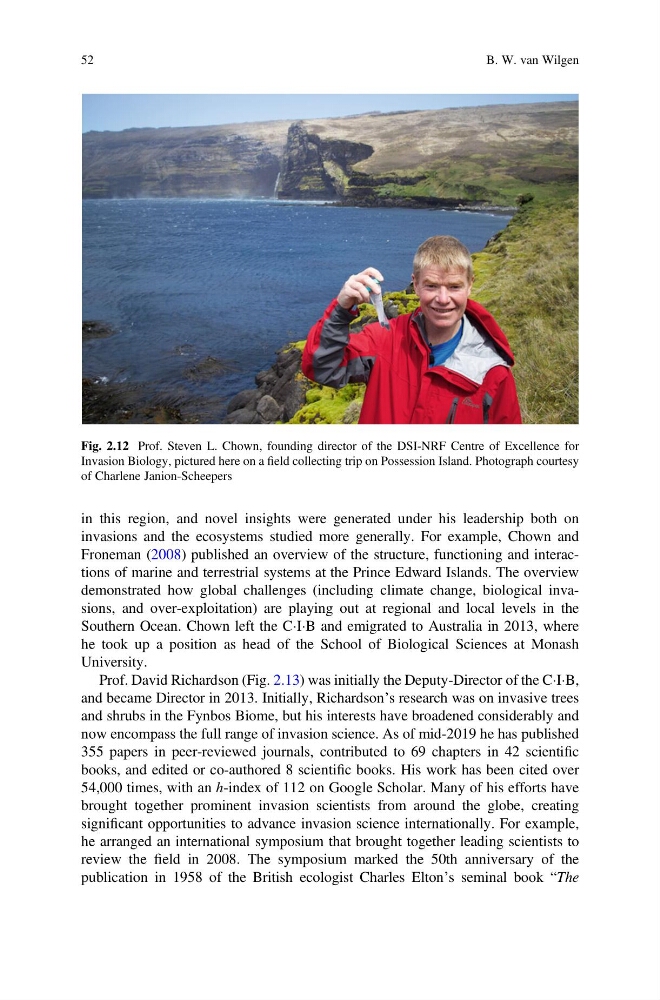
Fig. 2.12 Prof. Steven L. Chown, founding director of the DSI-NRF Centre of Excellence for
Invasion Biology, pictured here on a field collecting trip on Possession Island. Photograph courtesy
of Charlene Janion-Scheepers
52
B. W. van Wilgen
invasions and the ecosystems studied more generally. For example, Chown and
Froneman (2008) published an overview of the structure, functioning and interactions of marine and terrestrial systems at the Prince Edward Islands. The overview
demonstrated how global challenges (including climate change, biological invasions, and over-exploitation) are playing out at regional and local levels in the
Southern Ocean. Chown left the CÁIÁB and emigrated to Australia in 2013, where
he took up a position as head of the School of Biological Sciences at Monash
University.
Prof. David Richardson (Fig. 2.13) was initially the Deputy-Director of the CÁIÁB,
and became Director in 2013. Initially, Richardson’s research was on invasive trees
and shrubs in the Fynbos Biome, but his interests have broadened considerably and
now encompass the full range of invasion science. As of mid-2019 he has published
355 papers in peer-reviewed journals, contributed to 69 chapters in 42 scientific
books, and edited or co-authored 8 scientific books. His work has been cited over
54,000 times, with an h-index of 112 on Google Scholar. Many of his efforts have
brought together prominent invasion scientists from around the globe, creating
significant opportunities to advance invasion science internationally. For example,
he arranged an international symposium that brought together leading scientists to
review the field in 2008. The symposium marked the 50th anniversary of the
publication in 1958 of the British ecologist Charles Elton’s seminal book “The
Fig. 2.12 Prof. Steven L. Chown, founding director of the DSI-NRF Centre of Excellence for
Invasion Biology, pictured here on a field collecting trip on Possession Island. Photograph courtesy
of Charlene Janion-Scheepers
52
B. W. van Wilgen