

cooperation (e.g. Hoffmann and Moran 1998; Moran et al. 2005) in a partnership
that has been sustained for more than four decades.
2.2.2 Establishment of the Centre for Biological Control
In 2002, stakeholders in teaching, research and implementation of biological control
at Rhodes University combined as an informal research team—the Biological
Control Research Group—where work began on biologically-based techniques
against threats to agriculture, animals and humans. This group continued to grow
and on 2 November 2017, the Centre for Biological Control (CBC) was officially
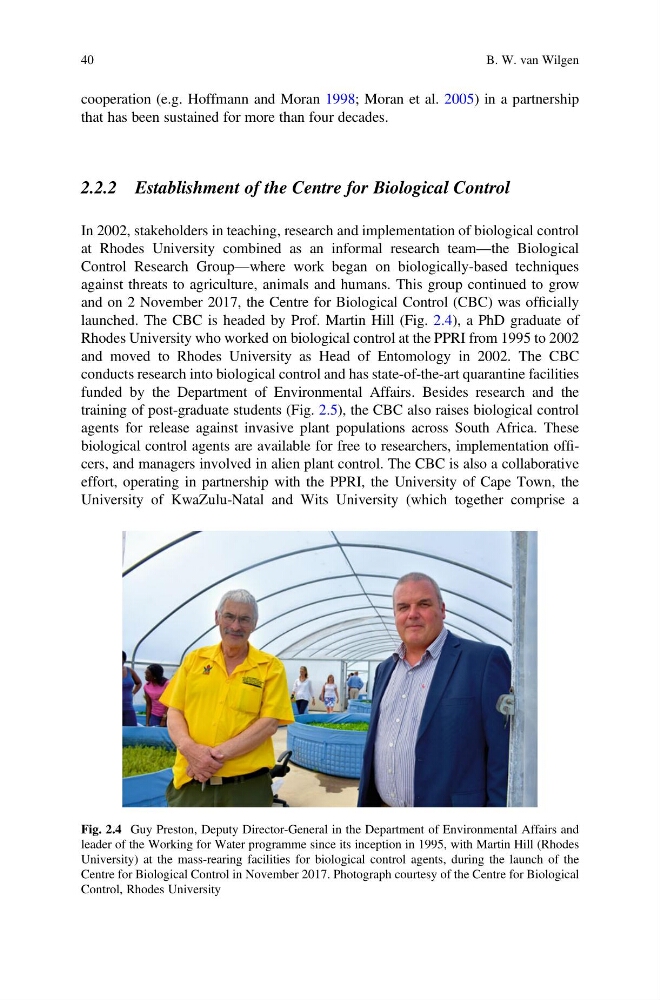
launched. The CBC is headed by Prof. Martin Hill (Fig. 2.4), a PhD graduate of
Rhodes University who worked on biological control at the PPRI from 1995 to 2002
and moved to Rhodes University as Head of Entomology in 2002. The CBC
conducts research into biological control and has state-of-the-art quarantine facilities
funded by the Department of Environmental Affairs. Besides research and the
training of post-graduate students (Fig. 2.5), the CBC also raises biological control
agents for release against invasive plant populations across South Africa. These
biological control agents are available for free to researchers, implementation officers, and managers involved in alien plant control. The CBC is also a collaborative
effort, operating in partnership with the PPRI, the University of Cape Town, the
University of KwaZulu-Natal and Wits University (which together comprise a
Fig. 2.4 Guy Preston, Deputy Director-General in the Department of Environmental Affairs and
leader of the Working for Water programme since its inception in 1995, with Martin Hill (Rhodes
University) at the mass-rearing facilities for biological control agents, during the launch of the
Centre for Biological Control in November 2017. Photograph courtesy of the Centre for Biological
Control, Rhodes University
40
B. W. van Wilgen
that has been sustained for more than four decades.
2.2.2 Establishment of the Centre for Biological Control
In 2002, stakeholders in teaching, research and implementation of biological control
at Rhodes University combined as an informal research team—the Biological
Control Research Group—where work began on biologically-based techniques
against threats to agriculture, animals and humans. This group continued to grow
and on 2 November 2017, the Centre for Biological Control (CBC) was officially
launched. The CBC is headed by Prof. Martin Hill (Fig. 2.4), a PhD graduate of
Rhodes University who worked on biological control at the PPRI from 1995 to 2002
and moved to Rhodes University as Head of Entomology in 2002. The CBC
conducts research into biological control and has state-of-the-art quarantine facilities
funded by the Department of Environmental Affairs. Besides research and the
training of post-graduate students (Fig. 2.5), the CBC also raises biological control
agents for release against invasive plant populations across South Africa. These
biological control agents are available for free to researchers, implementation officers, and managers involved in alien plant control. The CBC is also a collaborative
effort, operating in partnership with the PPRI, the University of Cape Town, the
University of KwaZulu-Natal and Wits University (which together comprise a
Fig. 2.4 Guy Preston, Deputy Director-General in the Department of Environmental Affairs and
leader of the Working for Water programme since its inception in 1995, with Martin Hill (Rhodes
University) at the mass-rearing facilities for biological control agents, during the launch of the
Centre for Biological Control in November 2017. Photograph courtesy of the Centre for Biological
Control, Rhodes University
40
B. W. van Wilgen