

3.4 Vibrating Rotor
63
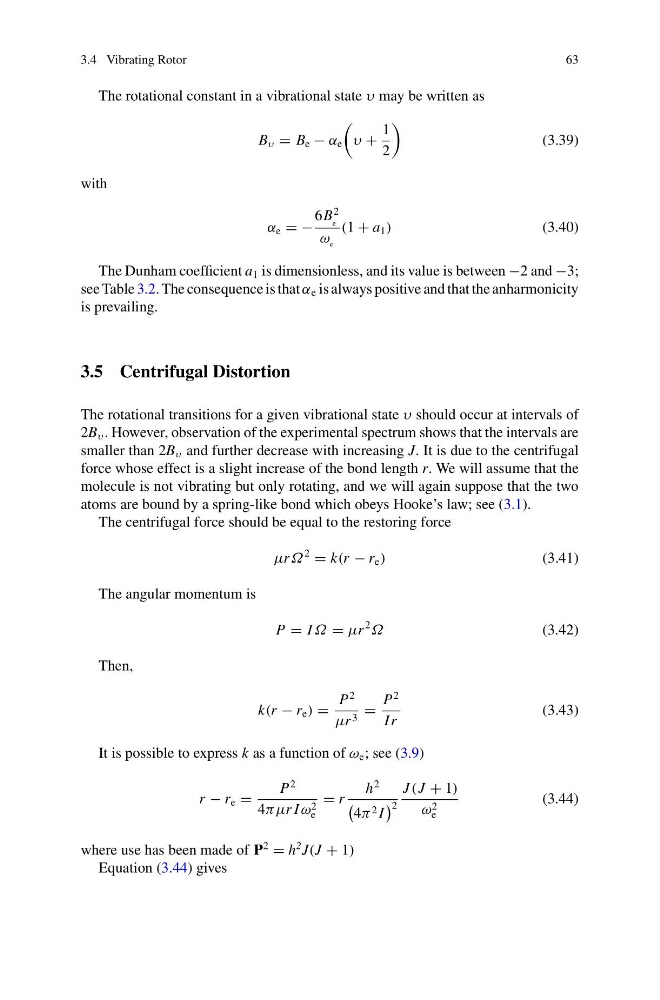
The rotational constant in a vibrational state υ may be written as
B υ = B e − α e
υ +
1
2
(3.39)
with
α e = −
6B
2
e
ω e
(1 + a 1 )
(3.40)
The Dunham coefficient a 1 is dimensionless, and its value is between −2 and −3;
see Table 3.2. The consequence is that α e is always positive and that the anharmonicity
is prevailing.
3.5 Centrifugal Distortion
The rotational transitions for a given vibrational state υ should occur at intervals of
2B υ . However, observation of the experimental spectrum shows that the intervals are
smaller than 2B υ and further decrease with increasing J. It is due to the centrifugal
force whose effect is a slight increase of the bond length r. We will assume that the
molecule is not vibrating but only rotating, and we will again suppose that the two
atoms are bound by a spring-like bond which obeys Hooke’s law; see (3.1).
The centrifugal force should be equal to the restoring force
μr Ω
2
= k(r − r e )
(3.41)
The angular momentum is
P = I Ω = μr
2
Ω
(3.42)
Then,
k(r − r e ) =
P
2
μr 3 =
P
2
Ir
(3.43)
It is possible to express k as a function of ω e ; see (3.9)
r − r e =
P
2
4πμr I ω 2
e
= r
h
2
4π 2 I
2
J (J + 1)
ω 2
e
(3.44)
where use has been made of P
2
= h
2 J(J + 1)
Equation (3.44) gives
63
The rotational constant in a vibrational state υ may be written as
B υ = B e − α e
υ +
1
2
(3.39)
with
α e = −
6B
2
e
ω e
(1 + a 1 )
(3.40)
The Dunham coefficient a 1 is dimensionless, and its value is between −2 and −3;
see Table 3.2. The consequence is that α e is always positive and that the anharmonicity
is prevailing.
3.5 Centrifugal Distortion
The rotational transitions for a given vibrational state υ should occur at intervals of
2B υ . However, observation of the experimental spectrum shows that the intervals are
smaller than 2B υ and further decrease with increasing J. It is due to the centrifugal
force whose effect is a slight increase of the bond length r. We will assume that the
molecule is not vibrating but only rotating, and we will again suppose that the two
atoms are bound by a spring-like bond which obeys Hooke’s law; see (3.1).
The centrifugal force should be equal to the restoring force
μr Ω
2
= k(r − r e )
(3.41)
The angular momentum is
P = I Ω = μr
2
Ω
(3.42)
Then,
k(r − r e ) =
P
2
μr 3 =
P
2
Ir
(3.43)
It is possible to express k as a function of ω e ; see (3.9)
r − r e =
P
2
4πμr I ω 2
e
= r
h
2
4π 2 I
2
J (J + 1)
ω 2
e
(3.44)
where use has been made of P
2
= h
2 J(J + 1)
Equation (3.44) gives