

62
3 Diatomic Molecules
To calculate the energy, one can use the virial theorem, which says that, for a
quadratic potential T = =V where T is the kinetic energy. Then,
E T = T + V = 2V
(3.32)
and
V =
1
2
k
(r − r e )
2
υ
=
r
2
e k
2
ξ
2
υ
= a 0
ξ
2
υ
(3.33)
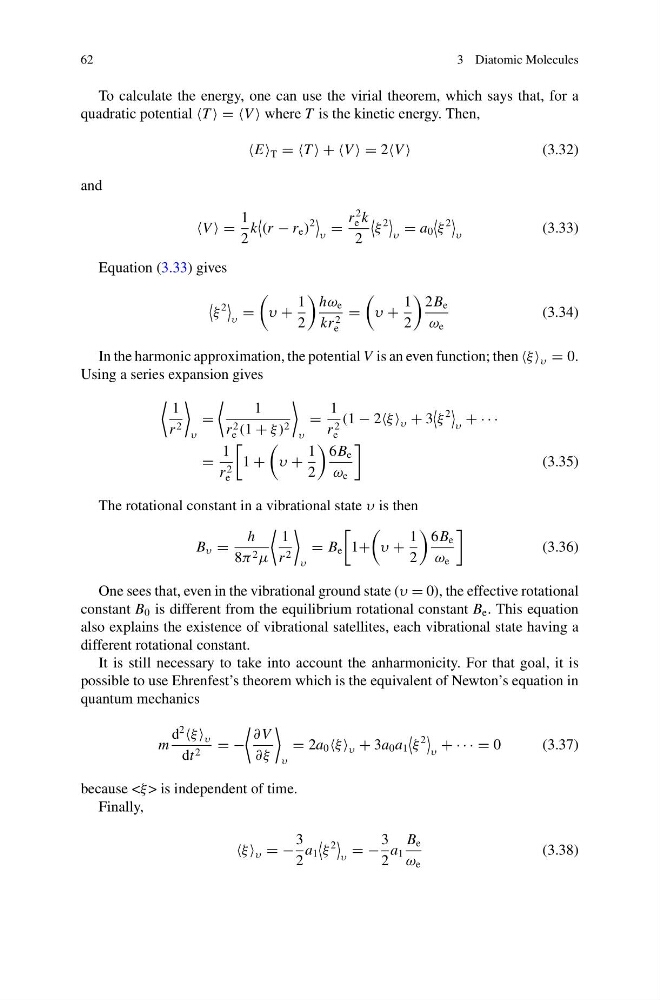
Equation (3.33) gives
ξ
2
υ
=
υ +
1
2
hω e
kr 2
e
=
υ +
1
2
2B e
ω e
(3.34)
In the harmonic approximation, the potential V is an even function; then ξ υ = 0.
Using a series expansion gives
1
r 2
υ
=
1
r 2
e (1 + ξ) 2
υ
=
1
r 2
e
(1 − 2ξ υ + 3
ξ
2
υ
+ · · ·
=
1
r 2
e
1 +
υ +
1
2
6B e
ω e
(3.35)
The rotational constant in a vibrational state υ is then
B υ =
h
8π 2 μ
1
r 2
υ
= B e
1+
υ +
1
2
6B e
ω e
(3.36)
One sees that, even in the vibrational ground state (υ = 0), the effective rotational
constant B 0 is different from the equilibrium rotational constant B e . This equation
also explains the existence of vibrational satellites, each vibrational state having a
different rotational constant.
It is still necessary to take into account the anharmonicity. For that goal, it is
possible to use Ehrenfest’s theorem which is the equivalent of Newton’s equation in
quantum mechanics
m
d
2
ξ υ
dt 2 = −
∂ V
∂ξ
υ
= 2a 0 ξ υ + 3a 0 a 1
ξ
2
υ
+ · · · = 0
(3.37)
because <ξ > is independent of time.
Finally,
ξ υ = −
3
2
a 1
ξ
2
υ
= −
3
2
a 1
B e
ω e
(3.38)
3 Diatomic Molecules
To calculate the energy, one can use the virial theorem, which says that, for a
quadratic potential T = =V where T is the kinetic energy. Then,
E T = T + V = 2V
(3.32)
and
V =
1
2
k
(r − r e )
2
υ
=
r
2
e k
2
ξ
2
υ
= a 0
ξ
2
υ
(3.33)
Equation (3.33) gives
ξ
2
υ
=
υ +
1
2
hω e
kr 2
e
=
υ +
1
2
2B e
ω e
(3.34)
In the harmonic approximation, the potential V is an even function; then ξ υ = 0.
Using a series expansion gives
1
r 2
υ
=
1
r 2
e (1 + ξ) 2
υ
=
1
r 2
e
(1 − 2ξ υ + 3
ξ
2
υ
+ · · ·
=
1
r 2
e
1 +
υ +
1
2
6B e
ω e
(3.35)
The rotational constant in a vibrational state υ is then
B υ =
h
8π 2 μ
1
r 2
υ
= B e
1+
υ +
1
2
6B e
ω e
(3.36)
One sees that, even in the vibrational ground state (υ = 0), the effective rotational
constant B 0 is different from the equilibrium rotational constant B e . This equation
also explains the existence of vibrational satellites, each vibrational state having a
different rotational constant.
It is still necessary to take into account the anharmonicity. For that goal, it is
possible to use Ehrenfest’s theorem which is the equivalent of Newton’s equation in
quantum mechanics
m
d
2
ξ υ
dt 2 = −
∂ V
∂ξ
υ
= 2a 0 ξ υ + 3a 0 a 1
ξ
2
υ
+ · · · = 0
(3.37)
because <ξ > is independent of time.
Finally,
ξ υ = −
3
2
a 1
ξ
2
υ
= −
3
2
a 1
B e
ω e
(3.38)