

2.19 Appendices
43
2.19 Appendices
2.19.1 Ratio of the Magnitudes of the Gravitational
and Electrostatic Forces Between a Proton and an Electron
(All Values in SI Units)
Electrostatic force:
F el =
1
4πε 0
e
2
r 2 = 8.99 × 10
9
1.6 × 10
−19
2
r 2
(2.52)
Gravitational force:
F g = G
m e M p
r 2 = 6.67 × 10
−11
9.11 × 10
−31
1.672 × 10
−27
r 2
(2.53)
⇒
F el
F g
= 2.3 × 10
39
(2.54)
2.19.2 Nuclear Size
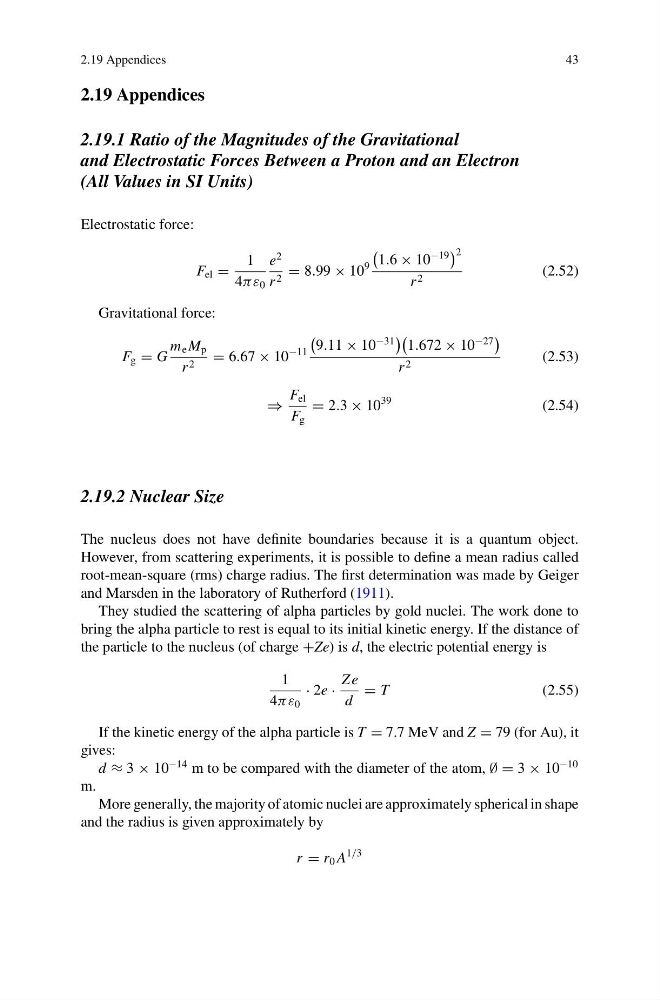
The nucleus does not have definite boundaries because it is a quantum object.
However, from scattering experiments, it is possible to define a mean radius called
root-mean-square (rms) charge radius. The first determination was made by Geiger
and Marsden in the laboratory of Rutherford (1911).
They studied the scattering of alpha particles by gold nuclei. The work done to
bring the alpha particle to rest is equal to its initial kinetic energy. If the distance of
the particle to the nucleus (of charge +Ze) is d, the electric potential energy is
1
4πε 0
· 2e ·
Ze
d
= T
(2.55)
If the kinetic energy of the alpha particle is T = 7.7 MeV and Z = 79 (for Au), it
gives:
d ≈ 3 × 10
−14 m to be compared with the diameter of the atom, ∅ = 3 × 10
−10
m.
More generally, the majority of atomic nuclei are approximately spherical in shape
and the radius is given approximately by
r = r 0 A
1/3
43
2.19 Appendices
2.19.1 Ratio of the Magnitudes of the Gravitational
and Electrostatic Forces Between a Proton and an Electron
(All Values in SI Units)
Electrostatic force:
F el =
1
4πε 0
e
2
r 2 = 8.99 × 10
9
1.6 × 10
−19
2
r 2
(2.52)
Gravitational force:
F g = G
m e M p
r 2 = 6.67 × 10
−11
9.11 × 10
−31
1.672 × 10
−27
r 2
(2.53)
⇒
F el
F g
= 2.3 × 10
39
(2.54)
2.19.2 Nuclear Size
The nucleus does not have definite boundaries because it is a quantum object.
However, from scattering experiments, it is possible to define a mean radius called
root-mean-square (rms) charge radius. The first determination was made by Geiger
and Marsden in the laboratory of Rutherford (1911).
They studied the scattering of alpha particles by gold nuclei. The work done to
bring the alpha particle to rest is equal to its initial kinetic energy. If the distance of
the particle to the nucleus (of charge +Ze) is d, the electric potential energy is
1
4πε 0
· 2e ·
Ze
d
= T
(2.55)
If the kinetic energy of the alpha particle is T = 7.7 MeV and Z = 79 (for Au), it
gives:
d ≈ 3 × 10
−14 m to be compared with the diameter of the atom, ∅ = 3 × 10
−10
m.
More generally, the majority of atomic nuclei are approximately spherical in shape
and the radius is given approximately by
r = r 0 A
1/3