

42
2 Computational Methods
the increasing coordination number of the central atom because of the ligand–ligand
repulsion as will be further explained in Sect. 8.4.
It is also possible to define the following useful parameters
• The bonding radius r b is the distance from the bond critical point to the nucleus.
It is identical to the covalent radius for homonuclear diatomic molecules and it is
a well-defined property, contrary to the covalent radius see also Sect. 8.2.1.
• The atomic charge q. It is simply the charge of the nucleus, Z, minus the electron
population. The latter quantity is obtained by integrating ρ over the atomic basin
(zero-flux surface in the gradient vector field of ρ). Note, however, that Badercharge values exaggerate the atomic charges (Maslen and Spackman 1985). A
critical review of the different methods used to estimate atomic partial charges
may be found in Meister and Schwarz (1994). The problem of deriving atomic
charges from the results of ab initio calculations has been studied by many authors.
A recent example is by Wiberg and Rablen (2018). See also Sect. 8.6.7.
• The bond ellipticity ε provides a measure of the extent to which the charge is
preferentially accumulated at different angles in a given plane perpendicular to
the bond path and, for this reason, is a measure of the π-character of bond. It
is defined from the eigenvalues, λ 1 < λ 2 < λ 3 , of the Hessian of ρ at the bond
critical point (the Hessian is the 3×3 matrix of second-order partial derivatives,
∂
2
ρ/∂x∂y, …)
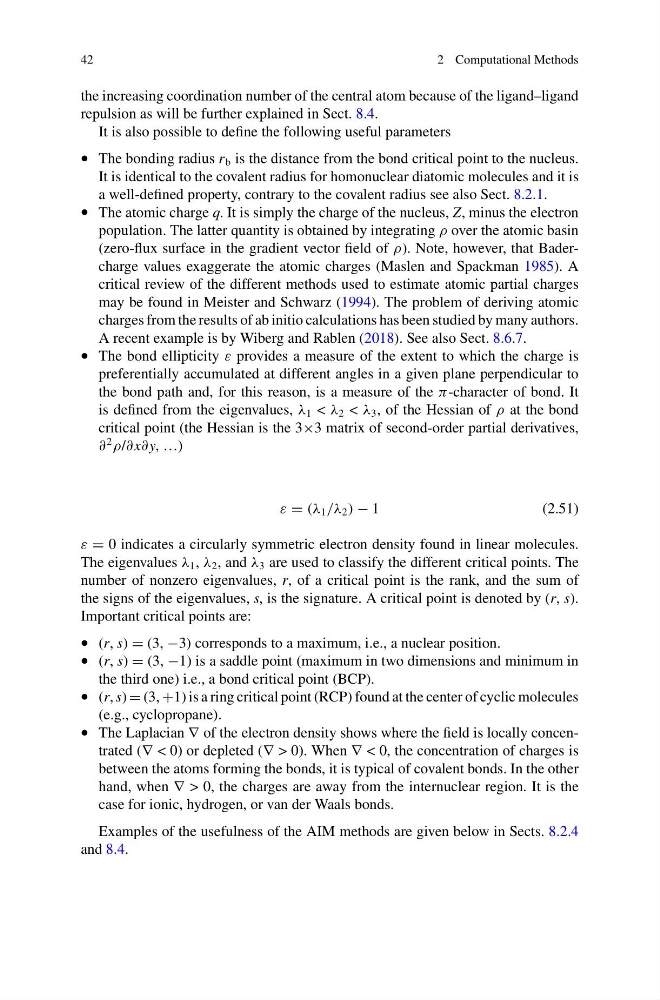
ε = (λ 1 /λ 2 ) − 1
(2.51)
ε = 0 indicates a circularly symmetric electron density found in linear molecules.
The eigenvalues λ 1 , λ 2 , and λ 3 are used to classify the different critical points. The
number of nonzero eigenvalues, r, of a critical point is the rank, and the sum of
the signs of the eigenvalues, s, is the signature. A critical point is denoted by (r, s).
Important critical points are:
• (r, s) = (3, −3) corresponds to a maximum, i.e., a nuclear position.
• (r, s) = (3, −1) is a saddle point (maximum in two dimensions and minimum in
the third one) i.e., a bond critical point (BCP).
• (r, s) = (3, +1) is a ring critical point (RCP) found at the center of cyclic molecules
(e.g., cyclopropane).
• The Laplacian ∇ of the electron density shows where the field is locally concentrated (∇ < 0) or depleted (∇ > 0). When ∇ < 0, the concentration of charges is
between the atoms forming the bonds, it is typical of covalent bonds. In the other
hand, when ∇ > 0, the charges are away from the internuclear region. It is the
case for ionic, hydrogen, or van der Waals bonds.
Examples of the usefulness of the AIM methods are given below in Sects. 8.2.4
and 8.4.
2 Computational Methods
the increasing coordination number of the central atom because of the ligand–ligand
repulsion as will be further explained in Sect. 8.4.
It is also possible to define the following useful parameters
• The bonding radius r b is the distance from the bond critical point to the nucleus.
It is identical to the covalent radius for homonuclear diatomic molecules and it is
a well-defined property, contrary to the covalent radius see also Sect. 8.2.1.
• The atomic charge q. It is simply the charge of the nucleus, Z, minus the electron
population. The latter quantity is obtained by integrating ρ over the atomic basin
(zero-flux surface in the gradient vector field of ρ). Note, however, that Badercharge values exaggerate the atomic charges (Maslen and Spackman 1985). A
critical review of the different methods used to estimate atomic partial charges
may be found in Meister and Schwarz (1994). The problem of deriving atomic
charges from the results of ab initio calculations has been studied by many authors.
A recent example is by Wiberg and Rablen (2018). See also Sect. 8.6.7.
• The bond ellipticity ε provides a measure of the extent to which the charge is
preferentially accumulated at different angles in a given plane perpendicular to
the bond path and, for this reason, is a measure of the π-character of bond. It
is defined from the eigenvalues, λ 1 < λ 2 < λ 3 , of the Hessian of ρ at the bond
critical point (the Hessian is the 3×3 matrix of second-order partial derivatives,
∂
2
ρ/∂x∂y, …)
ε = (λ 1 /λ 2 ) − 1
(2.51)
ε = 0 indicates a circularly symmetric electron density found in linear molecules.
The eigenvalues λ 1 , λ 2 , and λ 3 are used to classify the different critical points. The
number of nonzero eigenvalues, r, of a critical point is the rank, and the sum of
the signs of the eigenvalues, s, is the signature. A critical point is denoted by (r, s).
Important critical points are:
• (r, s) = (3, −3) corresponds to a maximum, i.e., a nuclear position.
• (r, s) = (3, −1) is a saddle point (maximum in two dimensions and minimum in
the third one) i.e., a bond critical point (BCP).
• (r, s) = (3, +1) is a ring critical point (RCP) found at the center of cyclic molecules
(e.g., cyclopropane).
• The Laplacian ∇ of the electron density shows where the field is locally concentrated (∇ < 0) or depleted (∇ > 0). When ∇ < 0, the concentration of charges is
between the atoms forming the bonds, it is typical of covalent bonds. In the other
hand, when ∇ > 0, the charges are away from the internuclear region. It is the
case for ionic, hydrogen, or van der Waals bonds.
Examples of the usefulness of the AIM methods are given below in Sects. 8.2.4
and 8.4.