

22
2 Computational Methods
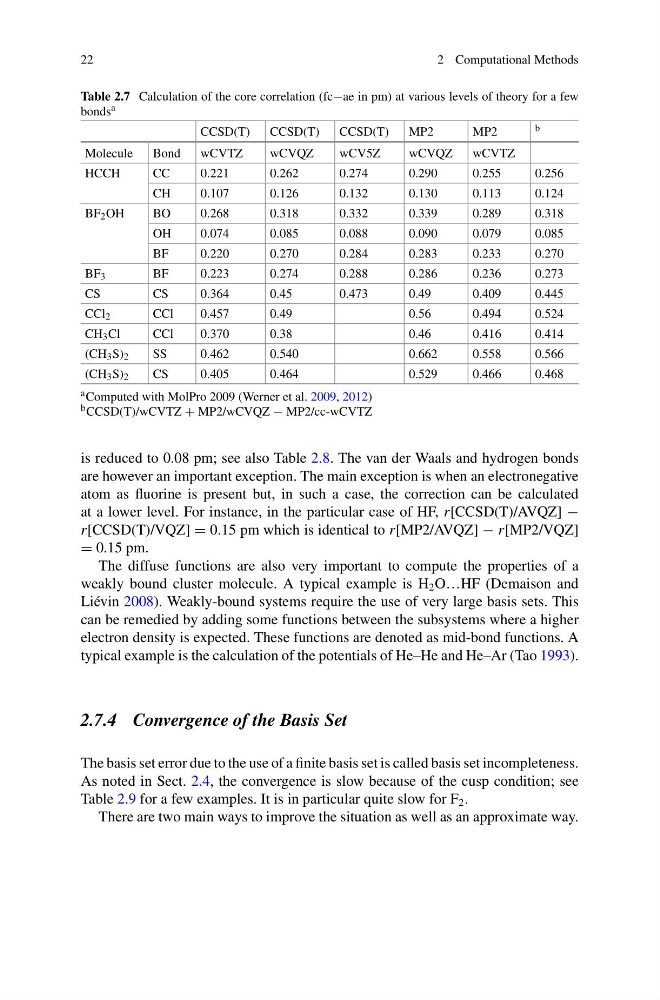
Table 2.7 Calculation of the core correlation (fc−ae in pm) at various levels of theory for a few
bonds a
CCSD(T)
CCSD(T)
CCSD(T)
MP2
MP2
b
Molecule
Bond
wCVTZ
wCVQZ
wCV5Z
wCVQZ
wCVTZ
HCCH
CC
0.221
0.262
0.274
0.290
0.255
0.256
CH
0.107
0.126
0.132
0.130
0.113
0.124
BF 2 OH
BO
0.268
0.318
0.332
0.339
0.289
0.318
OH
0.074
0.085
0.088
0.090
0.079
0.085
BF
0.220
0.270
0.284
0.283
0.233
0.270
BF 3
BF
0.223
0.274
0.288
0.286
0.236
0.273
CS
CS
0.364
0.45
0.473
0.49
0.409
0.445
CCl 2
CCl
0.457
0.49
0.56
0.494
0.524
CH 3 Cl
CCl
0.370
0.38
0.46
0.416
0.414
(CH 3 S) 2
SS
0.462
0.540
0.662
0.558
0.566
(CH 3 S) 2
CS
0.405
0.464
0.529
0.466
0.468
a Computed with MolPro 2009 (Werner et al. 2009, 2012)
b CCSD(T)/wCVTZ + MP2/wCVQZ − MP2/cc-wCVTZ
is reduced to 0.08 pm; see also Table 2.8. The van der Waals and hydrogen bonds
are however an important exception. The main exception is when an electronegative
atom as fluorine is present but, in such a case, the correction can be calculated
at a lower level. For instance, in the particular case of HF, r[CCSD(T)/AVQZ] −
r[CCSD(T)/VQZ] = 0.15 pm which is identical to r[MP2/AVQZ] − r[MP2/VQZ]
= 0.15 pm.
The diffuse functions are also very important to compute the properties of a
weakly bound cluster molecule. A typical example is H 2 O…HF (Demaison and
Liévin 2008). Weakly-bound systems require the use of very large basis sets. This
can be remedied by adding some functions between the subsystems where a higher
electron density is expected. These functions are denoted as mid-bond functions. A
typical example is the calculation of the potentials of He–He and He–Ar (Tao 1993).
2.7.4 Convergence of the Basis Set
The basis set error due to the use of a finite basis set is called basis set incompleteness.
As noted in Sect. 2.4, the convergence is slow because of the cusp condition; see
Table 2.9 for a few examples. It is in particular quite slow for F 2 .
There are two main ways to improve the situation as well as an approximate way.
2 Computational Methods
Table 2.7 Calculation of the core correlation (fc−ae in pm) at various levels of theory for a few
bonds a
CCSD(T)
CCSD(T)
CCSD(T)
MP2
MP2
b
Molecule
Bond
wCVTZ
wCVQZ
wCV5Z
wCVQZ
wCVTZ
HCCH
CC
0.221
0.262
0.274
0.290
0.255
0.256
CH
0.107
0.126
0.132
0.130
0.113
0.124
BF 2 OH
BO
0.268
0.318
0.332
0.339
0.289
0.318
OH
0.074
0.085
0.088
0.090
0.079
0.085
BF
0.220
0.270
0.284
0.283
0.233
0.270
BF 3
BF
0.223
0.274
0.288
0.286
0.236
0.273
CS
CS
0.364
0.45
0.473
0.49
0.409
0.445
CCl 2
CCl
0.457
0.49
0.56
0.494
0.524
CH 3 Cl
CCl
0.370
0.38
0.46
0.416
0.414
(CH 3 S) 2
SS
0.462
0.540
0.662
0.558
0.566
(CH 3 S) 2
CS
0.405
0.464
0.529
0.466
0.468
a Computed with MolPro 2009 (Werner et al. 2009, 2012)
b CCSD(T)/wCVTZ + MP2/wCVQZ − MP2/cc-wCVTZ
is reduced to 0.08 pm; see also Table 2.8. The van der Waals and hydrogen bonds
are however an important exception. The main exception is when an electronegative
atom as fluorine is present but, in such a case, the correction can be calculated
at a lower level. For instance, in the particular case of HF, r[CCSD(T)/AVQZ] −
r[CCSD(T)/VQZ] = 0.15 pm which is identical to r[MP2/AVQZ] − r[MP2/VQZ]
= 0.15 pm.
The diffuse functions are also very important to compute the properties of a
weakly bound cluster molecule. A typical example is H 2 O…HF (Demaison and
Liévin 2008). Weakly-bound systems require the use of very large basis sets. This
can be remedied by adding some functions between the subsystems where a higher
electron density is expected. These functions are denoted as mid-bond functions. A
typical example is the calculation of the potentials of He–He and He–Ar (Tao 1993).
2.7.4 Convergence of the Basis Set
The basis set error due to the use of a finite basis set is called basis set incompleteness.
As noted in Sect. 2.4, the convergence is slow because of the cusp condition; see
Table 2.9 for a few examples. It is in particular quite slow for F 2 .
There are two main ways to improve the situation as well as an approximate way.