

2.7 Choice of the Basis Sets
21
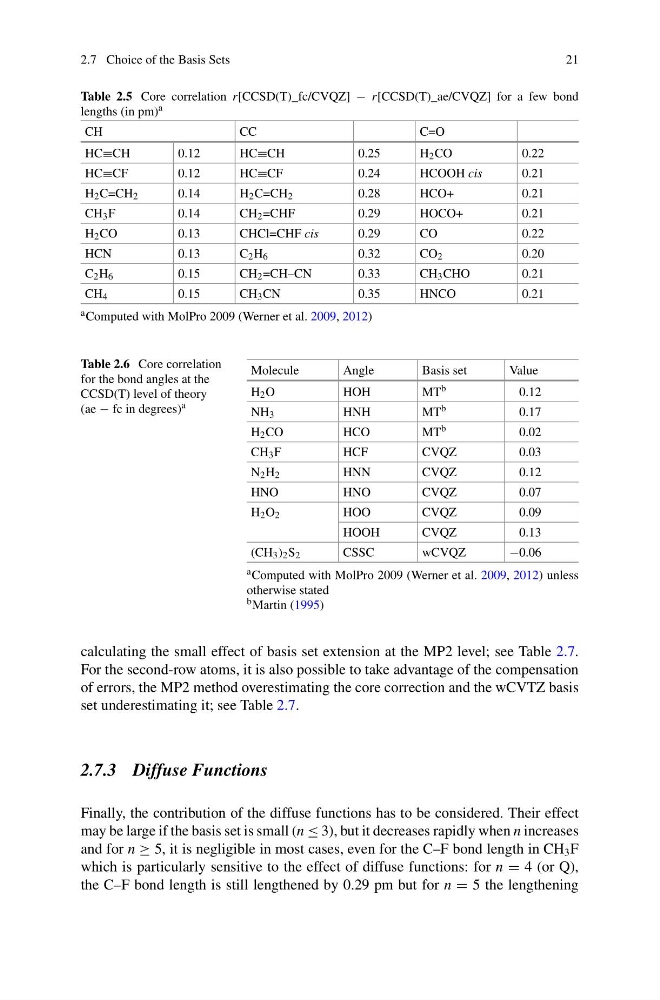
Table 2.5 Core correlation r[CCSD(T)_fc/CVQZ] − r[CCSD(T)_ae/CVQZ] for a few bond
lengths (in pm) a
CH
CC
C=O
HC≡CH
0.12
HC≡CH
0.25
H 2 CO
0.22
HC≡CF
0.12
HC≡CF
0.24
HCOOH cis
0.21
H 2 C=CH 2
0.14
H 2 C=CH 2
0.28
HCO+
0.21
CH 3 F
0.14
CH 2 =CHF
0.29
HOCO+
0.21
H 2 CO
0.13
CHCl=CHF cis
0.29
CO
0.22
HCN
0.13
C 2 H 6
0.32
CO 2
0.20
C 2 H 6
0.15
CH 2 =CH–CN
0.33
CH 3 CHO
0.21
CH 4
0.15
CH 3 CN
0.35
HNCO
0.21
a Computed with MolPro 2009 (Werner et al. 2009, 2012)
Table 2.6 Core correlation
for the bond angles at the
CCSD(T) level of theory
(ae − fc in degrees) a
Molecule
Angle
Basis set
Value
H 2 O
HOH
MT b
0.12
NH 3
HNH
MT b
0.17
H 2 CO
HCO
MT b
0.02
CH 3 F
HCF
CVQZ
0.03
N 2 H 2
HNN
CVQZ
0.12
HNO
HNO
CVQZ
0.07
H 2 O 2
HOO
CVQZ
0.09
HOOH
CVQZ
0.13
(CH 3 ) 2 S 2
CSSC
wCVQZ
−0.06
a Computed with MolPro 2009 (Werner et al. 2009, 2012) unless
otherwise stated
b Martin (1995)
calculating the small effect of basis set extension at the MP2 level; see Table 2.7.
For the second-row atoms, it is also possible to take advantage of the compensation
of errors, the MP2 method overestimating the core correction and the wCVTZ basis
set underestimating it; see Table 2.7.
2.7.3 Diffuse Functions
Finally, the contribution of the diffuse functions has to be considered. Their effect
may be large if the basis set is small (n ≤ 3), but it decreases rapidly when n increases
and for n ≥ 5, it is negligible in most cases, even for the C–F bond length in CH 3 F
which is particularly sensitive to the effect of diffuse functions: for n = 4 (or Q),
the C–F bond length is still lengthened by 0.29 pm but for n = 5 the lengthening
21
Table 2.5 Core correlation r[CCSD(T)_fc/CVQZ] − r[CCSD(T)_ae/CVQZ] for a few bond
lengths (in pm) a
CH
CC
C=O
HC≡CH
0.12
HC≡CH
0.25
H 2 CO
0.22
HC≡CF
0.12
HC≡CF
0.24
HCOOH cis
0.21
H 2 C=CH 2
0.14
H 2 C=CH 2
0.28
HCO+
0.21
CH 3 F
0.14
CH 2 =CHF
0.29
HOCO+
0.21
H 2 CO
0.13
CHCl=CHF cis
0.29
CO
0.22
HCN
0.13
C 2 H 6
0.32
CO 2
0.20
C 2 H 6
0.15
CH 2 =CH–CN
0.33
CH 3 CHO
0.21
CH 4
0.15
CH 3 CN
0.35
HNCO
0.21
a Computed with MolPro 2009 (Werner et al. 2009, 2012)
Table 2.6 Core correlation
for the bond angles at the
CCSD(T) level of theory
(ae − fc in degrees) a
Molecule
Angle
Basis set
Value
H 2 O
HOH
MT b
0.12
NH 3
HNH
MT b
0.17
H 2 CO
HCO
MT b
0.02
CH 3 F
HCF
CVQZ
0.03
N 2 H 2
HNN
CVQZ
0.12
HNO
HNO
CVQZ
0.07
H 2 O 2
HOO
CVQZ
0.09
HOOH
CVQZ
0.13
(CH 3 ) 2 S 2
CSSC
wCVQZ
−0.06
a Computed with MolPro 2009 (Werner et al. 2009, 2012) unless
otherwise stated
b Martin (1995)
calculating the small effect of basis set extension at the MP2 level; see Table 2.7.
For the second-row atoms, it is also possible to take advantage of the compensation
of errors, the MP2 method overestimating the core correction and the wCVTZ basis
set underestimating it; see Table 2.7.
2.7.3 Diffuse Functions
Finally, the contribution of the diffuse functions has to be considered. Their effect
may be large if the basis set is small (n ≤ 3), but it decreases rapidly when n increases
and for n ≥ 5, it is negligible in most cases, even for the C–F bond length in CH 3 F
which is particularly sensitive to the effect of diffuse functions: for n = 4 (or Q),
the C–F bond length is still lengthened by 0.29 pm but for n = 5 the lengthening