

268
10 Databases with Information on Molecular Structure
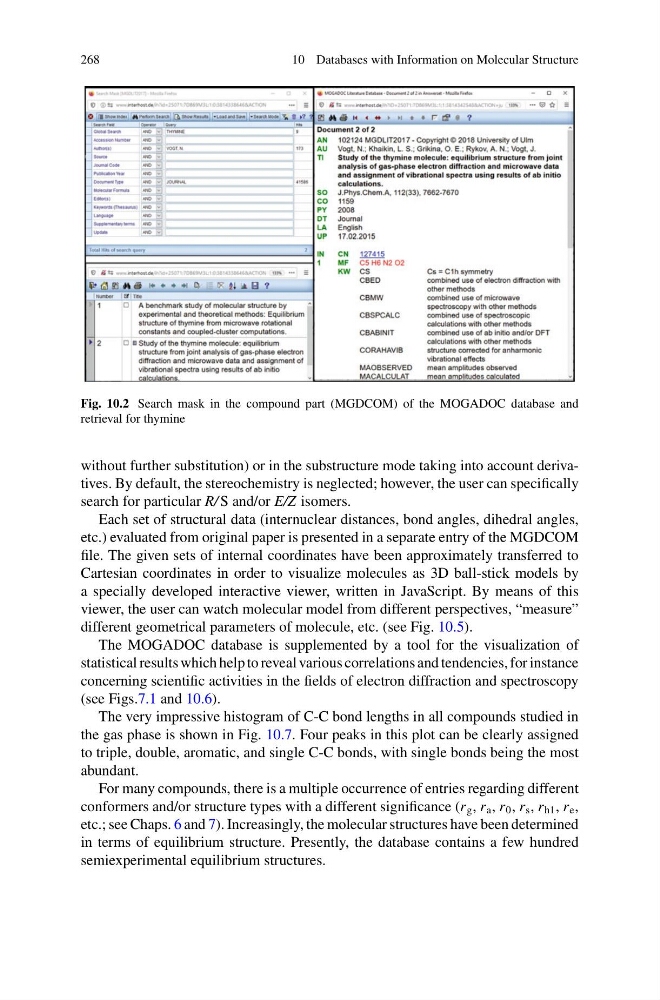
Fig. 10.2 Search mask in the compound part (MGDCOM) of the MOGADOC database and
retrieval for thymine
without further substitution) or in the substructure mode taking into account derivatives. By default, the stereochemistry is neglected; however, the user can specifically
search for particular R/ S and/or E/Z isomers.
Each set of structural data (internuclear distances, bond angles, dihedral angles,
etc.) evaluated from original paper is presented in a separate entry of the MGDCOM
file. The given sets of internal coordinates have been approximately transferred to
Cartesian coordinates in order to visualize molecules as 3D ball-stick models by
a specially developed interactive viewer, written in JavaScript. By means of this
viewer, the user can watch molecular model from different perspectives, “measure”
different geometrical parameters of molecule, etc. (see Fig. 10.5).
The MOGADOC database is supplemented by a tool for the visualization of
statistical results which help to reveal various correlations and tendencies, for instance
concerning scientific activities in the fields of electron diffraction and spectroscopy
(see Figs.7.1 and 10.6).
The very impressive histogram of C-C bond lengths in all compounds studied in
the gas phase is shown in Fig. 10.7. Four peaks in this plot can be clearly assigned
to triple, double, aromatic, and single C-C bonds, with single bonds being the most
abundant.
For many compounds, there is a multiple occurrence of entries regarding different
conformers and/or structure types with a different significance (r g , r a , r 0 , r s , r h1 , r e ,
etc.; see Chaps. 6 and 7). Increasingly, the molecular structures have been determined
in terms of equilibrium structure. Presently, the database contains a few hundred
semiexperimental equilibrium structures.
10 Databases with Information on Molecular Structure
Fig. 10.2 Search mask in the compound part (MGDCOM) of the MOGADOC database and
retrieval for thymine
without further substitution) or in the substructure mode taking into account derivatives. By default, the stereochemistry is neglected; however, the user can specifically
search for particular R/ S and/or E/Z isomers.
Each set of structural data (internuclear distances, bond angles, dihedral angles,
etc.) evaluated from original paper is presented in a separate entry of the MGDCOM
file. The given sets of internal coordinates have been approximately transferred to
Cartesian coordinates in order to visualize molecules as 3D ball-stick models by
a specially developed interactive viewer, written in JavaScript. By means of this
viewer, the user can watch molecular model from different perspectives, “measure”
different geometrical parameters of molecule, etc. (see Fig. 10.5).
The MOGADOC database is supplemented by a tool for the visualization of
statistical results which help to reveal various correlations and tendencies, for instance
concerning scientific activities in the fields of electron diffraction and spectroscopy
(see Figs.7.1 and 10.6).
The very impressive histogram of C-C bond lengths in all compounds studied in
the gas phase is shown in Fig. 10.7. Four peaks in this plot can be clearly assigned
to triple, double, aromatic, and single C-C bonds, with single bonds being the most
abundant.
For many compounds, there is a multiple occurrence of entries regarding different
conformers and/or structure types with a different significance (r g , r a , r 0 , r s , r h1 , r e ,
etc.; see Chaps. 6 and 7). Increasingly, the molecular structures have been determined
in terms of equilibrium structure. Presently, the database contains a few hundred
semiexperimental equilibrium structures.