

258
9 Least-Squares Method
Table 9.9 Substitution
structure of ethylene oxide,
c-C 2 H 4 O (distances in pm
and angles in deg.) (Hirose
1974)
Parameter
Correlated fit
Non-correlated fit
r(C–O)
143.09(10)
143.03(13)
r(C–C)
146.63(18)
146.57(28)
r(C–H)
108.54(10)
108.58(10)
∠(HCH)
116.61(10)
116.57(13)
τ a
21.99(15)
22.01(10)
a τ is the dihedral angle of the C–C bond to the H 2 C plane
Cov(I i − I 0 , I j − I 0 ) =
(ε i − ε 0 )(ε j − ε 0 )
=
ε
2
0
+
ε i ε j
− ε i ε 0 −
ε j ε 0
= σ
2
0
(9.72)
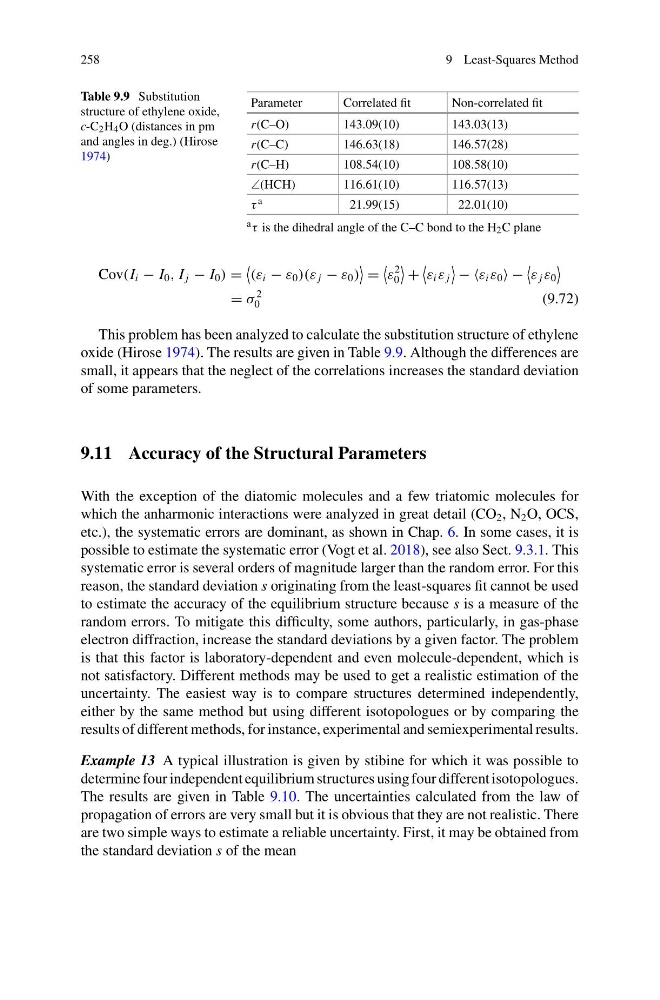
This problem has been analyzed to calculate the substitution structure of ethylene
oxide (Hirose 1974). The results are given in Table 9.9. Although the differences are
small, it appears that the neglect of the correlations increases the standard deviation
of some parameters.
9.11 Accuracy of the Structural Parameters
With the exception of the diatomic molecules and a few triatomic molecules for
which the anharmonic interactions were analyzed in great detail (CO 2 , N 2 O, OCS,
etc.), the systematic errors are dominant, as shown in Chap. 6. In some cases, it is
possible to estimate the systematic error (Vogt et al. 2018), see also Sect. 9.3.1. This
systematic error is several orders of magnitude larger than the random error. For this
reason, the standard deviation s originating from the least-squares fit cannot be used
to estimate the accuracy of the equilibrium structure because s is a measure of the
random errors. To mitigate this difficulty, some authors, particularly, in gas-phase
electron diffraction, increase the standard deviations by a given factor. The problem
is that this factor is laboratory-dependent and even molecule-dependent, which is
not satisfactory. Different methods may be used to get a realistic estimation of the
uncertainty. The easiest way is to compare structures determined independently,
either by the same method but using different isotopologues or by comparing the
results of different methods, for instance, experimental and semiexperimental results.
Example 13 A typical illustration is given by stibine for which it was possible to
determine four independent equilibrium structures using four different isotopologues.
The results are given in Table 9.10. The uncertainties calculated from the law of
propagation of errors are very small but it is obvious that they are not realistic. There
are two simple ways to estimate a reliable uncertainty. First, it may be obtained from
the standard deviation s of the mean
9 Least-Squares Method
Table 9.9 Substitution
structure of ethylene oxide,
c-C 2 H 4 O (distances in pm
and angles in deg.) (Hirose
1974)
Parameter
Correlated fit
Non-correlated fit
r(C–O)
143.09(10)
143.03(13)
r(C–C)
146.63(18)
146.57(28)
r(C–H)
108.54(10)
108.58(10)
∠(HCH)
116.61(10)
116.57(13)
τ a
21.99(15)
22.01(10)
a τ is the dihedral angle of the C–C bond to the H 2 C plane
Cov(I i − I 0 , I j − I 0 ) =
(ε i − ε 0 )(ε j − ε 0 )
=
ε
2
0
+
ε i ε j
− ε i ε 0 −
ε j ε 0
= σ
2
0
(9.72)
This problem has been analyzed to calculate the substitution structure of ethylene
oxide (Hirose 1974). The results are given in Table 9.9. Although the differences are
small, it appears that the neglect of the correlations increases the standard deviation
of some parameters.
9.11 Accuracy of the Structural Parameters
With the exception of the diatomic molecules and a few triatomic molecules for
which the anharmonic interactions were analyzed in great detail (CO 2 , N 2 O, OCS,
etc.), the systematic errors are dominant, as shown in Chap. 6. In some cases, it is
possible to estimate the systematic error (Vogt et al. 2018), see also Sect. 9.3.1. This
systematic error is several orders of magnitude larger than the random error. For this
reason, the standard deviation s originating from the least-squares fit cannot be used
to estimate the accuracy of the equilibrium structure because s is a measure of the
random errors. To mitigate this difficulty, some authors, particularly, in gas-phase
electron diffraction, increase the standard deviations by a given factor. The problem
is that this factor is laboratory-dependent and even molecule-dependent, which is
not satisfactory. Different methods may be used to get a realistic estimation of the
uncertainty. The easiest way is to compare structures determined independently,
either by the same method but using different isotopologues or by comparing the
results of different methods, for instance, experimental and semiexperimental results.
Example 13 A typical illustration is given by stibine for which it was possible to
determine four independent equilibrium structures using four different isotopologues.
The results are given in Table 9.10. The uncertainties calculated from the law of
propagation of errors are very small but it is obvious that they are not realistic. There
are two simple ways to estimate a reliable uncertainty. First, it may be obtained from
the standard deviation s of the mean