

8.6 Appendix: Electronegativity (χ)
229
8.10 Partial atomic charges for formaldehyde, H 2 C=O, using different methods
CM5
AIM
NBO
(8.35–8.37)
(8.38)
(8.26)
Q(H)
0.100
0.008
0.099
0.12
0.029
0.108
Q(C)
0.085
1.081
0.304
0.19
0.226
0.046
Q(O)
−0.285
−1.099
−0.502
−0.43
−0.284
−0.263
E(Q 1 . . . Q N ) =
A
E A0 + χ
0
A Q A +
1
2
J
0
AA Q
2
A
+
A
(8.34)
where N is the number of atoms.
Deriving with respect to Q A gives
χ A (Q 1 . . . Q N ) =
∂ E
∂ Q A
= χ
0
A +
B
J AB Q B
(8.35)
At equilibrium, we should have
χ 1 = χ 2 = · · · = χ N
(8.36)
Adding the condition of total charge
Q tot =
N
i=1
Q i
(8.37)
gives a system of N simultaneous equations that can be solved to obtain the charges.
There is another easy way to calculate reasonable partial charges using a method
developed by Allen (1989).
Q A = group number of A − number of lone pair electrons on A
− (χ A /
χ) × (number of bonding electrons shared by A)
(8.38)
where
χ is the sum of the electronegativities of atom A and the atoms to which A
is bonded. In this equation, the choice of the electronegativity scale (either Pauling
or Allred-Rochow) is not important).
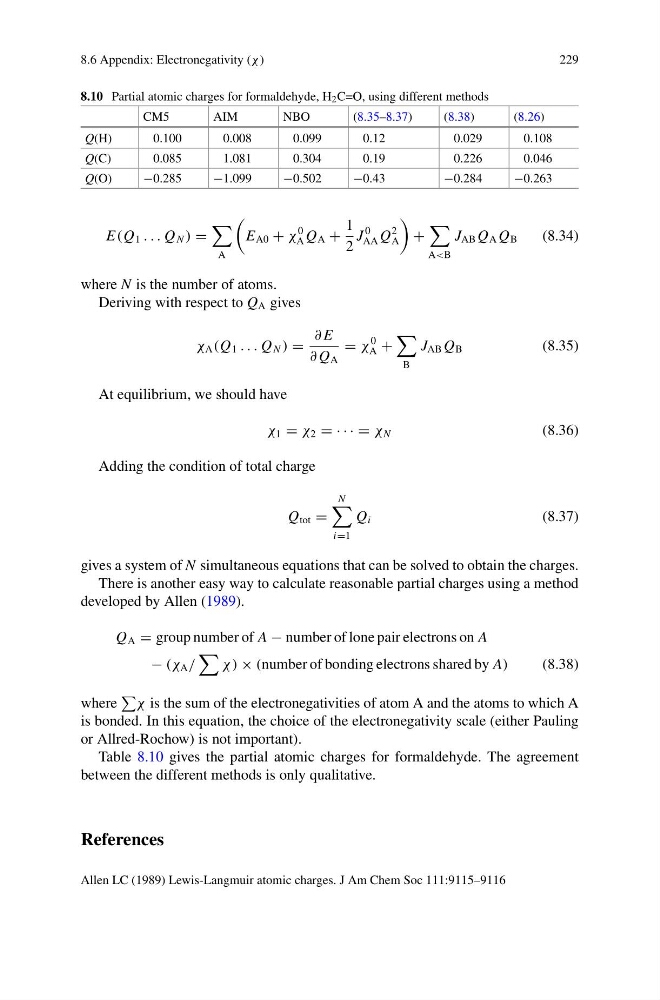
Table 8.10 gives the partial atomic charges for formaldehyde. The agreement
between the different methods is only qualitative.
References
Allen LC (1989) Lewis-Langmuir atomic charges. J Am Chem Soc 111:9115–9116
229
8.10 Partial atomic charges for formaldehyde, H 2 C=O, using different methods
CM5
AIM
NBO
(8.35–8.37)
(8.38)
(8.26)
Q(H)
0.100
0.008
0.099
0.12
0.029
0.108
Q(C)
0.085
1.081
0.304
0.19
0.226
0.046
Q(O)
−0.285
−1.099
−0.502
−0.43
−0.284
−0.263
E(Q 1 . . . Q N ) =
A
E A0 + χ
0
A Q A +
1
2
J
0
AA Q
2
A
+
A
(8.34)
where N is the number of atoms.
Deriving with respect to Q A gives
χ A (Q 1 . . . Q N ) =
∂ E
∂ Q A
= χ
0
A +
B
J AB Q B
(8.35)
At equilibrium, we should have
χ 1 = χ 2 = · · · = χ N
(8.36)
Adding the condition of total charge
Q tot =
N
i=1
Q i
(8.37)
gives a system of N simultaneous equations that can be solved to obtain the charges.
There is another easy way to calculate reasonable partial charges using a method
developed by Allen (1989).
Q A = group number of A − number of lone pair electrons on A
− (χ A /
χ) × (number of bonding electrons shared by A)
(8.38)
where
χ is the sum of the electronegativities of atom A and the atoms to which A
is bonded. In this equation, the choice of the electronegativity scale (either Pauling
or Allred-Rochow) is not important).
Table 8.10 gives the partial atomic charges for formaldehyde. The agreement
between the different methods is only qualitative.
References
Allen LC (1989) Lewis-Langmuir atomic charges. J Am Chem Soc 111:9115–9116