

194
7 Molecular Structures from Gas-Phase Electron Diffraction
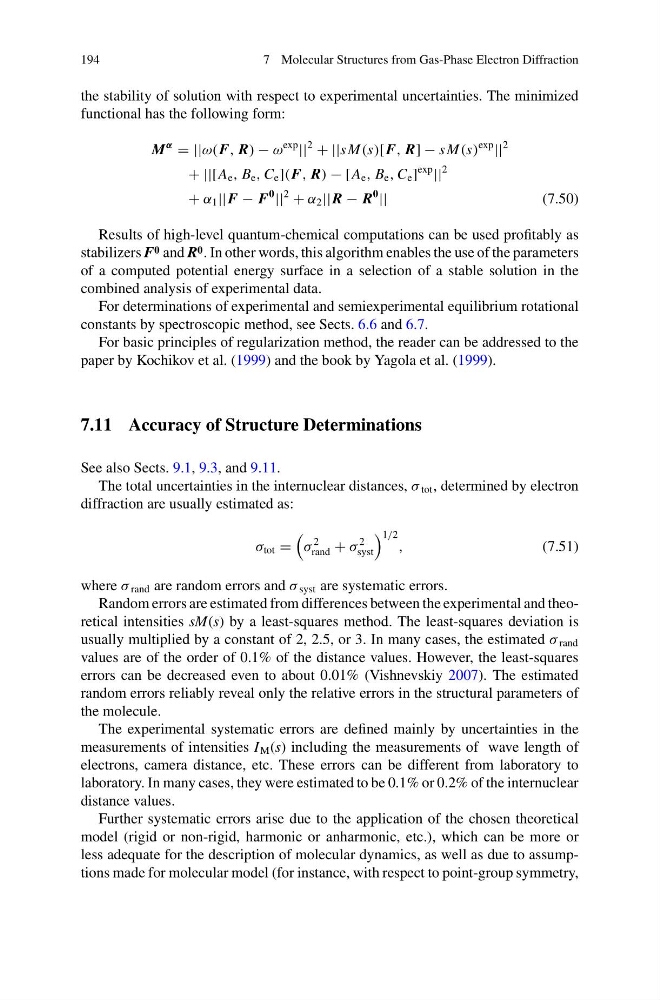
the stability of solution with respect to experimental uncertainties. The minimized
functional has the following form:
M
α
= ||ω(F, R) − ω
exp
||
2
+ ||s M(s)[F, R] − s M(s)
exp
||
2
+ ||[A e , B e , C e ](F, R) − [A e , B e , C e ]
exp
||
2
+ α 1 ||F − F
0
||
2
+ α 2 ||R − R
0
||
(7.50)
Results of high-level quantum-chemical computations can be used profitably as
stabilizers F 0 and R 0 . In other words, this algorithm enables the use of the parameters
of a computed potential energy surface in a selection of a stable solution in the
combined analysis of experimental data.
For determinations of experimental and semiexperimental equilibrium rotational
constants by spectroscopic method, see Sects. 6.6 and 6.7.
For basic principles of regularization method, the reader can be addressed to the
paper by Kochikov et al. (1999) and the book by Yagola et al. (1999).
7.11 Accuracy of Structure Determinations
See also Sects. 9.1, 9.3, and 9.11.
The total uncertainties in the internuclear distances, σ tot , determined by electron
diffraction are usually estimated as:
σ tot =
σ
2
rand + σ
2
syst
1/2 ,
(7.51)
where σ rand are random errors and σ syst are systematic errors.
Random errors are estimated from differences between the experimental and theoretical intensities sM(s) by a least-squares method. The least-squares deviation is
usually multiplied by a constant of 2, 2.5, or 3. In many cases, the estimated σ rand
values are of the order of 0.1% of the distance values. However, the least-squares
errors can be decreased even to about 0.01% (Vishnevskiy 2007). The estimated
random errors reliably reveal only the relative errors in the structural parameters of
the molecule.
The experimental systematic errors are defined mainly by uncertainties in the
measurements of intensities I M (s) including the measurements of wave length of
electrons, camera distance, etc. These errors can be different from laboratory to
laboratory. In many cases, they were estimated to be 0.1% or 0.2% of the internuclear
distance values.
Further systematic errors arise due to the application of the chosen theoretical
model (rigid or non-rigid, harmonic or anharmonic, etc.), which can be more or
less adequate for the description of molecular dynamics, as well as due to assumptions made for molecular model (for instance, with respect to point-group symmetry,
7 Molecular Structures from Gas-Phase Electron Diffraction
the stability of solution with respect to experimental uncertainties. The minimized
functional has the following form:
M
α
= ||ω(F, R) − ω
exp
||
2
+ ||s M(s)[F, R] − s M(s)
exp
||
2
+ ||[A e , B e , C e ](F, R) − [A e , B e , C e ]
exp
||
2
+ α 1 ||F − F
0
||
2
+ α 2 ||R − R
0
||
(7.50)
Results of high-level quantum-chemical computations can be used profitably as
stabilizers F 0 and R 0 . In other words, this algorithm enables the use of the parameters
of a computed potential energy surface in a selection of a stable solution in the
combined analysis of experimental data.
For determinations of experimental and semiexperimental equilibrium rotational
constants by spectroscopic method, see Sects. 6.6 and 6.7.
For basic principles of regularization method, the reader can be addressed to the
paper by Kochikov et al. (1999) and the book by Yagola et al. (1999).
7.11 Accuracy of Structure Determinations
See also Sects. 9.1, 9.3, and 9.11.
The total uncertainties in the internuclear distances, σ tot , determined by electron
diffraction are usually estimated as:
σ tot =
σ
2
rand + σ
2
syst
1/2 ,
(7.51)
where σ rand are random errors and σ syst are systematic errors.
Random errors are estimated from differences between the experimental and theoretical intensities sM(s) by a least-squares method. The least-squares deviation is
usually multiplied by a constant of 2, 2.5, or 3. In many cases, the estimated σ rand
values are of the order of 0.1% of the distance values. However, the least-squares
errors can be decreased even to about 0.01% (Vishnevskiy 2007). The estimated
random errors reliably reveal only the relative errors in the structural parameters of
the molecule.
The experimental systematic errors are defined mainly by uncertainties in the
measurements of intensities I M (s) including the measurements of wave length of
electrons, camera distance, etc. These errors can be different from laboratory to
laboratory. In many cases, they were estimated to be 0.1% or 0.2% of the internuclear
distance values.
Further systematic errors arise due to the application of the chosen theoretical
model (rigid or non-rigid, harmonic or anharmonic, etc.), which can be more or
less adequate for the description of molecular dynamics, as well as due to assumptions made for molecular model (for instance, with respect to point-group symmetry,