

7.10 Combined Analysis of Data from Different Methods
193
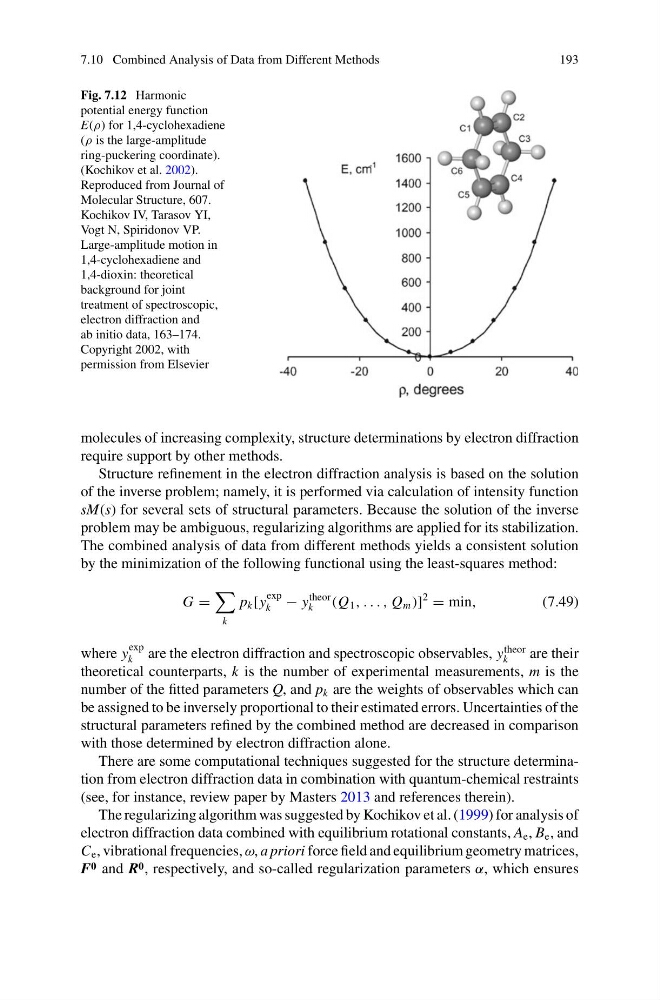
Fig. 7.12 Harmonic
potential energy function
E(ρ) for 1,4-cyclohexadiene
(ρ is the large-amplitude
ring-puckering coordinate).
(Kochikov et al. 2002).
Reproduced from Journal of
Molecular Structure, 607.
Kochikov IV, Tarasov YI,
Vogt N, Spiridonov VP.
Large-amplitude motion in
1,4-cyclohexadiene and
1,4-dioxin: theoretical
background for joint
treatment of spectroscopic,
electron diffraction and
ab initio data, 163–174.
Copyright 2002, with
permission from Elsevier
molecules of increasing complexity, structure determinations by electron diffraction
require support by other methods.
Structure refinement in the electron diffraction analysis is based on the solution
of the inverse problem; namely, it is performed via calculation of intensity function
sM(s) for several sets of structural parameters. Because the solution of the inverse
problem may be ambiguous, regularizing algorithms are applied for its stabilization.
The combined analysis of data from different methods yields a consistent solution
by the minimization of the following functional using the least-squares method:
G =
k
p k [y
exp
k − y
theor
k
(Q 1 , . . . , Q m )]
2
= min,
(7.49)
where y
exp
k are the electron diffraction and spectroscopic observables, y
theor
k
are their
theoretical counterparts, k is the number of experimental measurements, m is the
number of the fitted parameters Q, and p k are the weights of observables which can
be assigned to be inversely proportional to their estimated errors. Uncertainties of the
structural parameters refined by the combined method are decreased in comparison
with those determined by electron diffraction alone.
There are some computational techniques suggested for the structure determination from electron diffraction data in combination with quantum-chemical restraints
(see, for instance, review paper by Masters 2013 and references therein).
The regularizing algorithm was suggested by Kochikov et al. (1999) for analysis of
electron diffraction data combined with equilibrium rotational constants, A e , B e , and
C e , vibrational frequencies, ω, a priori force field and equilibrium geometry matrices,
F 0 and R 0 , respectively, and so-called regularization parameters α, which ensures
193
Fig. 7.12 Harmonic
potential energy function
E(ρ) for 1,4-cyclohexadiene
(ρ is the large-amplitude
ring-puckering coordinate).
(Kochikov et al. 2002).
Reproduced from Journal of
Molecular Structure, 607.
Kochikov IV, Tarasov YI,
Vogt N, Spiridonov VP.
Large-amplitude motion in
1,4-cyclohexadiene and
1,4-dioxin: theoretical
background for joint
treatment of spectroscopic,
electron diffraction and
ab initio data, 163–174.
Copyright 2002, with
permission from Elsevier
molecules of increasing complexity, structure determinations by electron diffraction
require support by other methods.
Structure refinement in the electron diffraction analysis is based on the solution
of the inverse problem; namely, it is performed via calculation of intensity function
sM(s) for several sets of structural parameters. Because the solution of the inverse
problem may be ambiguous, regularizing algorithms are applied for its stabilization.
The combined analysis of data from different methods yields a consistent solution
by the minimization of the following functional using the least-squares method:
G =
k
p k [y
exp
k − y
theor
k
(Q 1 , . . . , Q m )]
2
= min,
(7.49)
where y
exp
k are the electron diffraction and spectroscopic observables, y
theor
k
are their
theoretical counterparts, k is the number of experimental measurements, m is the
number of the fitted parameters Q, and p k are the weights of observables which can
be assigned to be inversely proportional to their estimated errors. Uncertainties of the
structural parameters refined by the combined method are decreased in comparison
with those determined by electron diffraction alone.
There are some computational techniques suggested for the structure determination from electron diffraction data in combination with quantum-chemical restraints
(see, for instance, review paper by Masters 2013 and references therein).
The regularizing algorithm was suggested by Kochikov et al. (1999) for analysis of
electron diffraction data combined with equilibrium rotational constants, A e , B e , and
C e , vibrational frequencies, ω, a priori force field and equilibrium geometry matrices,
F 0 and R 0 , respectively, and so-called regularization parameters α, which ensures