

7.8 The Use of Curvilinear Internal Coordinates
187
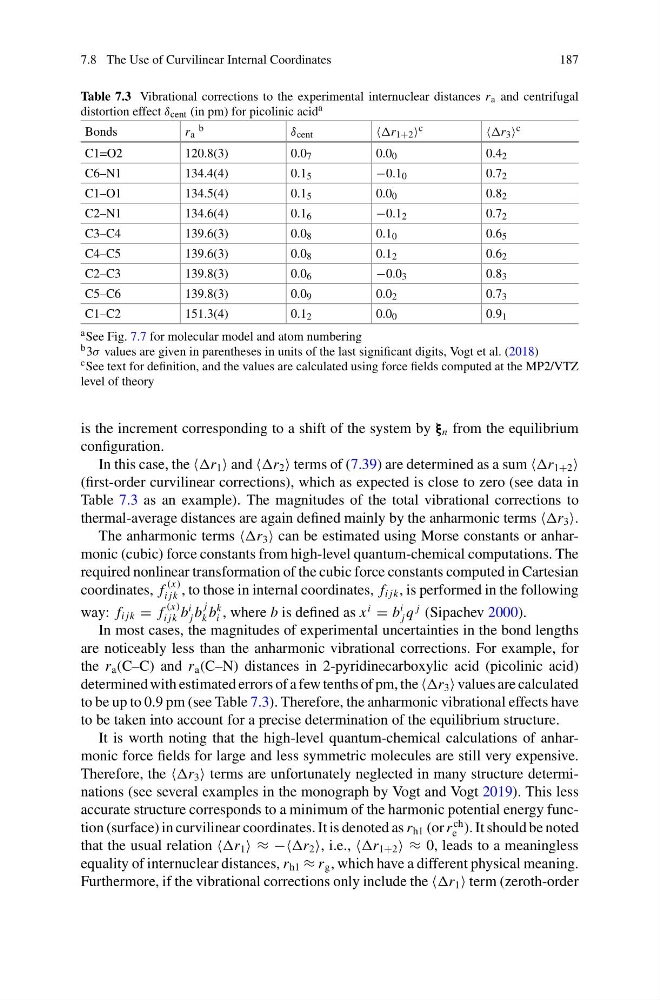
Table 7.3 Vibrational corrections to the experimental internuclear distances r a and centrifugal
distortion effect δ cent (in pm) for picolinic acid a
Bonds
r a
b
δ cent
r 1+2 c
r 3 c
C1=O2
120.8(3)
0.0 7
0.0 0
0.4 2
C6–N1
134.4(4)
0.1 5
−0.1 0
0.7 2
C1–O1
134.5(4)
0.1 5
0.0 0
0.8 2
C2–N1
134.6(4)
0.1 6
−0.1 2
0.7 2
C3–C4
139.6(3)
0.0 8
0.1 0
0.6 5
C4–C5
139.6(3)
0.0 8
0.1 2
0.6 2
C2–C3
139.8(3)
0.0 6
−0.0 3
0.8 3
C5–C6
139.8(3)
0.0 9
0.0 2
0.7 3
C1–C2
151.3(4)
0.1 2
0.0 0
0.9 1
a See Fig. 7.7 for molecular model and atom numbering
b 3σ values are given in parentheses in units of the last significant digits, Vogt et al. (2018)
c See text for definition, and the values are calculated using force fields computed at the MP2/VTZ
level of theory
is the increment corresponding to a shift of the system by ξ n from the equilibrium
configuration.
In this case, the r 1 and r 2 terms of (7.39) are determined as a sum r 1+2
(first-order curvilinear corrections), which as expected is close to zero (see data in
Table 7.3 as an example). The magnitudes of the total vibrational corrections to
thermal-average distances are again defined mainly by the anharmonic terms r 3 .
The anharmonic terms r 3 can be estimated using Morse constants or anharmonic (cubic) force constants from high-level quantum-chemical computations. The
required nonlinear transformation of the cubic force constants computed in Cartesian
coordinates, f
(x)
i jk , to those in internal coordinates, f i jk , is performed in the following
way: f i jk = f
(x)
i jk b
i
j b
j
k b
k
i , where b is defined as x
i
= b
i
j q
j (Sipachev 2000).
In most cases, the magnitudes of experimental uncertainties in the bond lengths
are noticeably less than the anharmonic vibrational corrections. For example, for
the r a (C–C) and r a (C–N) distances in 2-pyridinecarboxylic acid (picolinic acid)
determined with estimated errors of a few tenths of pm, the r 3 values are calculated
to be up to 0.9 pm (see Table 7.3). Therefore, the anharmonic vibrational effects have
to be taken into account for a precise determination of the equilibrium structure.
It is worth noting that the high-level quantum-chemical calculations of anharmonic force fields for large and less symmetric molecules are still very expensive.
Therefore, the r 3 terms are unfortunately neglected in many structure determinations (see several examples in the monograph by Vogt and Vogt 2019). This less
accurate structure corresponds to a minimum of the harmonic potential energy function (surface) in curvilinear coordinates. It is denoted as r h1 (or r
ch
e ). It should be noted
that the usual relation r 1 ≈ −r 2 , i.e., r 1+2 ≈ 0, leads to a meaningless
equality of internuclear distances, r h1 ≈ r g , which have a different physical meaning.
Furthermore, if the vibrational corrections only include the r 1 term (zeroth-order
187
Table 7.3 Vibrational corrections to the experimental internuclear distances r a and centrifugal
distortion effect δ cent (in pm) for picolinic acid a
Bonds
r a
b
δ cent
r 1+2 c
r 3 c
C1=O2
120.8(3)
0.0 7
0.0 0
0.4 2
C6–N1
134.4(4)
0.1 5
−0.1 0
0.7 2
C1–O1
134.5(4)
0.1 5
0.0 0
0.8 2
C2–N1
134.6(4)
0.1 6
−0.1 2
0.7 2
C3–C4
139.6(3)
0.0 8
0.1 0
0.6 5
C4–C5
139.6(3)
0.0 8
0.1 2
0.6 2
C2–C3
139.8(3)
0.0 6
−0.0 3
0.8 3
C5–C6
139.8(3)
0.0 9
0.0 2
0.7 3
C1–C2
151.3(4)
0.1 2
0.0 0
0.9 1
a See Fig. 7.7 for molecular model and atom numbering
b 3σ values are given in parentheses in units of the last significant digits, Vogt et al. (2018)
c See text for definition, and the values are calculated using force fields computed at the MP2/VTZ
level of theory
is the increment corresponding to a shift of the system by ξ n from the equilibrium
configuration.
In this case, the r 1 and r 2 terms of (7.39) are determined as a sum r 1+2
(first-order curvilinear corrections), which as expected is close to zero (see data in
Table 7.3 as an example). The magnitudes of the total vibrational corrections to
thermal-average distances are again defined mainly by the anharmonic terms r 3 .
The anharmonic terms r 3 can be estimated using Morse constants or anharmonic (cubic) force constants from high-level quantum-chemical computations. The
required nonlinear transformation of the cubic force constants computed in Cartesian
coordinates, f
(x)
i jk , to those in internal coordinates, f i jk , is performed in the following
way: f i jk = f
(x)
i jk b
i
j b
j
k b
k
i , where b is defined as x
i
= b
i
j q
j (Sipachev 2000).
In most cases, the magnitudes of experimental uncertainties in the bond lengths
are noticeably less than the anharmonic vibrational corrections. For example, for
the r a (C–C) and r a (C–N) distances in 2-pyridinecarboxylic acid (picolinic acid)
determined with estimated errors of a few tenths of pm, the r 3 values are calculated
to be up to 0.9 pm (see Table 7.3). Therefore, the anharmonic vibrational effects have
to be taken into account for a precise determination of the equilibrium structure.
It is worth noting that the high-level quantum-chemical calculations of anharmonic force fields for large and less symmetric molecules are still very expensive.
Therefore, the r 3 terms are unfortunately neglected in many structure determinations (see several examples in the monograph by Vogt and Vogt 2019). This less
accurate structure corresponds to a minimum of the harmonic potential energy function (surface) in curvilinear coordinates. It is denoted as r h1 (or r
ch
e ). It should be noted
that the usual relation r 1 ≈ −r 2 , i.e., r 1+2 ≈ 0, leads to a meaningless
equality of internuclear distances, r h1 ≈ r g , which have a different physical meaning.
Furthermore, if the vibrational corrections only include the r 1 term (zeroth-order