

7.8 The Use of Curvilinear Internal Coordinates
185
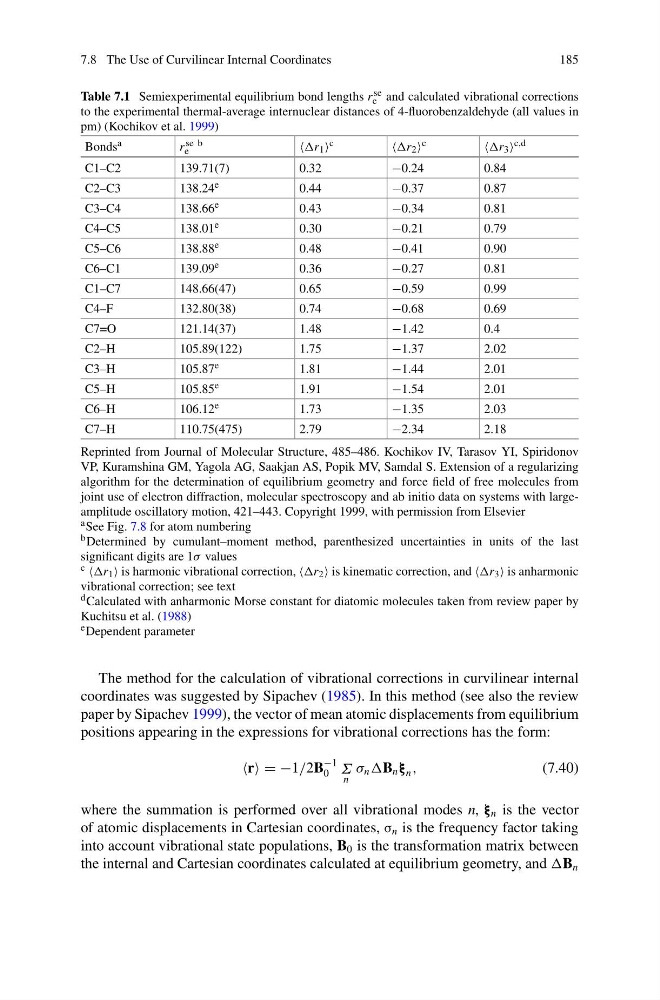
Table 7.1 Semiexperimental equilibrium bond lengths r se
e and calculated vibrational corrections
to the experimental thermal-average internuclear distances of 4-fluorobenzaldehyde (all values in
pm) (Kochikov et al. 1999)
Bonds a
r se
e
b
r 1 c
r 2 c
r 3 c,d
C1–C2
139.71(7)
0.32
−0.24
0.84
C2–C3
138.24 e
0.44
−0.37
0.87
C3–C4
138.66 e
0.43
−0.34
0.81
C4–C5
138.01 e
0.30
−0.21
0.79
C5–C6
138.88 e
0.48
−0.41
0.90
C6–C1
139.09 e
0.36
−0.27
0.81
C1–C7
148.66(47)
0.65
−0.59
0.99
C4–F
132.80(38)
0.74
−0.68
0.69
C7=O
121.14(37)
1.48
−1.42
0.4
C2–H
105.89(122)
1.75
−1.37
2.02
C3–H
105.87 e
1.81
−1.44
2.01
C5–H
105.85 e
1.91
−1.54
2.01
C6–H
106.12 e
1.73
−1.35
2.03
C7–H
110.75(475)
2.79
−2.34
2.18
Reprinted from Journal of Molecular Structure, 485–486. Kochikov IV, Tarasov YI, Spiridonov
VP, Kuramshina GM, Yagola AG, Saakjan AS, Popik MV, Samdal S. Extension of a regularizing
algorithm for the determination of equilibrium geometry and force field of free molecules from
joint use of electron diffraction, molecular spectroscopy and ab initio data on systems with largeamplitude oscillatory motion, 421–443. Copyright 1999, with permission from Elsevier
a See Fig. 7.8 for atom numbering
b Determined by cumulant–moment method, parenthesized uncertainties in units of the last
significant digits are 1σ values
c r 1 is harmonic vibrational correction, r 2 is kinematic correction, and r 3 is anharmonic
vibrational correction; see text
d Calculated with anharmonic Morse constant for diatomic molecules taken from review paper by
Kuchitsu et al. (1988)
e Dependent parameter
The method for the calculation of vibrational corrections in curvilinear internal
coordinates was suggested by Sipachev (1985). In this method (see also the review
paper by Sipachev 1999), the vector of mean atomic displacements from equilibrium
positions appearing in the expressions for vibrational corrections has the form:
r = −1/2B
−1
0 Σ
n
σ n B n ξ n ,
(7.40)
where the summation is performed over all vibrational modes n, ξ n is the vector
of atomic displacements in Cartesian coordinates, σ n is the frequency factor taking
into account vibrational state populations, B 0 is the transformation matrix between
the internal and Cartesian coordinates calculated at equilibrium geometry, and B n
185
Table 7.1 Semiexperimental equilibrium bond lengths r se
e and calculated vibrational corrections
to the experimental thermal-average internuclear distances of 4-fluorobenzaldehyde (all values in
pm) (Kochikov et al. 1999)
Bonds a
r se
e
b
r 1 c
r 2 c
r 3 c,d
C1–C2
139.71(7)
0.32
−0.24
0.84
C2–C3
138.24 e
0.44
−0.37
0.87
C3–C4
138.66 e
0.43
−0.34
0.81
C4–C5
138.01 e
0.30
−0.21
0.79
C5–C6
138.88 e
0.48
−0.41
0.90
C6–C1
139.09 e
0.36
−0.27
0.81
C1–C7
148.66(47)
0.65
−0.59
0.99
C4–F
132.80(38)
0.74
−0.68
0.69
C7=O
121.14(37)
1.48
−1.42
0.4
C2–H
105.89(122)
1.75
−1.37
2.02
C3–H
105.87 e
1.81
−1.44
2.01
C5–H
105.85 e
1.91
−1.54
2.01
C6–H
106.12 e
1.73
−1.35
2.03
C7–H
110.75(475)
2.79
−2.34
2.18
Reprinted from Journal of Molecular Structure, 485–486. Kochikov IV, Tarasov YI, Spiridonov
VP, Kuramshina GM, Yagola AG, Saakjan AS, Popik MV, Samdal S. Extension of a regularizing
algorithm for the determination of equilibrium geometry and force field of free molecules from
joint use of electron diffraction, molecular spectroscopy and ab initio data on systems with largeamplitude oscillatory motion, 421–443. Copyright 1999, with permission from Elsevier
a See Fig. 7.8 for atom numbering
b Determined by cumulant–moment method, parenthesized uncertainties in units of the last
significant digits are 1σ values
c r 1 is harmonic vibrational correction, r 2 is kinematic correction, and r 3 is anharmonic
vibrational correction; see text
d Calculated with anharmonic Morse constant for diatomic molecules taken from review paper by
Kuchitsu et al. (1988)
e Dependent parameter
The method for the calculation of vibrational corrections in curvilinear internal
coordinates was suggested by Sipachev (1985). In this method (see also the review
paper by Sipachev 1999), the vector of mean atomic displacements from equilibrium
positions appearing in the expressions for vibrational corrections has the form:
r = −1/2B
−1
0 Σ
n
σ n B n ξ n ,
(7.40)
where the summation is performed over all vibrational modes n, ξ n is the vector
of atomic displacements in Cartesian coordinates, σ n is the frequency factor taking
into account vibrational state populations, B 0 is the transformation matrix between
the internal and Cartesian coordinates calculated at equilibrium geometry, and B n