

7.6 Methodology of Equilibrium Structure Determination
179
on each step of the fitting, and thus, the complete (semiexperimental) equilibrium
structure will be refined. The method of vibrational correction calculations suggested
by Sipachev (1985, 2000) is mainly used in modern electron diffraction structural
analysis (see Sect. 7.8).
The second algorithm was suggested by Spiridonov et al. (1981a). In the developed
method, the molecular electron scattering intensity is expressed as a function of the
equilibrium structural parameters and force constants (see Sect. 7.8). Therefore,
the parameters of potential energy functions of the simplest polyatomic molecules
could be simultaneously refined in the least-squares analysis of experimental data.
However, the quality of experimental intensities is often not high enough to determine
the force constants with appropriate uncertainties. Many examples of studies within
this scheme can be found in review by Spiridonov et al. (2001).
7.7 Determination of Molecular Structure in Terms
of Potential Energy Functions
See also Sects. 5.1–5.3, 5.6, and 5.7.
7.7.1 Harmonic Approximation
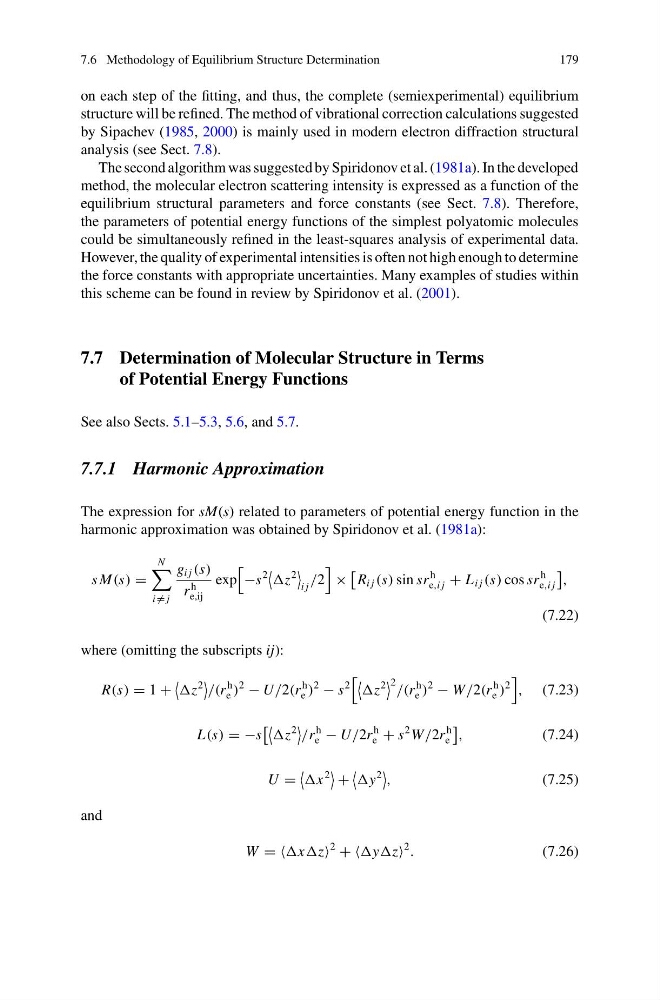
The expression for sM(s) related to parameters of potential energy function in the
harmonic approximation was obtained by Spiridonov et al. (1981a):
s M(s) =
N
i = j
g i j (s)
r
h
e,ij
exp
−s
2
z
2
i j
/2
×
R i j (s) sin sr
h
e,i j + L i j (s) cos sr
h
e,i j
,
(7.22)
where (omitting the subscripts ij):
R(s) = 1 +
z
2
/(r
h
e )
2
− U/2(r
h
e )
2
− s
2
z
2
2 /(r
h
e )
2
− W/2(r
h
e )
2
, (7.23)
L(s) = −s
z
2
/r
h
e − U/2r
h
e + s
2 W/2r
h
e
,
(7.24)
U =
x
2
+
y
2
,
(7.25)
and
W = xz
2
+ yz
2
.
(7.26)
179
on each step of the fitting, and thus, the complete (semiexperimental) equilibrium
structure will be refined. The method of vibrational correction calculations suggested
by Sipachev (1985, 2000) is mainly used in modern electron diffraction structural
analysis (see Sect. 7.8).
The second algorithm was suggested by Spiridonov et al. (1981a). In the developed
method, the molecular electron scattering intensity is expressed as a function of the
equilibrium structural parameters and force constants (see Sect. 7.8). Therefore,
the parameters of potential energy functions of the simplest polyatomic molecules
could be simultaneously refined in the least-squares analysis of experimental data.
However, the quality of experimental intensities is often not high enough to determine
the force constants with appropriate uncertainties. Many examples of studies within
this scheme can be found in review by Spiridonov et al. (2001).
7.7 Determination of Molecular Structure in Terms
of Potential Energy Functions
See also Sects. 5.1–5.3, 5.6, and 5.7.
7.7.1 Harmonic Approximation
The expression for sM(s) related to parameters of potential energy function in the
harmonic approximation was obtained by Spiridonov et al. (1981a):
s M(s) =
N
i = j
g i j (s)
r
h
e,ij
exp
−s
2
z
2
i j
/2
×
R i j (s) sin sr
h
e,i j + L i j (s) cos sr
h
e,i j
,
(7.22)
where (omitting the subscripts ij):
R(s) = 1 +
z
2
/(r
h
e )
2
− U/2(r
h
e )
2
− s
2
z
2
2 /(r
h
e )
2
− W/2(r
h
e )
2
, (7.23)
L(s) = −s
z
2
/r
h
e − U/2r
h
e + s
2 W/2r
h
e
,
(7.24)
U =
x
2
+
y
2
,
(7.25)
and
W = xz
2
+ yz
2
.
(7.26)