

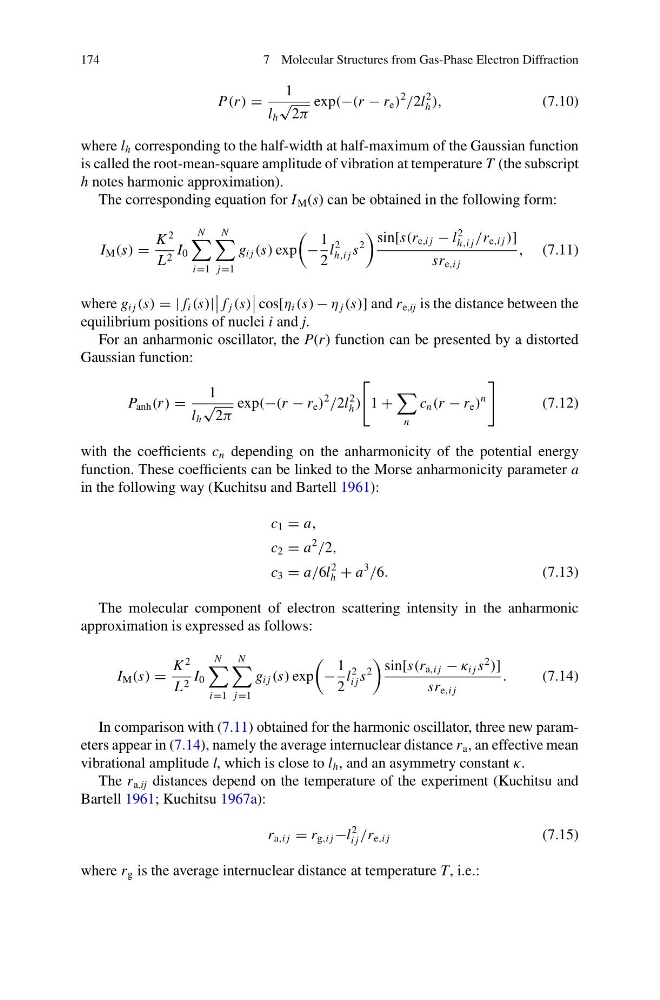
174
7 Molecular Structures from Gas-Phase Electron Diffraction
P(r ) =
1
l h
√
2π
exp(−(r − r e )
2
/2l
2
h ),
(7.10)
where l h corresponding to the half-width at half-maximum of the Gaussian function
is called the root-mean-square amplitude of vibration at temperature T (the subscript
h notes harmonic approximation).
The corresponding equation for I M (s) can be obtained in the following form:
I M (s) =
K
2
L 2 I 0
N
i=1
N
j=1
g i j (s) exp
−
1
2
l
2
h,i j s
2
sin[s(r e,i j − l
2
h,i j /r e,i j )]
sr e,i j
, (7.11)
where g i j (s) = | f i (s)|
f j (s)
cos[η i (s) − η j (s)] and r e,ij is the distance between the
equilibrium positions of nuclei i and j.
For an anharmonic oscillator, the P(r) function can be presented by a distorted
Gaussian function:
P anh (r ) =
1
l h
√
2π
exp(−(r − r e )
2
/2l
2
h )
1 +
n
c n (r − r e )
n
(7.12)
with the coefficients c n depending on the anharmonicity of the potential energy
function. These coefficients can be linked to the Morse anharmonicity parameter a
in the following way (Kuchitsu and Bartell 1961):
c 1 = a,
c 2 = a
2
/2,
c 3 = a/6l
2
h + a
3
/6.
(7.13)
The molecular component of electron scattering intensity in the anharmonic
approximation is expressed as follows:
I M (s) =
K
2
L 2 I 0
N
i=1
N
j=1
g i j (s) exp
−
1
2
l
2
i j s
2
sin[s(r a,i j − κ i j s
2
)]
sr e,i j
.
(7.14)
In comparison with (7.11) obtained for the harmonic oscillator, three new parameters appear in (7.14), namely the average internuclear distance r a , an effective mean
vibrational amplitude l, which is close to l h , and an asymmetry constant κ.
The r a,ij distances depend on the temperature of the experiment (Kuchitsu and
Bartell 1961; Kuchitsu 1967a):
r a,i j = r g,i j −l
2
i j /r e,i j
(7.15)
where r g is the average internuclear distance at temperature T, i.e.:
7 Molecular Structures from Gas-Phase Electron Diffraction
P(r ) =
1
l h
√
2π
exp(−(r − r e )
2
/2l
2
h ),
(7.10)
where l h corresponding to the half-width at half-maximum of the Gaussian function
is called the root-mean-square amplitude of vibration at temperature T (the subscript
h notes harmonic approximation).
The corresponding equation for I M (s) can be obtained in the following form:
I M (s) =
K
2
L 2 I 0
N
i=1
N
j=1
g i j (s) exp
−
1
2
l
2
h,i j s
2
sin[s(r e,i j − l
2
h,i j /r e,i j )]
sr e,i j
, (7.11)
where g i j (s) = | f i (s)|
f j (s)
cos[η i (s) − η j (s)] and r e,ij is the distance between the
equilibrium positions of nuclei i and j.
For an anharmonic oscillator, the P(r) function can be presented by a distorted
Gaussian function:
P anh (r ) =
1
l h
√
2π
exp(−(r − r e )
2
/2l
2
h )
1 +
n
c n (r − r e )
n
(7.12)
with the coefficients c n depending on the anharmonicity of the potential energy
function. These coefficients can be linked to the Morse anharmonicity parameter a
in the following way (Kuchitsu and Bartell 1961):
c 1 = a,
c 2 = a
2
/2,
c 3 = a/6l
2
h + a
3
/6.
(7.13)
The molecular component of electron scattering intensity in the anharmonic
approximation is expressed as follows:
I M (s) =
K
2
L 2 I 0
N
i=1
N
j=1
g i j (s) exp
−
1
2
l
2
i j s
2
sin[s(r a,i j − κ i j s
2
)]
sr e,i j
.
(7.14)
In comparison with (7.11) obtained for the harmonic oscillator, three new parameters appear in (7.14), namely the average internuclear distance r a , an effective mean
vibrational amplitude l, which is close to l h , and an asymmetry constant κ.
The r a,ij distances depend on the temperature of the experiment (Kuchitsu and
Bartell 1961; Kuchitsu 1967a):
r a,i j = r g,i j −l
2
i j /r e,i j
(7.15)
where r g is the average internuclear distance at temperature T, i.e.: