

172
7 Molecular Structures from Gas-Phase Electron Diffraction
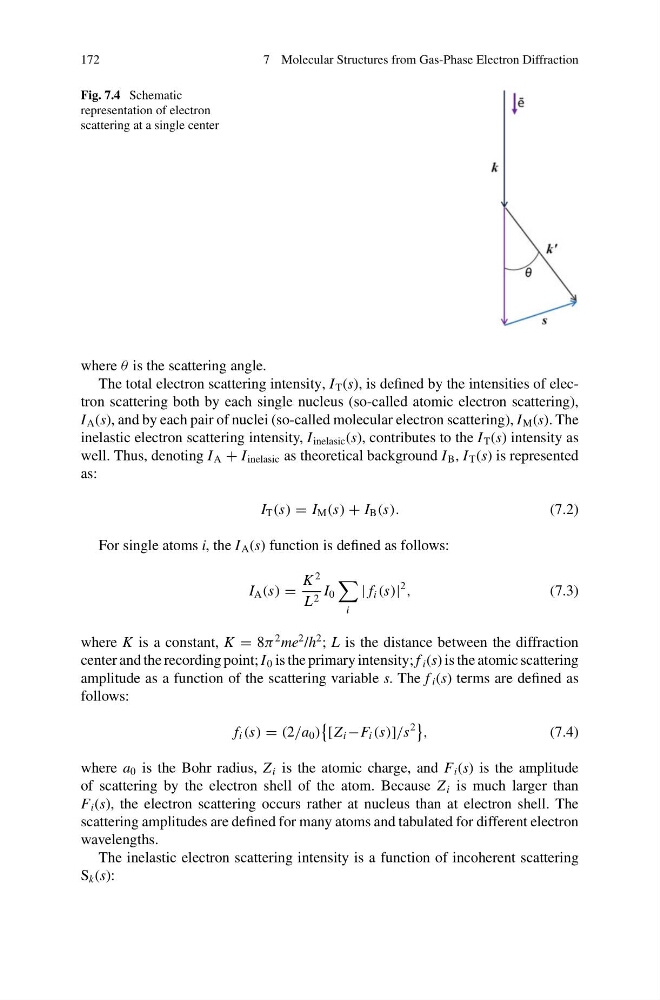
Fig. 7.4 Schematic
representation of electron
scattering at a single center
where θ is the scattering angle.
The total electron scattering intensity, I T (s), is defined by the intensities of electron scattering both by each single nucleus (so-called atomic electron scattering),
I A (s), and by each pair of nuclei (so-called molecular electron scattering), I M (s). The
inelastic electron scattering intensity, I inelasic (s), contributes to the I T (s) intensity as
well. Thus, denoting I A + I inelasic as theoretical background I B , I T (s) is represented
as:
I T (s) = I M (s) + I B (s).
(7.2)
For single atoms i, the I A (s) function is defined as follows:
I A (s) =
K
2
L 2 I 0
i
| f i (s)|
2
,
(7.3)
where K is a constant, K = 8π
2 me
2 /h
2 ; L is the distance between the diffraction
center and the recording point; I 0 is the primary intensity; f i (s) is the atomic scattering
amplitude as a function of the scattering variable s. The f i (s) terms are defined as
follows:
f i (s) = (2/a 0 )
[Z i −F i (s)]/s
2
,
(7.4)
where a 0 is the Bohr radius, Z i is the atomic charge, and F i (s) is the amplitude
of scattering by the electron shell of the atom. Because Z i is much larger than
F i (s), the electron scattering occurs rather at nucleus than at electron shell. The
scattering amplitudes are defined for many atoms and tabulated for different electron
wavelengths.
The inelastic electron scattering intensity is a function of incoherent scattering
S k (s):
7 Molecular Structures from Gas-Phase Electron Diffraction
Fig. 7.4 Schematic
representation of electron
scattering at a single center
where θ is the scattering angle.
The total electron scattering intensity, I T (s), is defined by the intensities of electron scattering both by each single nucleus (so-called atomic electron scattering),
I A (s), and by each pair of nuclei (so-called molecular electron scattering), I M (s). The
inelastic electron scattering intensity, I inelasic (s), contributes to the I T (s) intensity as
well. Thus, denoting I A + I inelasic as theoretical background I B , I T (s) is represented
as:
I T (s) = I M (s) + I B (s).
(7.2)
For single atoms i, the I A (s) function is defined as follows:
I A (s) =
K
2
L 2 I 0
i
| f i (s)|
2
,
(7.3)
where K is a constant, K = 8π
2 me
2 /h
2 ; L is the distance between the diffraction
center and the recording point; I 0 is the primary intensity; f i (s) is the atomic scattering
amplitude as a function of the scattering variable s. The f i (s) terms are defined as
follows:
f i (s) = (2/a 0 )
[Z i −F i (s)]/s
2
,
(7.4)
where a 0 is the Bohr radius, Z i is the atomic charge, and F i (s) is the amplitude
of scattering by the electron shell of the atom. Because Z i is much larger than
F i (s), the electron scattering occurs rather at nucleus than at electron shell. The
scattering amplitudes are defined for many atoms and tabulated for different electron
wavelengths.
The inelastic electron scattering intensity is a function of incoherent scattering
S k (s):