

170
7 Molecular Structures from Gas-Phase Electron Diffraction
where E is kinetic energy of the electron and c is the speed of light). The electron wavelength is determined in a complementary investigation of molecules with
well-known values of internuclear distances (e.g., benzene and tetrachloromethane).
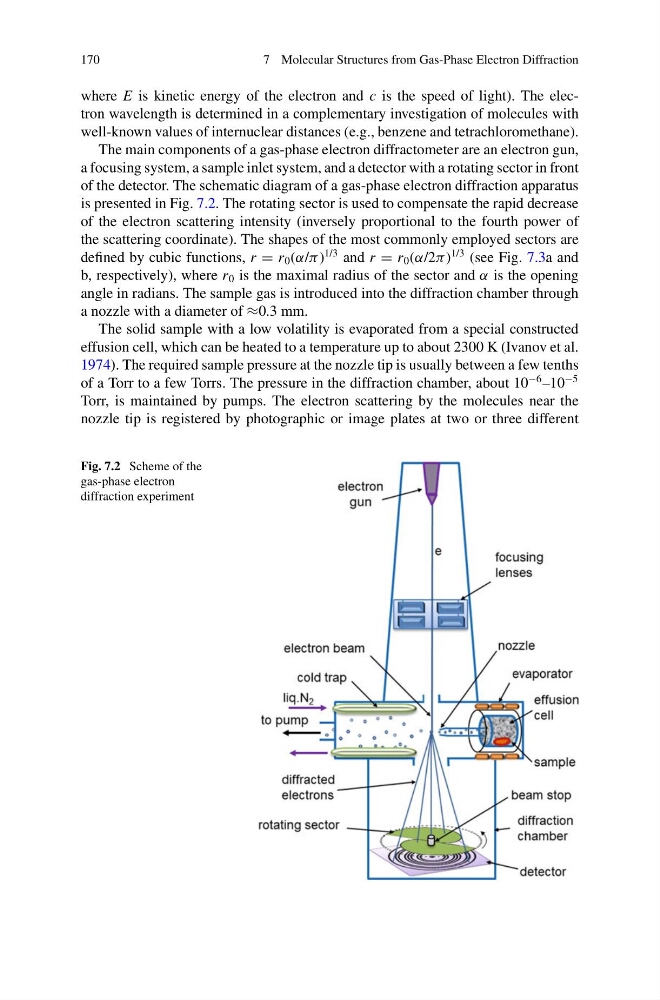
The main components of a gas-phase electron diffractometer are an electron gun,
a focusing system, a sample inlet system, and a detector with a rotating sector in front
of the detector. The schematic diagram of a gas-phase electron diffraction apparatus
is presented in Fig. 7.2. The rotating sector is used to compensate the rapid decrease
of the electron scattering intensity (inversely proportional to the fourth power of
the scattering coordinate). The shapes of the most commonly employed sectors are
defined by cubic functions, r = r 0 (α/π )
1/3 and r = r 0 (α/2π )
1/3 (see Fig. 7.3a and
b, respectively), where r 0 is the maximal radius of the sector and α is the opening
angle in radians. The sample gas is introduced into the diffraction chamber through
a nozzle with a diameter of ≈0.3 mm.
The solid sample with a low volatility is evaporated from a special constructed
effusion cell, which can be heated to a temperature up to about 2300 K (Ivanov et al.
1974). The required sample pressure at the nozzle tip is usually between a few tenths
of a Torr to a few Torrs. The pressure in the diffraction chamber, about 10
−6 –10
−5
Torr, is maintained by pumps. The electron scattering by the molecules near the
nozzle tip is registered by photographic or image plates at two or three different
Fig. 7.2 Scheme of the
gas-phase electron
diffraction experiment
7 Molecular Structures from Gas-Phase Electron Diffraction
where E is kinetic energy of the electron and c is the speed of light). The electron wavelength is determined in a complementary investigation of molecules with
well-known values of internuclear distances (e.g., benzene and tetrachloromethane).
The main components of a gas-phase electron diffractometer are an electron gun,
a focusing system, a sample inlet system, and a detector with a rotating sector in front
of the detector. The schematic diagram of a gas-phase electron diffraction apparatus
is presented in Fig. 7.2. The rotating sector is used to compensate the rapid decrease
of the electron scattering intensity (inversely proportional to the fourth power of
the scattering coordinate). The shapes of the most commonly employed sectors are
defined by cubic functions, r = r 0 (α/π )
1/3 and r = r 0 (α/2π )
1/3 (see Fig. 7.3a and
b, respectively), where r 0 is the maximal radius of the sector and α is the opening
angle in radians. The sample gas is introduced into the diffraction chamber through
a nozzle with a diameter of ≈0.3 mm.
The solid sample with a low volatility is evaporated from a special constructed
effusion cell, which can be heated to a temperature up to about 2300 K (Ivanov et al.
1974). The required sample pressure at the nozzle tip is usually between a few tenths
of a Torr to a few Torrs. The pressure in the diffraction chamber, about 10
−6 –10
−5
Torr, is maintained by pumps. The electron scattering by the molecules near the
nozzle tip is registered by photographic or image plates at two or three different
Fig. 7.2 Scheme of the
gas-phase electron
diffraction experiment