

156
6 Equilibrium Structures from Spectroscopy
r e =
h
8π 2 B e
(6.30)
6.9.5 Use of the Quadrupole Coupling Constants (Legon
and Demaison 2011)
Although the quadrupole coupling constants furnish useful information on the structure of any molecule including the semirigid ones, it is mainly used in the case of
molecular complexes.
A nucleus with a nuclear spin I > 1/2 possesses a quadrupole moment Q. The
interaction between Q and the electric field gradient of the molecule gives raise
to a hyperfine structure of the rotation spectrum characterized by a set of nuclear
quadrupole coupling constants, which form a symmetric tensor χ of rank 3
χ =
⎛
⎝
χ aa χ ab χ ac
χ ab χ bb χ bc
χ ac χ bc χ cc
⎞
⎠
(6.31)
where
χ xy = eQ
∂
2 V
∂ x∂ y
(6.32)
The diagonal elements of χ are easy to determine and may be used to gather
useful information on the structure.
Example: Planar T-shaped Ar· · · HC≡CC≡N van der Waals complex (Huckauf
et al. 2003).
It is assumed that the electric field gradient at the nitrogen nucleus is the same in
both the free HC≡CC≡N molecule and the complex. If this assumption is correct,
the quadrupole coupling constant χ cc = −2.1609(5) MHz of the complex should
be close to value χ 0 /2 = −2.1590(2) MHz found for free HC≡CC≡N, since the
atoms of the complex lie in the ab principal plane. The values of the quadrupole
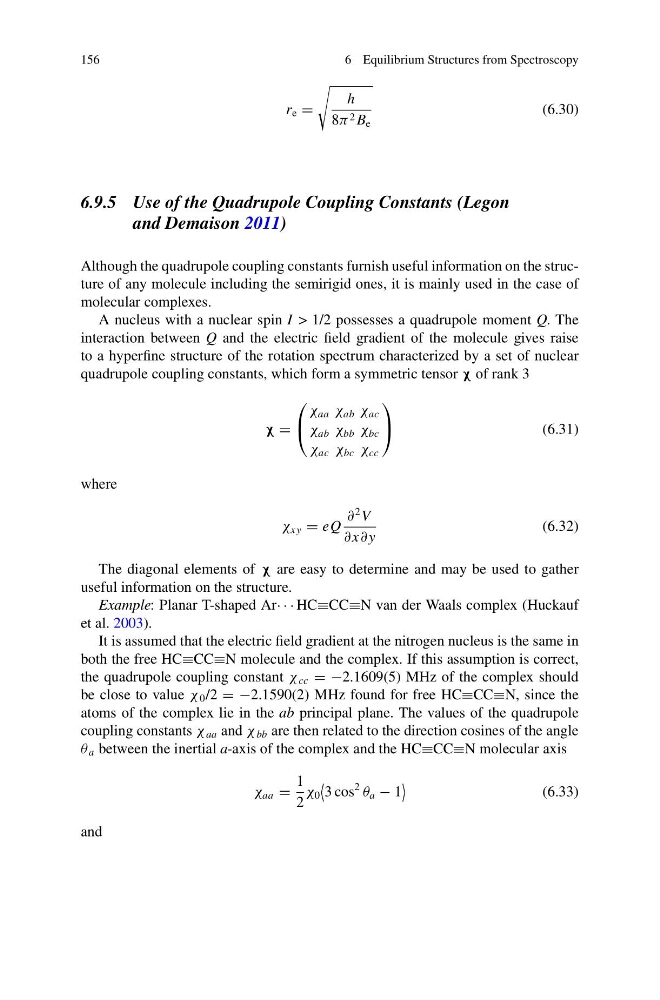
coupling constants χ aa and χ bb are then related to the direction cosines of the angle
θ a between the inertial a-axis of the complex and the HC≡CC≡N molecular axis
χ aa =
1
2
χ 0
3 cos
2
θ a − 1
(6.33)
and
6 Equilibrium Structures from Spectroscopy
r e =
h
8π 2 B e
(6.30)
6.9.5 Use of the Quadrupole Coupling Constants (Legon
and Demaison 2011)
Although the quadrupole coupling constants furnish useful information on the structure of any molecule including the semirigid ones, it is mainly used in the case of
molecular complexes.
A nucleus with a nuclear spin I > 1/2 possesses a quadrupole moment Q. The
interaction between Q and the electric field gradient of the molecule gives raise
to a hyperfine structure of the rotation spectrum characterized by a set of nuclear
quadrupole coupling constants, which form a symmetric tensor χ of rank 3
χ =
⎛
⎝
χ aa χ ab χ ac
χ ab χ bb χ bc
χ ac χ bc χ cc
⎞
⎠
(6.31)
where
χ xy = eQ
∂
2 V
∂ x∂ y
(6.32)
The diagonal elements of χ are easy to determine and may be used to gather
useful information on the structure.
Example: Planar T-shaped Ar· · · HC≡CC≡N van der Waals complex (Huckauf
et al. 2003).
It is assumed that the electric field gradient at the nitrogen nucleus is the same in
both the free HC≡CC≡N molecule and the complex. If this assumption is correct,
the quadrupole coupling constant χ cc = −2.1609(5) MHz of the complex should
be close to value χ 0 /2 = −2.1590(2) MHz found for free HC≡CC≡N, since the
atoms of the complex lie in the ab principal plane. The values of the quadrupole
coupling constants χ aa and χ bb are then related to the direction cosines of the angle
θ a between the inertial a-axis of the complex and the HC≡CC≡N molecular axis
χ aa =
1
2
χ 0
3 cos
2
θ a − 1
(6.33)
and