

6.9 Structure of Weakly Bound Complexes
155
+
1
2
I
(2)
bb
1 +
cos
2
θ 2
+
1
2
I
(2)
aa
sin
2
θ 2
(6.24)
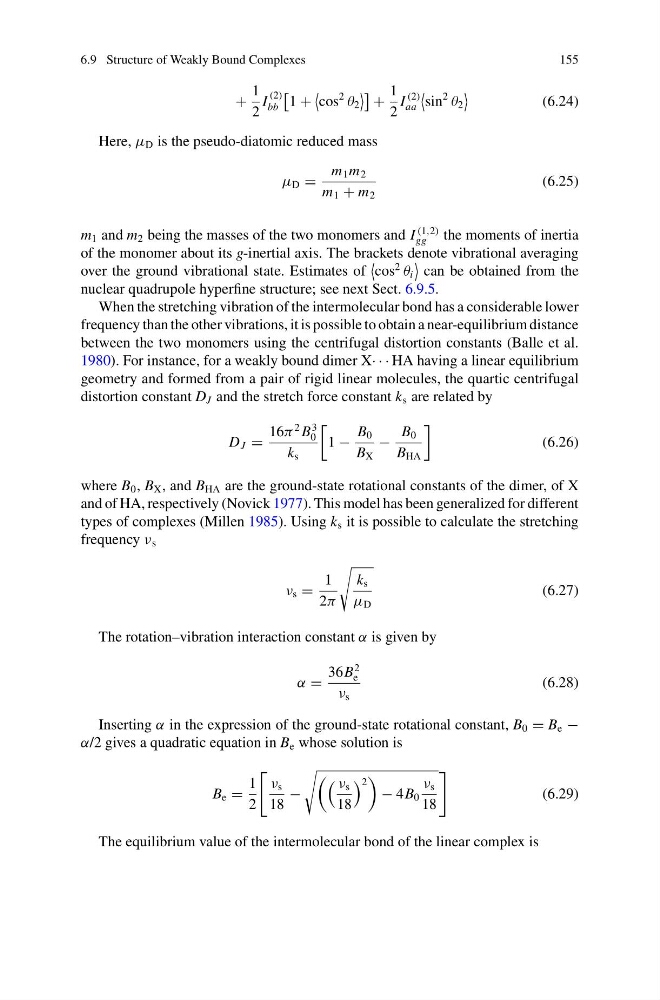
Here, μ D is the pseudo-diatomic reduced mass
μ D =
m 1 m 2
m 1 + m 2
(6.25)
m 1 and m 2 being the masses of the two monomers and I
(1,2)
gg
the moments of inertia
of the monomer about its g-inertial axis. The brackets denote vibrational averaging
over the ground vibrational state. Estimates of
cos
2
θ i
can be obtained from the
nuclear quadrupole hyperfine structure; see next Sect. 6.9.5.
When the stretching vibration of the intermolecular bond has a considerable lower
frequency than the other vibrations, it is possible to obtain a near-equilibrium distance
between the two monomers using the centrifugal distortion constants (Balle et al.
1980). For instance, for a weakly bound dimer X· · · HA having a linear equilibrium
geometry and formed from a pair of rigid linear molecules, the quartic centrifugal
distortion constant D J and the stretch force constant k s are related by
D J =
16π
2 B
3
0
k s
1 −
B 0
B X
−
B 0
B HA
(6.26)
where B 0 , B X , and B HA are the ground-state rotational constants of the dimer, of X
and of HA, respectively (Novick 1977). This model has been generalized for different
types of complexes (Millen 1985). Using k s it is possible to calculate the stretching
frequency ν s
ν s =
1
2π
k s
μ D
(6.27)
The rotation–vibration interaction constant α is given by
α =
36B
2
e
ν s
(6.28)
Inserting α in the expression of the ground-state rotational constant, B 0 = B e −
α/2 gives a quadratic equation in B e whose solution is
B e =
1
2
ν s
18
−
ν s
18
2
− 4B 0
ν s
18
(6.29)
The equilibrium value of the intermolecular bond of the linear complex is
155
+
1
2
I
(2)
bb
1 +
cos
2
θ 2
+
1
2
I
(2)
aa
sin
2
θ 2
(6.24)
Here, μ D is the pseudo-diatomic reduced mass
μ D =
m 1 m 2
m 1 + m 2
(6.25)
m 1 and m 2 being the masses of the two monomers and I
(1,2)
gg
the moments of inertia
of the monomer about its g-inertial axis. The brackets denote vibrational averaging
over the ground vibrational state. Estimates of
cos
2
θ i
can be obtained from the
nuclear quadrupole hyperfine structure; see next Sect. 6.9.5.
When the stretching vibration of the intermolecular bond has a considerable lower
frequency than the other vibrations, it is possible to obtain a near-equilibrium distance
between the two monomers using the centrifugal distortion constants (Balle et al.
1980). For instance, for a weakly bound dimer X· · · HA having a linear equilibrium
geometry and formed from a pair of rigid linear molecules, the quartic centrifugal
distortion constant D J and the stretch force constant k s are related by
D J =
16π
2 B
3
0
k s
1 −
B 0
B X
−
B 0
B HA
(6.26)
where B 0 , B X , and B HA are the ground-state rotational constants of the dimer, of X
and of HA, respectively (Novick 1977). This model has been generalized for different
types of complexes (Millen 1985). Using k s it is possible to calculate the stretching
frequency ν s
ν s =
1
2π
k s
μ D
(6.27)
The rotation–vibration interaction constant α is given by
α =
36B
2
e
ν s
(6.28)
Inserting α in the expression of the ground-state rotational constant, B 0 = B e −
α/2 gives a quadratic equation in B e whose solution is
B e =
1
2
ν s
18
−
ν s
18
2
− 4B 0
ν s
18
(6.29)
The equilibrium value of the intermolecular bond of the linear complex is