

142
6 Equilibrium Structures from Spectroscopy
such a case, the perturbation calculation breaks down, and the resonance should be
treated by construction and diagonalization of a matrix of the rotational states of the
coupled vibrations.
The case of the anharmonic resonances, even weak, is particularly important
because they are not taken into account in (6.2). The experimental rotational constants
have to be corrected before using them for a structure determination. When the
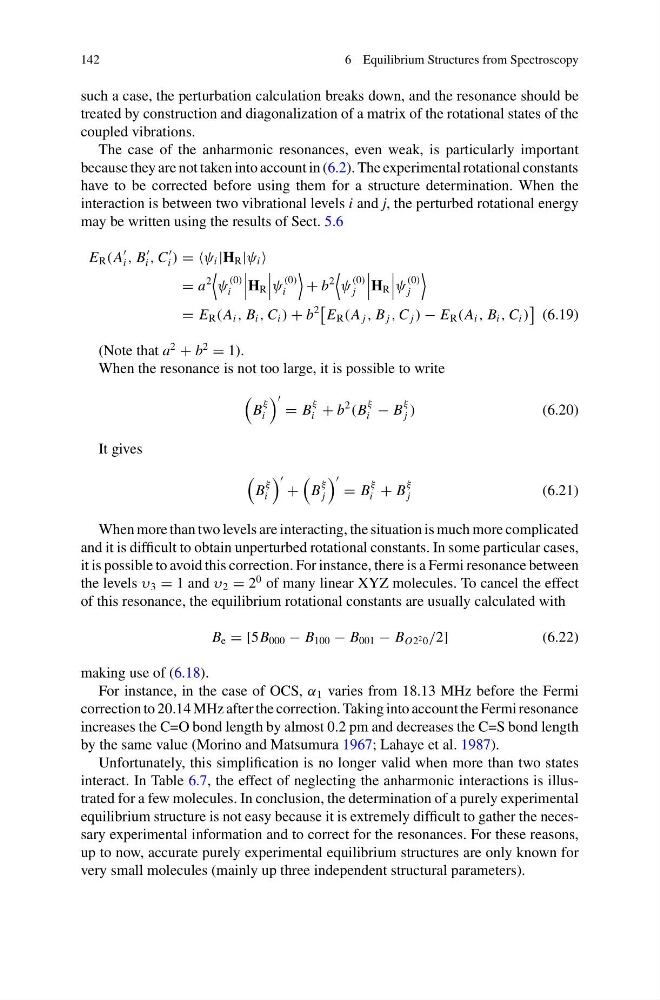
interaction is between two vibrational levels i and j, the perturbed rotational energy
may be written using the results of Sect. 5.6
E R (A
i , B
i , C
i ) = ψ i |H R |ψ i
= a
2
ψ
(0)
i
HR
ψ
(0)
i
+ b
2
ψ
(0)
j
HR
ψ
(0)
j
= E R (A i , B i , C i ) + b
2
E R (A j , B j , C j ) − E R (A i , B i , C i )
(6.19)
(Note that a
2
+ b
2
= 1).
When the resonance is not too large, it is possible to write
B
ξ
i
= B
ξ
i + b
2
(B
ξ
i − B
ξ
j )
(6.20)
It gives
B
ξ
i
+
B
ξ
j
= B
ξ
i + B
ξ
j
(6.21)
When more than two levels are interacting, the situation is much more complicated
and it is difficult to obtain unperturbed rotational constants. In some particular cases,
it is possible to avoid this correction. For instance, there is a Fermi resonance between
the levels υ 3 = 1 and υ 2 = 2
0 of many linear XYZ molecules. To cancel the effect
of this resonance, the equilibrium rotational constants are usually calculated with
B e = [5B 000 − B 100 − B 001 − B O2 2 0 /2]
(6.22)
making use of (6.18).
For instance, in the case of OCS, α 1 varies from 18.13 MHz before the Fermi
correction to 20.14 MHz after the correction. Taking into account the Fermi resonance
increases the C=O bond length by almost 0.2 pm and decreases the C=S bond length
by the same value (Morino and Matsumura 1967; Lahaye et al. 1987).
Unfortunately, this simplification is no longer valid when more than two states
interact. In Table 6.7, the effect of neglecting the anharmonic interactions is illustrated for a few molecules. In conclusion, the determination of a purely experimental
equilibrium structure is not easy because it is extremely difficult to gather the necessary experimental information and to correct for the resonances. For these reasons,
up to now, accurate purely experimental equilibrium structures are only known for
very small molecules (mainly up three independent structural parameters).
6 Equilibrium Structures from Spectroscopy
such a case, the perturbation calculation breaks down, and the resonance should be
treated by construction and diagonalization of a matrix of the rotational states of the
coupled vibrations.
The case of the anharmonic resonances, even weak, is particularly important
because they are not taken into account in (6.2). The experimental rotational constants
have to be corrected before using them for a structure determination. When the
interaction is between two vibrational levels i and j, the perturbed rotational energy
may be written using the results of Sect. 5.6
E R (A
i , B
i , C
i ) = ψ i |H R |ψ i
= a
2
ψ
(0)
i
HR
ψ
(0)
i
+ b
2
ψ
(0)
j
HR
ψ
(0)
j
= E R (A i , B i , C i ) + b
2
E R (A j , B j , C j ) − E R (A i , B i , C i )
(6.19)
(Note that a
2
+ b
2
= 1).
When the resonance is not too large, it is possible to write
B
ξ
i
= B
ξ
i + b
2
(B
ξ
i − B
ξ
j )
(6.20)
It gives
B
ξ
i
+
B
ξ
j
= B
ξ
i + B
ξ
j
(6.21)
When more than two levels are interacting, the situation is much more complicated
and it is difficult to obtain unperturbed rotational constants. In some particular cases,
it is possible to avoid this correction. For instance, there is a Fermi resonance between
the levels υ 3 = 1 and υ 2 = 2
0 of many linear XYZ molecules. To cancel the effect
of this resonance, the equilibrium rotational constants are usually calculated with
B e = [5B 000 − B 100 − B 001 − B O2 2 0 /2]
(6.22)
making use of (6.18).
For instance, in the case of OCS, α 1 varies from 18.13 MHz before the Fermi
correction to 20.14 MHz after the correction. Taking into account the Fermi resonance
increases the C=O bond length by almost 0.2 pm and decreases the C=S bond length
by the same value (Morino and Matsumura 1967; Lahaye et al. 1987).
Unfortunately, this simplification is no longer valid when more than two states
interact. In Table 6.7, the effect of neglecting the anharmonic interactions is illustrated for a few molecules. In conclusion, the determination of a purely experimental
equilibrium structure is not easy because it is extremely difficult to gather the necessary experimental information and to correct for the resonances. For these reasons,
up to now, accurate purely experimental equilibrium structures are only known for
very small molecules (mainly up three independent structural parameters).