

6.6 Experimental Equilibrium Structure
141
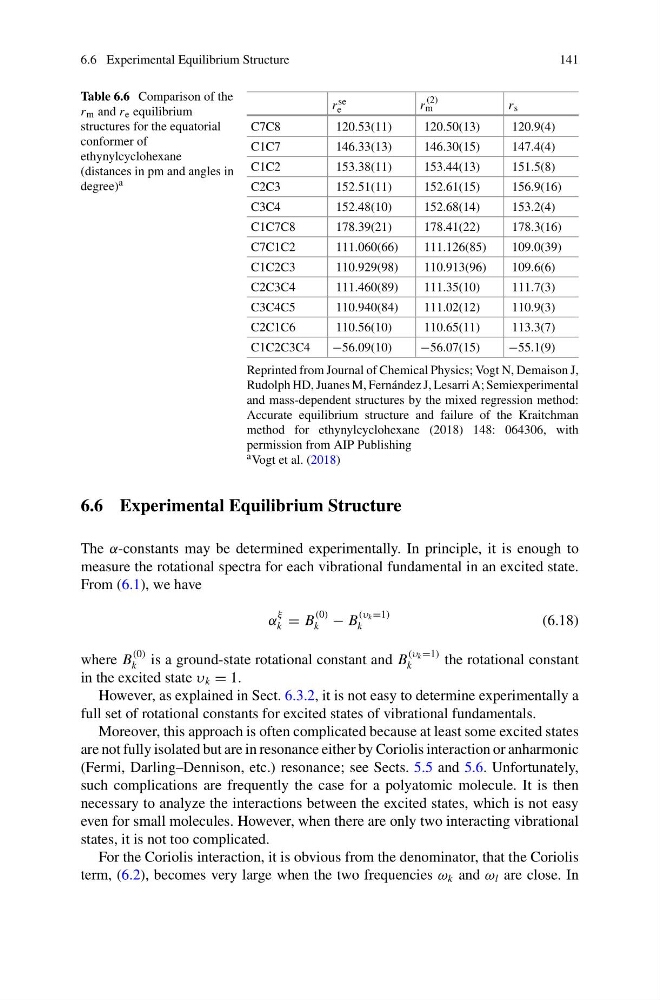
Table 6.6 Comparison of the
r m and r e equilibrium
structures for the equatorial
conformer of
ethynylcyclohexane
(distances in pm and angles in
degree) a
r se
e
r
(2)
m
r s
C7C8
120.53(11)
120.50(13)
120.9(4)
C1C7
146.33(13)
146.30(15)
147.4(4)
C1C2
153.38(11)
153.44(13)
151.5(8)
C2C3
152.51(11)
152.61(15)
156.9(16)
C3C4
152.48(10)
152.68(14)
153.2(4)
C1C7C8
178.39(21)
178.41(22)
178.3(16)
C7C1C2
111.060(66)
111.126(85)
109.0(39)
C1C2C3
110.929(98)
110.913(96)
109.6(6)
C2C3C4
111.460(89)
111.35(10)
111.7(3)
C3C4C5
110.940(84)
111.02(12)
110.9(3)
C2C1C6
110.56(10)
110.65(11)
113.3(7)
C1C2C3C4
−56.09(10)
−56.07(15)
−55.1(9)
Reprinted from Journal of Chemical Physics; Vogt N, Demaison J,
Rudolph HD, Juanes M, Fernández J, Lesarri A; Semiexperimental
and mass-dependent structures by the mixed regression method:
Accurate equilibrium structure and failure of the Kraitchman
method for ethynylcyclohexane (2018) 148: 064306, with
permission from AIP Publishing
a Vogt et al. (2018)
6.6 Experimental Equilibrium Structure
The α-constants may be determined experimentally. In principle, it is enough to
measure the rotational spectra for each vibrational fundamental in an excited state.
From (6.1), we have
α
ξ
k = B
(0)
k − B
(υ k =1)
k
(6.18)
where B
(0)
k is a ground-state rotational constant and B
(υ k =1)
k
the rotational constant
in the excited state υ k = 1.
However, as explained in Sect. 6.3.2, it is not easy to determine experimentally a
full set of rotational constants for excited states of vibrational fundamentals.
Moreover, this approach is often complicated because at least some excited states
are not fully isolated but are in resonance either by Coriolis interaction or anharmonic
(Fermi, Darling–Dennison, etc.) resonance; see Sects. 5.5 and 5.6. Unfortunately,
such complications are frequently the case for a polyatomic molecule. It is then
necessary to analyze the interactions between the excited states, which is not easy
even for small molecules. However, when there are only two interacting vibrational
states, it is not too complicated.
For the Coriolis interaction, it is obvious from the denominator, that the Coriolis
term, (6.2), becomes very large when the two frequencies ω k and ω l are close. In
141
Table 6.6 Comparison of the
r m and r e equilibrium
structures for the equatorial
conformer of
ethynylcyclohexane
(distances in pm and angles in
degree) a
r se
e
r
(2)
m
r s
C7C8
120.53(11)
120.50(13)
120.9(4)
C1C7
146.33(13)
146.30(15)
147.4(4)
C1C2
153.38(11)
153.44(13)
151.5(8)
C2C3
152.51(11)
152.61(15)
156.9(16)
C3C4
152.48(10)
152.68(14)
153.2(4)
C1C7C8
178.39(21)
178.41(22)
178.3(16)
C7C1C2
111.060(66)
111.126(85)
109.0(39)
C1C2C3
110.929(98)
110.913(96)
109.6(6)
C2C3C4
111.460(89)
111.35(10)
111.7(3)
C3C4C5
110.940(84)
111.02(12)
110.9(3)
C2C1C6
110.56(10)
110.65(11)
113.3(7)
C1C2C3C4
−56.09(10)
−56.07(15)
−55.1(9)
Reprinted from Journal of Chemical Physics; Vogt N, Demaison J,
Rudolph HD, Juanes M, Fernández J, Lesarri A; Semiexperimental
and mass-dependent structures by the mixed regression method:
Accurate equilibrium structure and failure of the Kraitchman
method for ethynylcyclohexane (2018) 148: 064306, with
permission from AIP Publishing
a Vogt et al. (2018)
6.6 Experimental Equilibrium Structure
The α-constants may be determined experimentally. In principle, it is enough to
measure the rotational spectra for each vibrational fundamental in an excited state.
From (6.1), we have
α
ξ
k = B
(0)
k − B
(υ k =1)
k
(6.18)
where B
(0)
k is a ground-state rotational constant and B
(υ k =1)
k
the rotational constant
in the excited state υ k = 1.
However, as explained in Sect. 6.3.2, it is not easy to determine experimentally a
full set of rotational constants for excited states of vibrational fundamentals.
Moreover, this approach is often complicated because at least some excited states
are not fully isolated but are in resonance either by Coriolis interaction or anharmonic
(Fermi, Darling–Dennison, etc.) resonance; see Sects. 5.5 and 5.6. Unfortunately,
such complications are frequently the case for a polyatomic molecule. It is then
necessary to analyze the interactions between the excited states, which is not easy
even for small molecules. However, when there are only two interacting vibrational
states, it is not too complicated.
For the Coriolis interaction, it is obvious from the denominator, that the Coriolis
term, (6.2), becomes very large when the two frequencies ω k and ω l are close. In