

6.4 Empirical Structures
135
6.4.3.2 Accuracy (Demaison and Rudolph 2002)
The drawback of the substitution method is that Kraitchman’s equations are
numerically unstable for small coordinates and may give inaccurate coordinates.
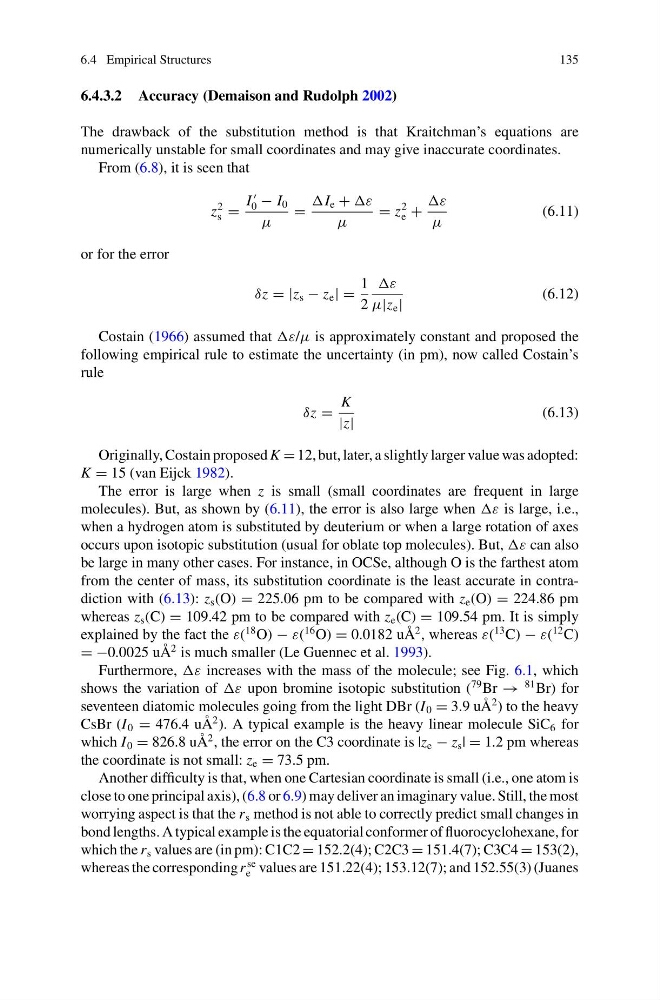
From (6.8), it is seen that
z
2
s =
I
0 − I 0
μ
=
I e + ε
μ
= z
2
e +
ε
μ
(6.11)
or for the error
δz = |z s − z e | =
1
2
ε
μ|z e |
(6.12)
Costain (1966) assumed that ε/μ is approximately constant and proposed the
following empirical rule to estimate the uncertainty (in pm), now called Costain’s
rule
δz =
K
|z|
(6.13)
Originally, Costain proposed K = 12, but, later, a slightly larger value was adopted:
K = 15 (van Eijck 1982).
The error is large when z is small (small coordinates are frequent in large
molecules). But, as shown by (6.11), the error is also large when ε is large, i.e.,
when a hydrogen atom is substituted by deuterium or when a large rotation of axes
occurs upon isotopic substitution (usual for oblate top molecules). But, ε can also
be large in many other cases. For instance, in OCSe, although O is the farthest atom
from the center of mass, its substitution coordinate is the least accurate in contradiction with (6.13): z s (O) = 225.06 pm to be compared with z e (O) = 224.86 pm
whereas z s (C) = 109.42 pm to be compared with z e (C) = 109.54 pm. It is simply
explained by the fact the ε(
18 O) − ε(
16 O) = 0.0182 uÅ
2 , whereas ε(
13 C) − ε(
12 C)
= −0.0025 uÅ
2 is much smaller (Le Guennec et al. 1993).
Furthermore, ε increases with the mass of the molecule; see Fig. 6.1, which
shows the variation of ε upon bromine isotopic substitution (
79 Br →
81 Br) for
seventeen diatomic molecules going from the light DBr (I 0 = 3.9 uÅ
2 ) to the heavy
CsBr (I 0 = 476.4 uÅ
2 ). A typical example is the heavy linear molecule SiC 6 for
which I 0 = 826.8 uÅ
2 , the error on the C3 coordinate is |z e − z s | = 1.2 pm whereas
the coordinate is not small: z e = 73.5 pm.
Another difficulty is that, when one Cartesian coordinate is small (i.e., one atom is
close to one principal axis), (6.8 or 6.9) may deliver an imaginary value. Still, the most
worrying aspect is that the r s method is not able to correctly predict small changes in
bond lengths. A typical example is the equatorial conformer of fluorocyclohexane, for
which the r s values are (in pm): C1C2 = 152.2(4); C2C3 = 151.4(7); C3C4 = 153(2),
whereas the corresponding r
se
e values are 151.22(4); 153.12(7); and 152.55(3) (Juanes
135
6.4.3.2 Accuracy (Demaison and Rudolph 2002)
The drawback of the substitution method is that Kraitchman’s equations are
numerically unstable for small coordinates and may give inaccurate coordinates.
From (6.8), it is seen that
z
2
s =
I
0 − I 0
μ
=
I e + ε
μ
= z
2
e +
ε
μ
(6.11)
or for the error
δz = |z s − z e | =
1
2
ε
μ|z e |
(6.12)
Costain (1966) assumed that ε/μ is approximately constant and proposed the
following empirical rule to estimate the uncertainty (in pm), now called Costain’s
rule
δz =
K
|z|
(6.13)
Originally, Costain proposed K = 12, but, later, a slightly larger value was adopted:
K = 15 (van Eijck 1982).
The error is large when z is small (small coordinates are frequent in large
molecules). But, as shown by (6.11), the error is also large when ε is large, i.e.,
when a hydrogen atom is substituted by deuterium or when a large rotation of axes
occurs upon isotopic substitution (usual for oblate top molecules). But, ε can also
be large in many other cases. For instance, in OCSe, although O is the farthest atom
from the center of mass, its substitution coordinate is the least accurate in contradiction with (6.13): z s (O) = 225.06 pm to be compared with z e (O) = 224.86 pm
whereas z s (C) = 109.42 pm to be compared with z e (C) = 109.54 pm. It is simply
explained by the fact the ε(
18 O) − ε(
16 O) = 0.0182 uÅ
2 , whereas ε(
13 C) − ε(
12 C)
= −0.0025 uÅ
2 is much smaller (Le Guennec et al. 1993).
Furthermore, ε increases with the mass of the molecule; see Fig. 6.1, which
shows the variation of ε upon bromine isotopic substitution (
79 Br →
81 Br) for
seventeen diatomic molecules going from the light DBr (I 0 = 3.9 uÅ
2 ) to the heavy
CsBr (I 0 = 476.4 uÅ
2 ). A typical example is the heavy linear molecule SiC 6 for
which I 0 = 826.8 uÅ
2 , the error on the C3 coordinate is |z e − z s | = 1.2 pm whereas
the coordinate is not small: z e = 73.5 pm.
Another difficulty is that, when one Cartesian coordinate is small (i.e., one atom is
close to one principal axis), (6.8 or 6.9) may deliver an imaginary value. Still, the most
worrying aspect is that the r s method is not able to correctly predict small changes in
bond lengths. A typical example is the equatorial conformer of fluorocyclohexane, for
which the r s values are (in pm): C1C2 = 152.2(4); C2C3 = 151.4(7); C3C4 = 153(2),
whereas the corresponding r
se
e values are 151.22(4); 153.12(7); and 152.55(3) (Juanes