

134
6 Equilibrium Structures from Spectroscopy
I
x
e =
m i z
2
i + μz
2 with μ =
Mm
M + m
(6.7)
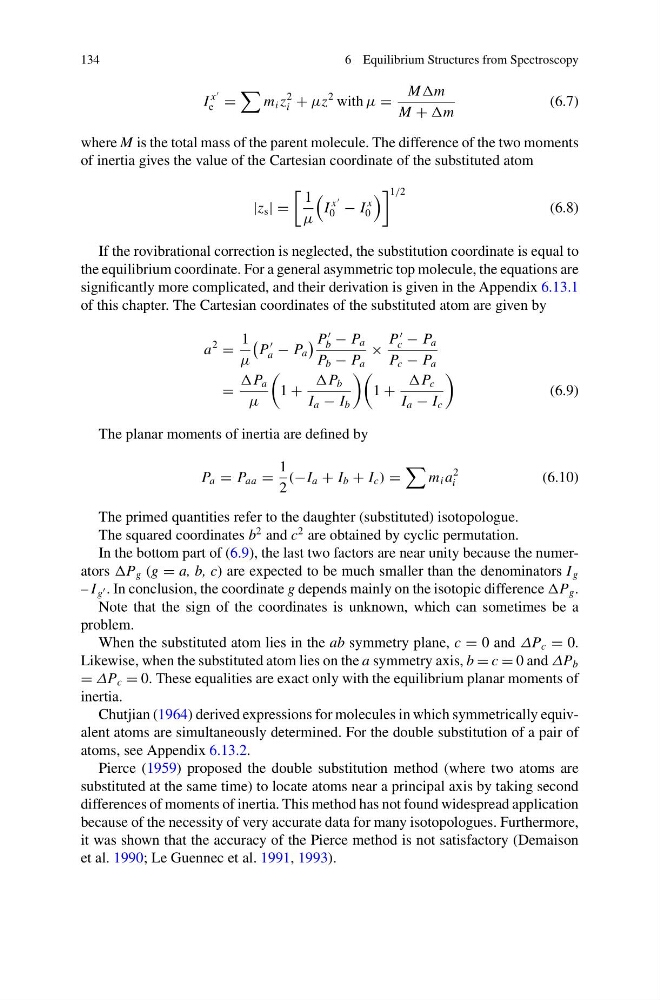
where M is the total mass of the parent molecule. The difference of the two moments
of inertia gives the value of the Cartesian coordinate of the substituted atom
|z s | =
1
μ
I
x
0 − I
x
0
1/2
(6.8)
If the rovibrational correction is neglected, the substitution coordinate is equal to
the equilibrium coordinate. For a general asymmetric top molecule, the equations are
significantly more complicated, and their derivation is given in the Appendix 6.13.1
of this chapter. The Cartesian coordinates of the substituted atom are given by
a
2
=
1
μ
P
a − P a
P
b − P a
P b − P a
×
P
c − P a
P c − P a
=
P a
μ
1 +
P b
I a − I b
1 +
P c
I a − I c
(6.9)
The planar moments of inertia are defined by
P a = P aa =
1
2
(−I a + I b + I c ) =
m i a
2
i
(6.10)
The primed quantities refer to the daughter (substituted) isotopologue.
The squared coordinates b
2 and c
2 are obtained by cyclic permutation.
In the bottom part of (6.9), the last two factors are near unity because the numerators P g (g = a, b, c) are expected to be much smaller than the denominators I g
– I g . In conclusion, the coordinate g depends mainly on the isotopic difference P g .
Note that the sign of the coordinates is unknown, which can sometimes be a
problem.
When the substituted atom lies in the ab symmetry plane, c = 0 and ΔP c = 0.
Likewise, when the substituted atom lies on the a symmetry axis, b = c = 0 and ΔP b
= ΔP c = 0. These equalities are exact only with the equilibrium planar moments of
inertia.
Chutjian (1964) derived expressions for molecules in which symmetrically equivalent atoms are simultaneously determined. For the double substitution of a pair of
atoms, see Appendix 6.13.2.
Pierce (1959) proposed the double substitution method (where two atoms are
substituted at the same time) to locate atoms near a principal axis by taking second
differences of moments of inertia. This method has not found widespread application
because of the necessity of very accurate data for many isotopologues. Furthermore,
it was shown that the accuracy of the Pierce method is not satisfactory (Demaison
et al. 1990; Le Guennec et al. 1991, 1993).
6 Equilibrium Structures from Spectroscopy
I
x
e =
m i z
2
i + μz
2 with μ =
Mm
M + m
(6.7)
where M is the total mass of the parent molecule. The difference of the two moments
of inertia gives the value of the Cartesian coordinate of the substituted atom
|z s | =
1
μ
I
x
0 − I
x
0
1/2
(6.8)
If the rovibrational correction is neglected, the substitution coordinate is equal to
the equilibrium coordinate. For a general asymmetric top molecule, the equations are
significantly more complicated, and their derivation is given in the Appendix 6.13.1
of this chapter. The Cartesian coordinates of the substituted atom are given by
a
2
=
1
μ
P
a − P a
P
b − P a
P b − P a
×
P
c − P a
P c − P a
=
P a
μ
1 +
P b
I a − I b
1 +
P c
I a − I c
(6.9)
The planar moments of inertia are defined by
P a = P aa =
1
2
(−I a + I b + I c ) =
m i a
2
i
(6.10)
The primed quantities refer to the daughter (substituted) isotopologue.
The squared coordinates b
2 and c
2 are obtained by cyclic permutation.
In the bottom part of (6.9), the last two factors are near unity because the numerators P g (g = a, b, c) are expected to be much smaller than the denominators I g
– I g . In conclusion, the coordinate g depends mainly on the isotopic difference P g .
Note that the sign of the coordinates is unknown, which can sometimes be a
problem.
When the substituted atom lies in the ab symmetry plane, c = 0 and ΔP c = 0.
Likewise, when the substituted atom lies on the a symmetry axis, b = c = 0 and ΔP b
= ΔP c = 0. These equalities are exact only with the equilibrium planar moments of
inertia.
Chutjian (1964) derived expressions for molecules in which symmetrically equivalent atoms are simultaneously determined. For the double substitution of a pair of
atoms, see Appendix 6.13.2.
Pierce (1959) proposed the double substitution method (where two atoms are
substituted at the same time) to locate atoms near a principal axis by taking second
differences of moments of inertia. This method has not found widespread application
because of the necessity of very accurate data for many isotopologues. Furthermore,
it was shown that the accuracy of the Pierce method is not satisfactory (Demaison
et al. 1990; Le Guennec et al. 1991, 1993).