

6.2 Vibrational Dependence of the Rotational …
129
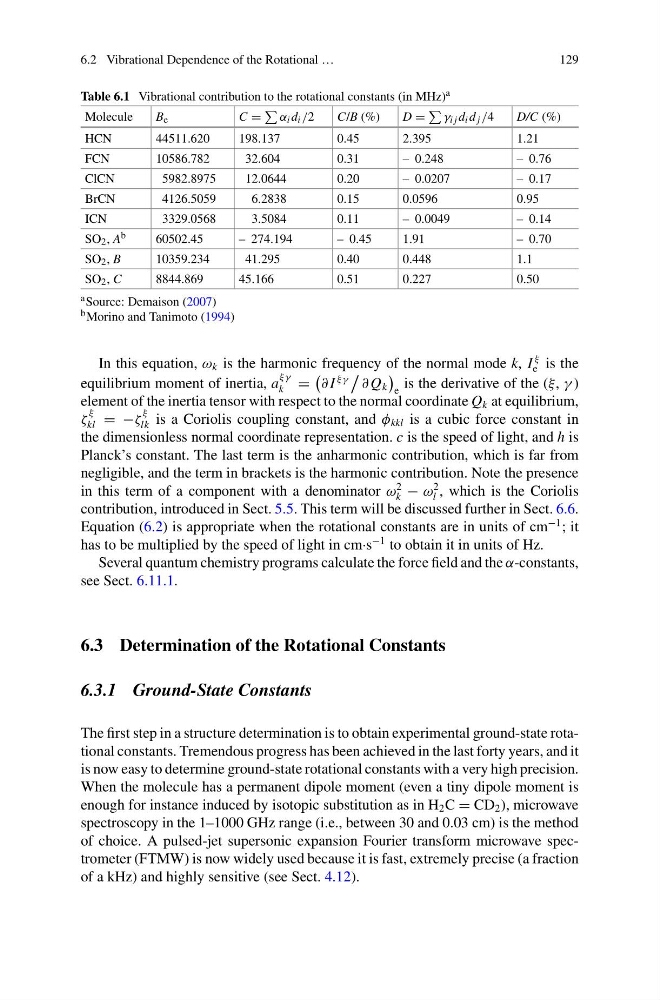
Table 6.1 Vibrational contribution to the rotational constants (in MHz) a
Molecule
B e
C =
α i d i /2
C/B (%)
D =
γ i j d i d j /4
D/C (%)
HCN
44511.620
198.137
0.45
2.395
1.21
FCN
10586.782
32.604
0.31
– 0.248
– 0.76
ClCN
5982.8975
12.0644
0.20
– 0.0207
– 0.17
BrCN
4126.5059
6.2838
0.15
0.0596
0.95
ICN
3329.0568
3.5084
0.11
– 0.0049
– 0.14
SO 2 , A b
60502.45
– 274.194
– 0.45
1.91
– 0.70
SO 2 , B
10359.234
41.295
0.40
0.448
1.1
SO 2 , C
8844.869
45.166
0.51
0.227
0.50
a Source: Demaison (2007)
b Morino and Tanimoto (1994)
In this equation, ω k is the harmonic frequency of the normal mode k, I
ξ
e is the
equilibrium moment of inertia, a
ξγ
k =
∂ I
ξγ
∂ Q k
e
is the derivative of the (ξ, γ )
element of the inertia tensor with respect to the normal coordinate Q k at equilibrium,
ζ
ξ
kl = −ζ
ξ
lk is a Coriolis coupling constant, and φ kkl is a cubic force constant in
the dimensionless normal coordinate representation. c is the speed of light, and h is
Planck’s constant. The last term is the anharmonic contribution, which is far from
negligible, and the term in brackets is the harmonic contribution. Note the presence
in this term of a component with a denominator ω
2
k − ω
2
l , which is the Coriolis
contribution, introduced in Sect. 5.5. This term will be discussed further in Sect. 6.6.
Equation (6.2) is appropriate when the rotational constants are in units of cm
−1 ; it
has to be multiplied by the speed of light in cm·s
−1 to obtain it in units of Hz.
Several quantum chemistry programs calculate the force field and the α-constants,
see Sect. 6.11.1.
6.3 Determination of the Rotational Constants
6.3.1 Ground-State Constants
The first step in a structure determination is to obtain experimental ground-state rotational constants. Tremendous progress has been achieved in the last forty years, and it
is now easy to determine ground-state rotational constants with a very high precision.
When the molecule has a permanent dipole moment (even a tiny dipole moment is
enough for instance induced by isotopic substitution as in H 2 C = CD 2 ), microwave
spectroscopy in the 1–1000 GHz range (i.e., between 30 and 0.03 cm) is the method
of choice. A pulsed-jet supersonic expansion Fourier transform microwave spectrometer (FTMW) is now widely used because it is fast, extremely precise (a fraction
of a kHz) and highly sensitive (see Sect. 4.12).
129
Table 6.1 Vibrational contribution to the rotational constants (in MHz) a
Molecule
B e
C =
α i d i /2
C/B (%)
D =
γ i j d i d j /4
D/C (%)
HCN
44511.620
198.137
0.45
2.395
1.21
FCN
10586.782
32.604
0.31
– 0.248
– 0.76
ClCN
5982.8975
12.0644
0.20
– 0.0207
– 0.17
BrCN
4126.5059
6.2838
0.15
0.0596
0.95
ICN
3329.0568
3.5084
0.11
– 0.0049
– 0.14
SO 2 , A b
60502.45
– 274.194
– 0.45
1.91
– 0.70
SO 2 , B
10359.234
41.295
0.40
0.448
1.1
SO 2 , C
8844.869
45.166
0.51
0.227
0.50
a Source: Demaison (2007)
b Morino and Tanimoto (1994)
In this equation, ω k is the harmonic frequency of the normal mode k, I
ξ
e is the
equilibrium moment of inertia, a
ξγ
k =
∂ I
ξγ
∂ Q k
e
is the derivative of the (ξ, γ )
element of the inertia tensor with respect to the normal coordinate Q k at equilibrium,
ζ
ξ
kl = −ζ
ξ
lk is a Coriolis coupling constant, and φ kkl is a cubic force constant in
the dimensionless normal coordinate representation. c is the speed of light, and h is
Planck’s constant. The last term is the anharmonic contribution, which is far from
negligible, and the term in brackets is the harmonic contribution. Note the presence
in this term of a component with a denominator ω
2
k − ω
2
l , which is the Coriolis
contribution, introduced in Sect. 5.5. This term will be discussed further in Sect. 6.6.
Equation (6.2) is appropriate when the rotational constants are in units of cm
−1 ; it
has to be multiplied by the speed of light in cm·s
−1 to obtain it in units of Hz.
Several quantum chemistry programs calculate the force field and the α-constants,
see Sect. 6.11.1.
6.3 Determination of the Rotational Constants
6.3.1 Ground-State Constants
The first step in a structure determination is to obtain experimental ground-state rotational constants. Tremendous progress has been achieved in the last forty years, and it
is now easy to determine ground-state rotational constants with a very high precision.
When the molecule has a permanent dipole moment (even a tiny dipole moment is
enough for instance induced by isotopic substitution as in H 2 C = CD 2 ), microwave
spectroscopy in the 1–1000 GHz range (i.e., between 30 and 0.03 cm) is the method
of choice. A pulsed-jet supersonic expansion Fourier transform microwave spectrometer (FTMW) is now widely used because it is fast, extremely precise (a fraction
of a kHz) and highly sensitive (see Sect. 4.12).