

128
6 Equilibrium Structures from Spectroscopy
an empirical structure using only the ground-state rotational constants. Section 6.6
is devoted to the experimental equilibrium structure. Sections 6.7 and 6.8 discuss
the combined use of experimental ground-state rotational constants and ab initio
calculations to derive an equilibrium structure (called semiexperimental). Finally,
the Sect. 6.9 is devoted to the particular case of weakly bound complexes.
Recent references on this subject are: Demaison (2007); Gordy and Cook (1984);
Groner (2000); Puzzarini et al. (2010); Rudolph and Demaison (2011); Vázquez and
Stanton (2011).
6.2 Vibrational Dependence of the Rotational Constants;
See also Sect. 4.9
The difference between the equilibrium rotational constants and the experimental
constants is called the rovibrational contribution and may be written as a series
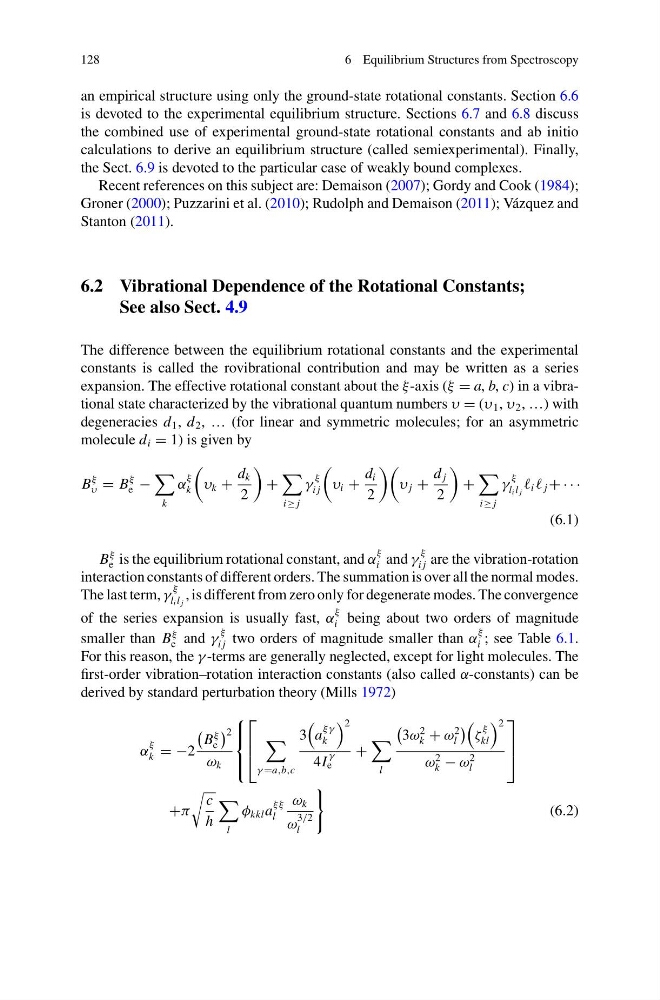
expansion. The effective rotational constant about the ξ-axis (ξ = a, b, c) in a vibrational state characterized by the vibrational quantum numbers υ = (υ 1 , υ 2 , …) with
degeneracies d 1 , d 2 , … (for linear and symmetric molecules; for an asymmetric
molecule d i = 1) is given by
B
ξ
υ = B
ξ
e −
k
α
ξ
k
υ k +
d k
2
+
i≥ j
γ
ξ
i j
υ i +
d i
2
υ j +
d j
2
+
i≥ j
γ
ξ
l i l j
i j + · · ·
(6.1)
B
ξ
e is the equilibrium rotational constant, and α
ξ
i and γ
ξ
i j are the vibration-rotation
interaction constants of different orders. The summation is over all the normal modes.
The last term, γ
ξ
l i l j
, is different from zero only for degenerate modes. The convergence
of the series expansion is usually fast, α
ξ
i being about two orders of magnitude
smaller than B
ξ
e and γ
ξ
i j two orders of magnitude smaller than α
ξ
i ; see Table 6.1.
For this reason, the γ -terms are generally neglected, except for light molecules. The
first-order vibration–rotation interaction constants (also called α-constants) can be
derived by standard perturbation theory (Mills 1972)
α
ξ
k = −2
B
ξ
e
2
ω k
⎧
⎪ ⎨
⎪ ⎩
⎡
⎢
⎣
γ =a,b,c
3
a
ξγ
k
2
4I
γ
e
+
l
3ω
2
k + ω
2
l
ζ
ξ
kl
2
ω
2
k − ω
2
l
⎤
⎥
⎦
+π
c
h
l
φ kkl a
ξξ
l
ω k
ω
3/2
l
(6.2)
6 Equilibrium Structures from Spectroscopy
an empirical structure using only the ground-state rotational constants. Section 6.6
is devoted to the experimental equilibrium structure. Sections 6.7 and 6.8 discuss
the combined use of experimental ground-state rotational constants and ab initio
calculations to derive an equilibrium structure (called semiexperimental). Finally,
the Sect. 6.9 is devoted to the particular case of weakly bound complexes.
Recent references on this subject are: Demaison (2007); Gordy and Cook (1984);
Groner (2000); Puzzarini et al. (2010); Rudolph and Demaison (2011); Vázquez and
Stanton (2011).
6.2 Vibrational Dependence of the Rotational Constants;
See also Sect. 4.9
The difference between the equilibrium rotational constants and the experimental
constants is called the rovibrational contribution and may be written as a series
expansion. The effective rotational constant about the ξ-axis (ξ = a, b, c) in a vibrational state characterized by the vibrational quantum numbers υ = (υ 1 , υ 2 , …) with
degeneracies d 1 , d 2 , … (for linear and symmetric molecules; for an asymmetric
molecule d i = 1) is given by
B
ξ
υ = B
ξ
e −
k
α
ξ
k
υ k +
d k
2
+
i≥ j
γ
ξ
i j
υ i +
d i
2
υ j +
d j
2
+
i≥ j
γ
ξ
l i l j
i j + · · ·
(6.1)
B
ξ
e is the equilibrium rotational constant, and α
ξ
i and γ
ξ
i j are the vibration-rotation
interaction constants of different orders. The summation is over all the normal modes.
The last term, γ
ξ
l i l j
, is different from zero only for degenerate modes. The convergence
of the series expansion is usually fast, α
ξ
i being about two orders of magnitude
smaller than B
ξ
e and γ
ξ
i j two orders of magnitude smaller than α
ξ
i ; see Table 6.1.
For this reason, the γ -terms are generally neglected, except for light molecules. The
first-order vibration–rotation interaction constants (also called α-constants) can be
derived by standard perturbation theory (Mills 1972)
α
ξ
k = −2
B
ξ
e
2
ω k
⎧
⎪ ⎨
⎪ ⎩
⎡
⎢
⎣
γ =a,b,c
3
a
ξγ
k
2
4I
γ
e
+
l
3ω
2
k + ω
2
l
ζ
ξ
kl
2
ω
2
k − ω
2
l
⎤
⎥
⎦
+π
c
h
l
φ kkl a
ξξ
l
ω k
ω
3/2
l
(6.2)