

5.7 Internal Coordinates
123
Furthermore, with well-chosen internal coordinates, the force constants matrix is
nearly diagonal.
Assuming that the displacements are infinitesimal, the relationship between
internal coordinates, R, and Cartesian ones, x, is linear
R = Bx
(5.60)
If n is the number of atoms, B is a 3n × (3n − 6) matrix, which is a function of
the structure of the molecule. The inverse relation is
x = AR
(5.61)
The relationship with normal coordinates is
R = LQ
(5.62)
Note that the matrix L in (5.62) is not identical to the matrix l of (5.13).
And the force field may be written
2V = x
T f
x x = R
T f
R R = Q
T
Q
(5.63)
With
f
R
= A
T f
x A and f
x
= B
T f
R B
(5.64)
and
L
T f
R L =
(5.65)
More relations are discussed in Winnewisser and Watson (2001).
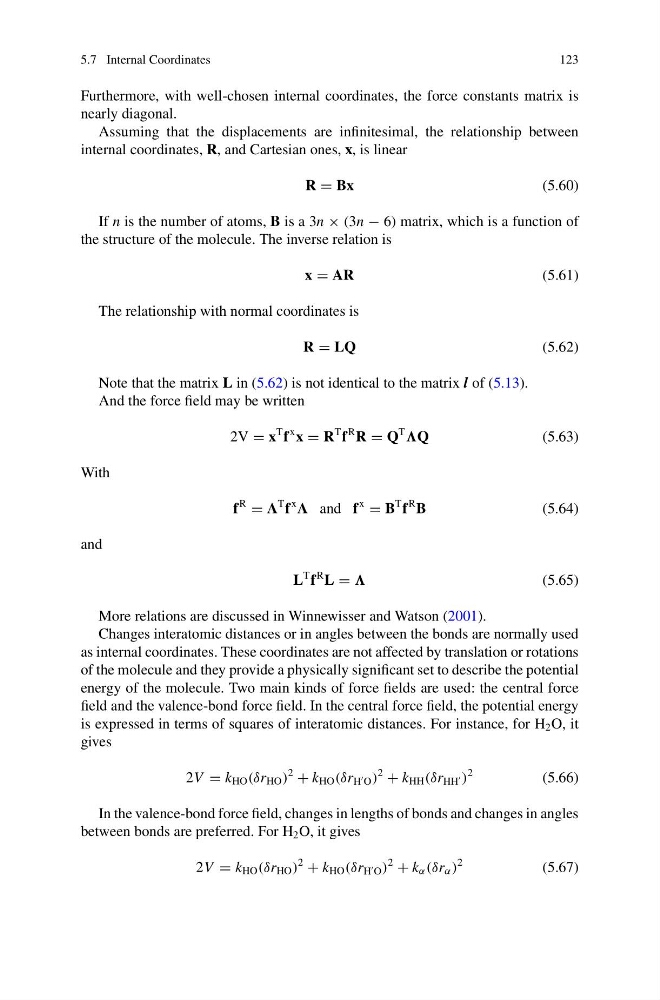
Changes interatomic distances or in angles between the bonds are normally used
as internal coordinates. These coordinates are not affected by translation or rotations
of the molecule and they provide a physically significant set to describe the potential
energy of the molecule. Two main kinds of force fields are used: the central force
field and the valence-bond force field. In the central force field, the potential energy
is expressed in terms of squares of interatomic distances. For instance, for H 2 O, it
gives
2V = k HO (δr HO )
2
+ k HO (δr H
O )
2
+ k HH (δr HH
)
2
(5.66)
In the valence-bond force field, changes in lengths of bonds and changes in angles
between bonds are preferred. For H 2 O, it gives
2V = k HO (δr HO )
2
+ k HO (δr H
O )
2
+ k α (δr α )
2
(5.67)
123
Furthermore, with well-chosen internal coordinates, the force constants matrix is
nearly diagonal.
Assuming that the displacements are infinitesimal, the relationship between
internal coordinates, R, and Cartesian ones, x, is linear
R = Bx
(5.60)
If n is the number of atoms, B is a 3n × (3n − 6) matrix, which is a function of
the structure of the molecule. The inverse relation is
x = AR
(5.61)
The relationship with normal coordinates is
R = LQ
(5.62)
Note that the matrix L in (5.62) is not identical to the matrix l of (5.13).
And the force field may be written
2V = x
T f
x x = R
T f
R R = Q
T
Q
(5.63)
With
f
R
= A
T f
x A and f
x
= B
T f
R B
(5.64)
and
L
T f
R L =
(5.65)
More relations are discussed in Winnewisser and Watson (2001).
Changes interatomic distances or in angles between the bonds are normally used
as internal coordinates. These coordinates are not affected by translation or rotations
of the molecule and they provide a physically significant set to describe the potential
energy of the molecule. Two main kinds of force fields are used: the central force
field and the valence-bond force field. In the central force field, the potential energy
is expressed in terms of squares of interatomic distances. For instance, for H 2 O, it
gives
2V = k HO (δr HO )
2
+ k HO (δr H
O )
2
+ k HH (δr HH
)
2
(5.66)
In the valence-bond force field, changes in lengths of bonds and changes in angles
between bonds are preferred. For H 2 O, it gives
2V = k HO (δr HO )
2
+ k HO (δr H
O )
2
+ k α (δr α )
2
(5.67)