

122
5 The Vibrations of Polyatomic Molecules
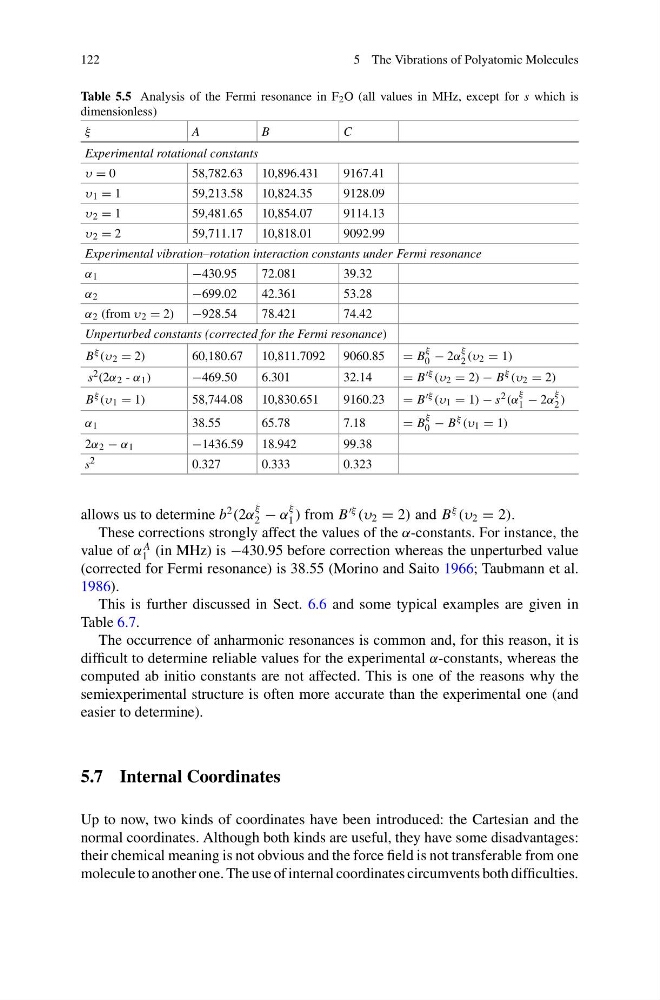
Table 5.5 Analysis of the Fermi resonance in F 2 O (all values in MHz, except for s which is
dimensionless)
ξ
A
B
C
Experimental rotational constants
υ = 0
58,782.63 10,896.431
9167.41
υ 1 = 1
59,213.58 10,824.35
9128.09
υ 2 = 1
59,481.65 10,854.07
9114.13
υ 2 = 2
59,711.17 10,818.01
9092.99
Experimental vibration–rotation interaction constants under Fermi resonance
α 1
−430.95
72.081
39.32
α 2
−699.02
42.361
53.28
α 2 (from υ 2 = 2) −928.54
78.421
74.42
Unperturbed constants (corrected for the Fermi resonance)
B ξ (υ 2 = 2)
60,180.67 10,811.7092 9060.85 = B
ξ
0 − 2α
ξ
2 (υ 2 = 1)
s 2 (2α 2 - α 1 )
−469.50
6.301
32.14
= B ξ (υ 2 = 2) − B ξ (υ 2 = 2)
B ξ (υ 1 = 1)
58,744.08 10,830.651
9160.23 = B ξ (υ 1 = 1) − s 2 (α
ξ
1 − 2α
ξ
2 )
α 1
38.55
65.78
7.18
= B
ξ
0 − B ξ (υ 1 = 1)
2α 2 − α 1
−1436.59 18.942
99.38
s 2
0.327
0.333
0.323
allows us to determine b
2
(2α
ξ
2 − α
ξ
1 ) from B
ξ
(υ 2 = 2) and B
ξ
(υ 2 = 2).
These corrections strongly affect the values of the α-constants. For instance, the
value of α
A
1 (in MHz) is −430.95 before correction whereas the unperturbed value
(corrected for Fermi resonance) is 38.55 (Morino and Saito 1966; Taubmann et al.
1986).
This is further discussed in Sect. 6.6 and some typical examples are given in
Table 6.7.
The occurrence of anharmonic resonances is common and, for this reason, it is
difficult to determine reliable values for the experimental α-constants, whereas the
computed ab initio constants are not affected. This is one of the reasons why the
semiexperimental structure is often more accurate than the experimental one (and
easier to determine).
5.7 Internal Coordinates
Up to now, two kinds of coordinates have been introduced: the Cartesian and the
normal coordinates. Although both kinds are useful, they have some disadvantages:
their chemical meaning is not obvious and the force field is not transferable from one
molecule to another one. The use of internal coordinates circumvents both difficulties.
5 The Vibrations of Polyatomic Molecules
Table 5.5 Analysis of the Fermi resonance in F 2 O (all values in MHz, except for s which is
dimensionless)
ξ
A
B
C
Experimental rotational constants
υ = 0
58,782.63 10,896.431
9167.41
υ 1 = 1
59,213.58 10,824.35
9128.09
υ 2 = 1
59,481.65 10,854.07
9114.13
υ 2 = 2
59,711.17 10,818.01
9092.99
Experimental vibration–rotation interaction constants under Fermi resonance
α 1
−430.95
72.081
39.32
α 2
−699.02
42.361
53.28
α 2 (from υ 2 = 2) −928.54
78.421
74.42
Unperturbed constants (corrected for the Fermi resonance)
B ξ (υ 2 = 2)
60,180.67 10,811.7092 9060.85 = B
ξ
0 − 2α
ξ
2 (υ 2 = 1)
s 2 (2α 2 - α 1 )
−469.50
6.301
32.14
= B ξ (υ 2 = 2) − B ξ (υ 2 = 2)
B ξ (υ 1 = 1)
58,744.08 10,830.651
9160.23 = B ξ (υ 1 = 1) − s 2 (α
ξ
1 − 2α
ξ
2 )
α 1
38.55
65.78
7.18
= B
ξ
0 − B ξ (υ 1 = 1)
2α 2 − α 1
−1436.59 18.942
99.38
s 2
0.327
0.333
0.323
allows us to determine b
2
(2α
ξ
2 − α
ξ
1 ) from B
ξ
(υ 2 = 2) and B
ξ
(υ 2 = 2).
These corrections strongly affect the values of the α-constants. For instance, the
value of α
A
1 (in MHz) is −430.95 before correction whereas the unperturbed value
(corrected for Fermi resonance) is 38.55 (Morino and Saito 1966; Taubmann et al.
1986).
This is further discussed in Sect. 6.6 and some typical examples are given in
Table 6.7.
The occurrence of anharmonic resonances is common and, for this reason, it is
difficult to determine reliable values for the experimental α-constants, whereas the
computed ab initio constants are not affected. This is one of the reasons why the
semiexperimental structure is often more accurate than the experimental one (and
easier to determine).
5.7 Internal Coordinates
Up to now, two kinds of coordinates have been introduced: the Cartesian and the
normal coordinates. Although both kinds are useful, they have some disadvantages:
their chemical meaning is not obvious and the force field is not transferable from one
molecule to another one. The use of internal coordinates circumvents both difficulties.