

88
4 Rotation of the Polyatomic Molecule
−2(A υ ζ )K should be added to (4.34) and for an oblate top A should be replaced
by C.
4.8 Asymmetric Molecule
4.8.1 Rigid Rotor
The matrix elements of the rigid rotor Hamiltonian may be easily found in the basis
of the symmetric top eigenfunctions |J K M, but the resulting matrix which is a (2J
+ 1)× (2J + 1) symmetric matrix will not be diagonal in K because of the presence
of terms J K M|H|J K ± 2M. The eigenvalues of this matrix are the rotational
energy. J remains a good quantum number but not K because of the presence of
non-diagonal elements in K. The energy levels of a slightly asymmetric rotor differ
from the limiting symmetric top one because the levels −K and +K are separated,
whereas they are degenerated in the symmetric rotor. By connecting the levels of
the limiting prolate top with those of the symmetric oblate top, it is possible to label
the levels: E(JK a K c ). The first subscript K a represents the K value of the limiting
prolate top, and K c represents the K value of the limiting oblate top. K a and K c are
called pseudo-quantum numbers.
The selection rule is unchanged for J, i.e., J = 0, ± 1, but there are also
restrictions for the pseudo-quantum numbers, which depend of the orientation of
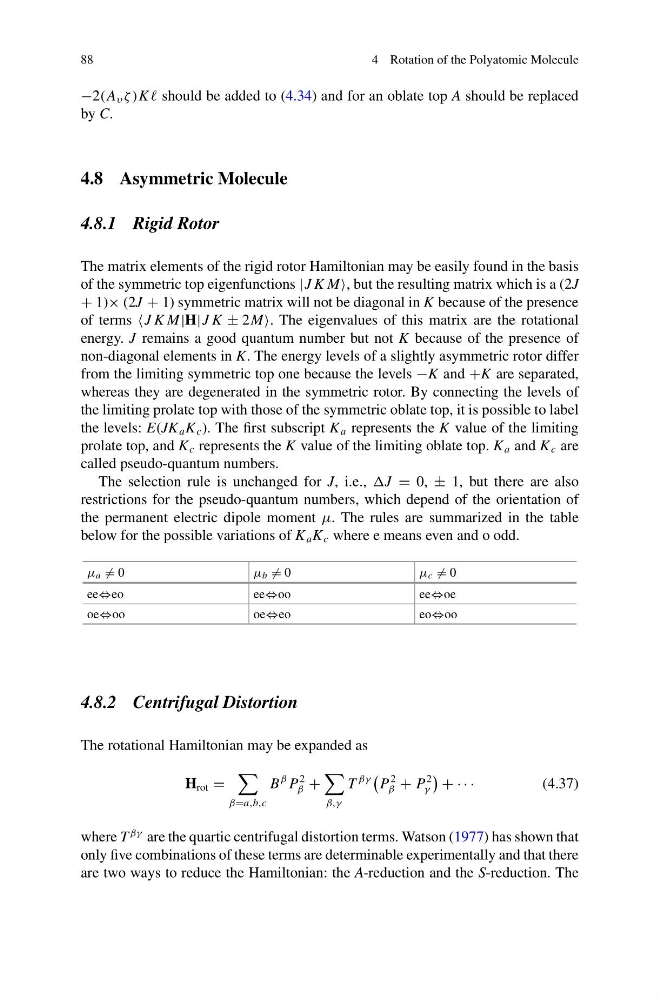
the permanent electric dipole moment μ. The rules are summarized in the table
below for the possible variations of K a K c where e means even and o odd.
μ a = 0
μ b = 0
μ c = 0
ee⇔eo
ee⇔oo
ee⇔oe
oe⇔oo
oe⇔eo
eo⇔oo
4.8.2 Centrifugal Distortion
The rotational Hamiltonian may be expanded as
H rot =
β=a,b,c
B
β P
2
β +
β,γ
T
βγ
P
2
β + P
2
γ
+ · · ·
(4.37)
where T
βγ are the quartic centrifugal distortion terms. Watson (1977) has shown that
only five combinations of these terms are determinable experimentally and that there
are two ways to reduce the Hamiltonian: the A-reduction and the S-reduction. The
4 Rotation of the Polyatomic Molecule
−2(A υ ζ )K should be added to (4.34) and for an oblate top A should be replaced
by C.
4.8 Asymmetric Molecule
4.8.1 Rigid Rotor
The matrix elements of the rigid rotor Hamiltonian may be easily found in the basis
of the symmetric top eigenfunctions |J K M, but the resulting matrix which is a (2J
+ 1)× (2J + 1) symmetric matrix will not be diagonal in K because of the presence
of terms J K M|H|J K ± 2M. The eigenvalues of this matrix are the rotational
energy. J remains a good quantum number but not K because of the presence of
non-diagonal elements in K. The energy levels of a slightly asymmetric rotor differ
from the limiting symmetric top one because the levels −K and +K are separated,
whereas they are degenerated in the symmetric rotor. By connecting the levels of
the limiting prolate top with those of the symmetric oblate top, it is possible to label
the levels: E(JK a K c ). The first subscript K a represents the K value of the limiting
prolate top, and K c represents the K value of the limiting oblate top. K a and K c are
called pseudo-quantum numbers.
The selection rule is unchanged for J, i.e., J = 0, ± 1, but there are also
restrictions for the pseudo-quantum numbers, which depend of the orientation of
the permanent electric dipole moment μ. The rules are summarized in the table
below for the possible variations of K a K c where e means even and o odd.
μ a = 0
μ b = 0
μ c = 0
ee⇔eo
ee⇔oo
ee⇔oe
oe⇔oo
oe⇔eo
eo⇔oo
4.8.2 Centrifugal Distortion
The rotational Hamiltonian may be expanded as
H rot =
β=a,b,c
B
β P
2
β +
β,γ
T
βγ
P
2
β + P
2
γ
+ · · ·
(4.37)
where T
βγ are the quartic centrifugal distortion terms. Watson (1977) has shown that
only five combinations of these terms are determinable experimentally and that there
are two ways to reduce the Hamiltonian: the A-reduction and the S-reduction. The