

10.12 Genes for the Biosynthesis of Known Sesterterpenoids
or Their Precursors
The genome-based approach has also identified the genes involved in the biosynthesis of known sesterterpenoids. Herein, such examples are introduced. Importantly, in many cases, the genome-based approach enables the isolation of the
biosynthetic precursors of the known sesterterpenoids, which have never been
isolated from Nature.
10.12.1 Stellatic Acid
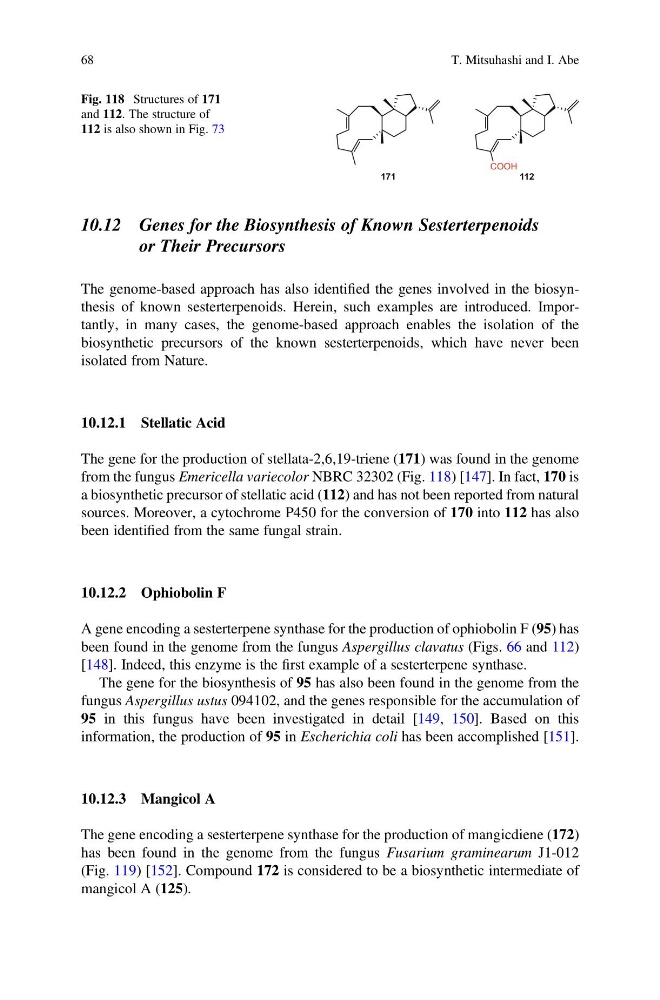
The gene for the production of stellata-2,6,19-triene (171) was found in the genome
from the fungus Emericella variecolor NBRC 32302 (Fig. 118) [147]. In fact, 170 is
a biosynthetic precursor of stellatic acid (112) and has not been reported from natural
sources. Moreover, a cytochrome P450 for the conversion of 170 into 112 has also
been identified from the same fungal strain.
10.12.2 Ophiobolin F
A gene encoding a sesterterpene synthase for the production of ophiobolin F (95) has
been found in the genome from the fungus Aspergillus clavatus (Figs. 66 and 112)
[148]. Indeed, this enzyme is the first example of a sesterterpene synthase.
The gene for the biosynthesis of 95 has also been found in the genome from the
fungus Aspergillus ustus 094102, and the genes responsible for the accumulation of
95 in this fungus have been investigated in detail [149, 150]. Based on this
information, the production of 95 in Escherichia coli has been accomplished [151].
10.12.3 Mangicol A
The gene encoding a sesterterpene synthase for the production of mangicdiene (172)
has been found in the genome from the fungus Fusarium graminearum J1-012
(Fig. 119) [152]. Compound 172 is considered to be a biosynthetic intermediate of
mangicol A (125).
COOH
112
171
Fig. 118 Structures of 171
and 112. The structure of
112 is also shown in Fig. 73
68
T. Mitsuhashi and I. Abe
or Their Precursors
The genome-based approach has also identified the genes involved in the biosynthesis of known sesterterpenoids. Herein, such examples are introduced. Importantly, in many cases, the genome-based approach enables the isolation of the
biosynthetic precursors of the known sesterterpenoids, which have never been
isolated from Nature.
10.12.1 Stellatic Acid
The gene for the production of stellata-2,6,19-triene (171) was found in the genome
from the fungus Emericella variecolor NBRC 32302 (Fig. 118) [147]. In fact, 170 is
a biosynthetic precursor of stellatic acid (112) and has not been reported from natural
sources. Moreover, a cytochrome P450 for the conversion of 170 into 112 has also
been identified from the same fungal strain.
10.12.2 Ophiobolin F
A gene encoding a sesterterpene synthase for the production of ophiobolin F (95) has
been found in the genome from the fungus Aspergillus clavatus (Figs. 66 and 112)
[148]. Indeed, this enzyme is the first example of a sesterterpene synthase.
The gene for the biosynthesis of 95 has also been found in the genome from the
fungus Aspergillus ustus 094102, and the genes responsible for the accumulation of
95 in this fungus have been investigated in detail [149, 150]. Based on this
information, the production of 95 in Escherichia coli has been accomplished [151].
10.12.3 Mangicol A
The gene encoding a sesterterpene synthase for the production of mangicdiene (172)
has been found in the genome from the fungus Fusarium graminearum J1-012
(Fig. 119) [152]. Compound 172 is considered to be a biosynthetic intermediate of
mangicol A (125).
COOH
112
171
Fig. 118 Structures of 171
and 112. The structure of
112 is also shown in Fig. 73
68
T. Mitsuhashi and I. Abe