

10.11 Tailoring Enzymes for the Derivatization
of Sesterterpenoids
In addition to the enzymes responsible for the formation of the basic carbon
skeletons of the sesterterpenoids, modification enzymes, which can attach a functional group to these compounds, have been found by the genome-based approach.
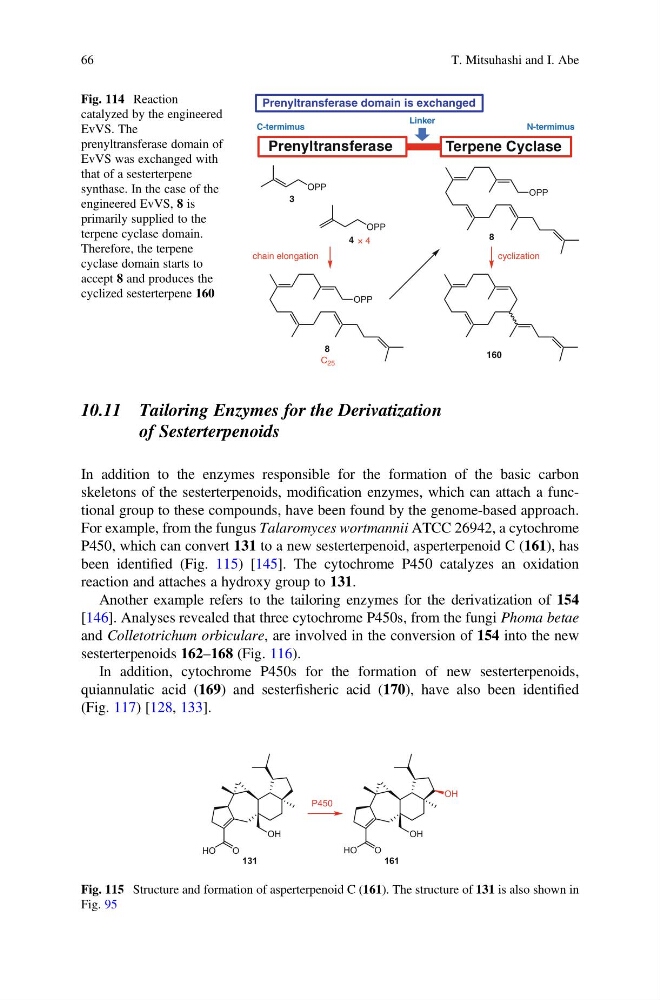
For example, from the fungus Talaromyces wortmannii ATCC 26942, a cytochrome
P450, which can convert 131 to a new sesterterpenoid, asperterpenoid C (161), has
been identified (Fig. 115) [145]. The cytochrome P450 catalyzes an oxidation
reaction and attaches a hydroxy group to 131.
Another example refers to the tailoring enzymes for the derivatization of 154
[146]. Analyses revealed that three cytochrome P450s, from the fungi Phoma betae
and Colletotrichum orbiculare, are involved in the conversion of 154 into the new
sesterterpenoids 162–168 (Fig. 116).
In addition, cytochrome P450s for the formation of new sesterterpenoids,
quiannulatic acid (169) and sesterfisheric acid (170), have also been identified
(Fig. 117) [128, 133].
Prenyltransferase
Terpene Cyclase
N-termimus
C-termimus
Linker
3
4 4
OPP
OPP
cyclization
chain elongation
8
160
8
C 25
Prenyltransferase domain is exchanged
OPP
OPP
Fig. 114 Reaction
catalyzed by the engineered
EvVS. The
prenyltransferase domain of
EvVS was exchanged with
that of a sesterterpene
synthase. In the case of the
engineered EvVS, 8 is
primarily supplied to the
terpene cyclase domain.
Therefore, the terpene
cyclase domain starts to
accept 8 and produces the
cyclized sesterterpene 160
O
HO
OH
131
O
HO
OH
161
OH
P450
Fig. 115 Structure and formation of asperterpenoid C (161). The structure of 131 is also shown in
Fig. 95
66
T. Mitsuhashi and I. Abe
of Sesterterpenoids
In addition to the enzymes responsible for the formation of the basic carbon
skeletons of the sesterterpenoids, modification enzymes, which can attach a functional group to these compounds, have been found by the genome-based approach.
For example, from the fungus Talaromyces wortmannii ATCC 26942, a cytochrome
P450, which can convert 131 to a new sesterterpenoid, asperterpenoid C (161), has
been identified (Fig. 115) [145]. The cytochrome P450 catalyzes an oxidation
reaction and attaches a hydroxy group to 131.
Another example refers to the tailoring enzymes for the derivatization of 154
[146]. Analyses revealed that three cytochrome P450s, from the fungi Phoma betae
and Colletotrichum orbiculare, are involved in the conversion of 154 into the new
sesterterpenoids 162–168 (Fig. 116).
In addition, cytochrome P450s for the formation of new sesterterpenoids,
quiannulatic acid (169) and sesterfisheric acid (170), have also been identified
(Fig. 117) [128, 133].
Prenyltransferase
Terpene Cyclase
N-termimus
C-termimus
Linker
3
4 4
OPP
OPP
cyclization
chain elongation
8
160
8
C 25
Prenyltransferase domain is exchanged
OPP
OPP
Fig. 114 Reaction
catalyzed by the engineered
EvVS. The
prenyltransferase domain of
EvVS was exchanged with
that of a sesterterpene
synthase. In the case of the
engineered EvVS, 8 is
primarily supplied to the
terpene cyclase domain.
Therefore, the terpene
cyclase domain starts to
accept 8 and produces the
cyclized sesterterpene 160
O
HO
OH
131
O
HO
OH
161
OH
P450
Fig. 115 Structure and formation of asperterpenoid C (161). The structure of 131 is also shown in
Fig. 95
66
T. Mitsuhashi and I. Abe